
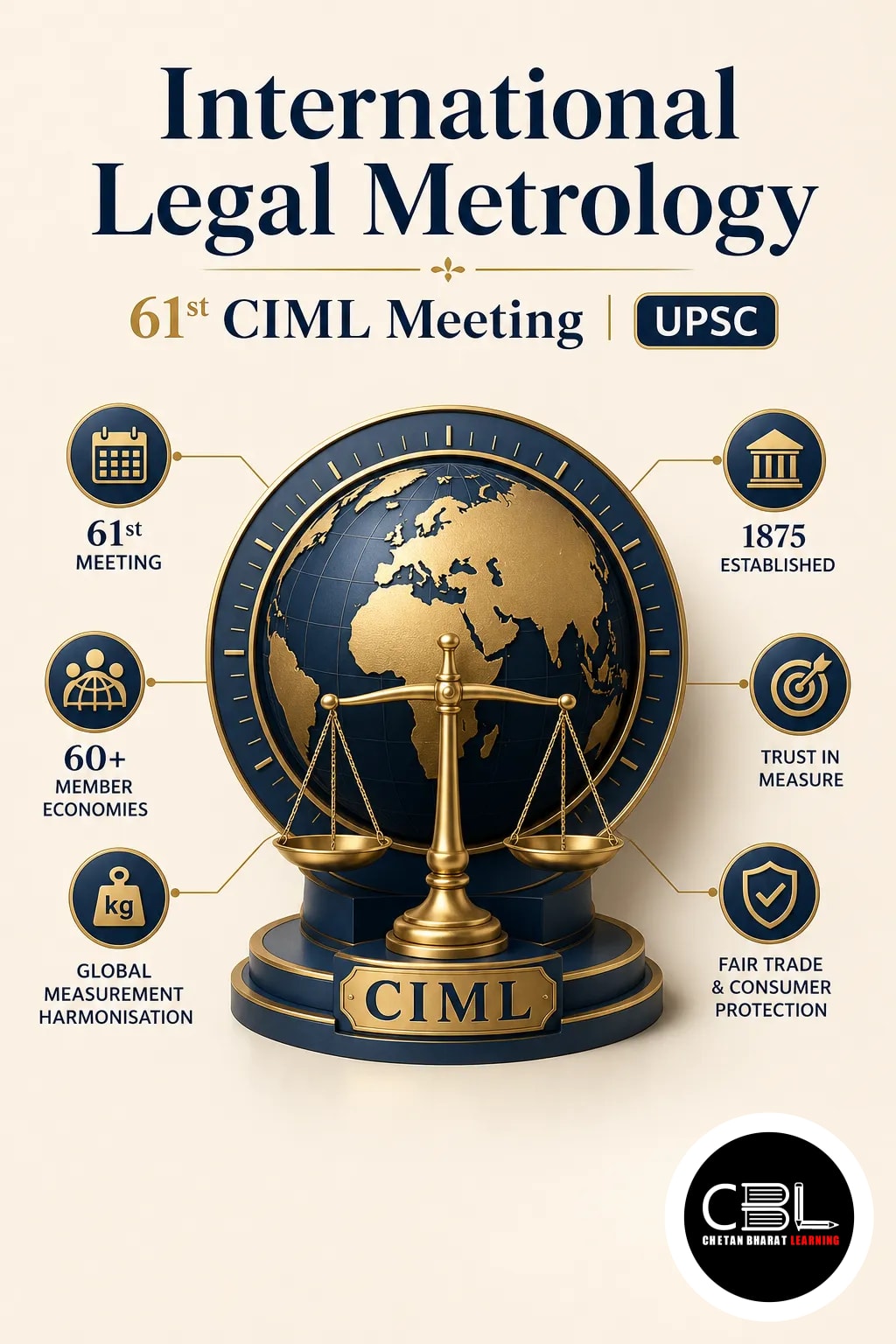

International Legal Metrology has gained prominence as India hosts the 61st Meeting of the International Committee of Legal Metrology (CIML) in New Delhi from 26 to 28 October 2026. This marks the first time India has hosted the meeting of the International Organization of Legal Metrology (OIML). Organised by the Department of Consumer Affairs in association with OIML, the three-day event focuses on global measurement standards, consumer protection, fair trade and technological innovation. The development is relevant to UPSC Economy, Science and Technology, and international organisations. Explore related developments through the daily current affairs archive.
The meeting brings together international delegates, government officials and technical experts to strengthen cooperation in measurement regulation. Discussions also address artificial intelligence, digital measurement systems and mutual recognition of measuring instruments.
What Is International Legal Metrology?
Legal metrology refers to the application of legal requirements to measurements and measuring instruments. It ensures that commercial transactions, public services and regulatory decisions rely on accurate and verifiable measurements.
The International Organization of Legal Metrology (OIML) is an intergovernmental organisation established under the International Convention of Legal Metrology, signed in Paris on 12 October 1955. It promotes harmonisation of measurement requirements across countries.
OIML develops international recommendations and certification arrangements covering instruments such as weighing scales, fuel dispensers, water meters and electricity meters. Its permanent secretariat is the International Bureau of Legal Metrology (BIML), located in Paris, France.
International Legal Metrology supports consumer confidence by helping ensure that measurements remain accurate, transparent and comparable across jurisdictions. For example, a verified fuel dispenser helps customers receive the quantity of petrol for which they pay.
Key Outcomes and Highlights of the 61st CIML Meeting
The meeting began on 26 October 2026 with an international seminar titled Evolutions in Legal Metrology, followed by the first CIML session. Participants discussed emerging technologies, regulatory modernisation and international recognition of measurement systems.
- International standardisation: Delegates examined greater harmonisation of technical requirements and international acceptance of measurement results.
- Digital transformation: Discussions covered digital regulatory services, electronic certification and improved compliance systems.
- Smart Recommendations: Experts considered OIML’s initiative to develop machine-readable technical standards suitable for emerging digital applications.
- Artificial intelligence: Participants explored the potential use of AI in measuring instruments, testing, verification and regulatory administration.
- OIML Strategy Workshop: The 27 October workshop examined future priorities, emerging challenges and international institutional cooperation.
- Scientific collaboration: The programme included a visit to CSIR–National Physical Laboratory on 28 October to highlight India’s measurement infrastructure.
The Department of Consumer Affairs showcased India’s initiatives in measurement regulation, including the e-Maap National Portal, Government Approved Test Centres and the One Nation, One Time initiative.
As of 28 October 2026, the meeting’s complete final resolutions should be distinguished from the programme discussions and announcements already reported.
Sources: PIB report on the 61st CIML Meeting and official OIML meeting information.
About the International Committee of Legal Metrology
The International Committee of Legal Metrology (CIML) is the principal functional decision-making body of OIML. Each OIML Member State designates one representative, generally a senior official with responsibility for measuring instruments or legal metrology.
CIML meets annually to guide the organisation’s administrative, financial, technical and strategic activities. Its responsibilities include approving technical recommendations, policy directions and aspects of the organisation’s work programme.
The Committee also supervises the activities of BIML and contributes to international cooperation among national legal metrology authorities.
Difference Between OIML, CIML and BIML
| Institution | Role |
|---|---|
| OIML | Intergovernmental organisation promoting harmonised legal metrology requirements. |
| CIML | Principal functional decision-making committee of OIML. |
| BIML | Permanent secretariat responsible for administrative and technical support. |
Prelims fact: OIML is the international organisation, CIML is its decision-making committee, and BIML serves as its permanent secretariat in Paris.
Significance for India
India joined OIML in 1956 and has participated in international efforts to improve legal measurement standards. In 2023, India gained recognition as an OIML Certification System (OIML-CS) Issuing Authority.
The certification framework helps manufacturers demonstrate that measuring instruments satisfy internationally recognised technical requirements. Acceptance of OIML certificates and test reports can reduce repetitive testing and facilitate market access.
Hosting the 61st CIML Meeting gives India an opportunity to present its regulatory reforms and contribute to global discussions on standards. It also supports cooperation on measurement technologies relevant to manufacturing, commerce and public services.
The Department of Consumer Affairs highlighted initiatives such as e-Maap, Government Approved Test Centres and the National Time Dissemination Project. The latter seeks to improve access to accurate and traceable Indian Standard Time for sectors including banking, telecommunications and power systems.
These initiatives complement India’s broader objectives of consumer protection, ease of doing business and international competitiveness.
Importance of Legal Metrology in International Trade
- Consumer protection: Accurate weighing and measuring instruments reduce the risk of unfair commercial practices.
- Trade facilitation: Harmonised requirements help reduce technical barriers and unnecessary duplicate testing.
- Industrial competitiveness: Internationally accepted certificates can support manufacturers entering overseas markets.
- Regulatory confidence: Standardised verification procedures strengthen trust between businesses, consumers and regulators.
- Public safety: Reliable measurement supports healthcare equipment, environmental monitoring and essential infrastructure.
OIML’s work is relevant to the World Trade Organization’s Agreement on Technical Barriers to Trade (WTO-TBT). International standards and conformity-assessment cooperation can help prevent avoidable obstacles to legitimate trade.
India’s Legal Metrology Framework
India’s principal legislation is the Legal Metrology Act, 2009, which regulates weights, measures and associated legal requirements. The law operates alongside rules covering measuring instruments, packaged commodities and verification procedures.
The Department of Consumer Affairs administers the central legal metrology framework, while state governments perform important enforcement functions. The Indian Institute of Legal Metrology, Ranchi provides specialised training.
CSIR–National Physical Laboratory, New Delhi maintains India’s national measurement standards and plays a central role in scientific metrology. Its work provides the measurement traceability needed for accurate calibration and verification.
Legal metrology, scientific metrology and industrial metrology are related but distinct. Legal metrology emphasises regulatory requirements, scientific metrology establishes measurement standards, and industrial metrology applies measurements to production and quality assurance.
Concerns and Challenges
- Different national regulations: Varying technical requirements can increase compliance costs for manufacturers operating internationally.
- Digitalisation gaps: Countries differ in their capacity to introduce electronic verification and certification systems.
- Emerging technologies: Smart meters, AI-enabled devices and software-controlled instruments require updated regulatory approaches.
- Testing infrastructure: Developing economies may face shortages of accredited laboratories and trained technical personnel.
- Mutual recognition limitations: Acceptance of international test results depends on applicable certification rules and regulatory arrangements.
Way Forward
Countries should strengthen cooperation on technical recommendations, conformity assessment and measurement traceability. Investment in modern testing laboratories and professional training can improve national regulatory capabilities.
India should continue digitalising verification services, expanding testing infrastructure and supporting international acceptance of certificates. The responsible integration of AI and machine-readable standards can improve administrative efficiency while preserving accuracy.
International cooperation must balance innovation with consumer protection and transparent regulation. Stronger measurement systems can support fair markets, reliable public services and competitive industrial development.
The 61st CIML Meeting represents an opportunity to deepen global cooperation in measurement governance. For more economy and science-related developments, visit the CBL current affairs platform.
Punjab PCS and Haryana HCS aspirants should connect legal metrology with consumer protection, fair trade, market inspection and state administrative responsibilities. Verification of weighing scales in agricultural mandis, fuel dispensers and packaged commodities provides practical governance examples. Prelims questions may focus on the Legal Metrology Act, 2009, OIML, CIML, BIML and India’s participation in international standards development.
Frequently Asked Questions
What is the International Committee of Legal Metrology?
The International Committee of Legal Metrology is the principal functional decision-making body of OIML. It supervises important technical, administrative and strategic activities relating to the international harmonisation of measurement regulation.
Why is the 61st CIML Meeting important for India?
India hosted the CIML Meeting for the first time from 26 to 28 October 2026 in New Delhi. The event highlighted India’s measurement reforms, international certification role and efforts to promote consumer protection and fair trade.
What is the difference between metrology and legal metrology?
Metrology is the science of measurement and its applications. Legal metrology deals specifically with measurement requirements established or enforced through laws and regulations, especially those affecting trade, safety and consumer protection.
Related Current Affairs
Preparing for UPSC, PCS or HCS?
Talk to a mentor at Chetan Bharat Learning, Chandigarh. Free guidance on choosing the right exam and building a study plan.
Chat on WhatsAppCall 97793 53345UPSC / IAS / PCS coaching in Chandigarh · Trusted by aspirants across Punjab & Haryana
Leave a Reply
You must be logged in to post a comment.