

UPSC Mapping
| Prelims | International Relations |
|---|---|
| Mains | GS Paper 2 (IR) |
Quick Facts
| Capital | Brussels |
|---|---|
| Strategic Asset | Antwerp-Bruges Port |
| Core Focus | Critical Minerals & Trade |
What Defines India Belgium Relations?
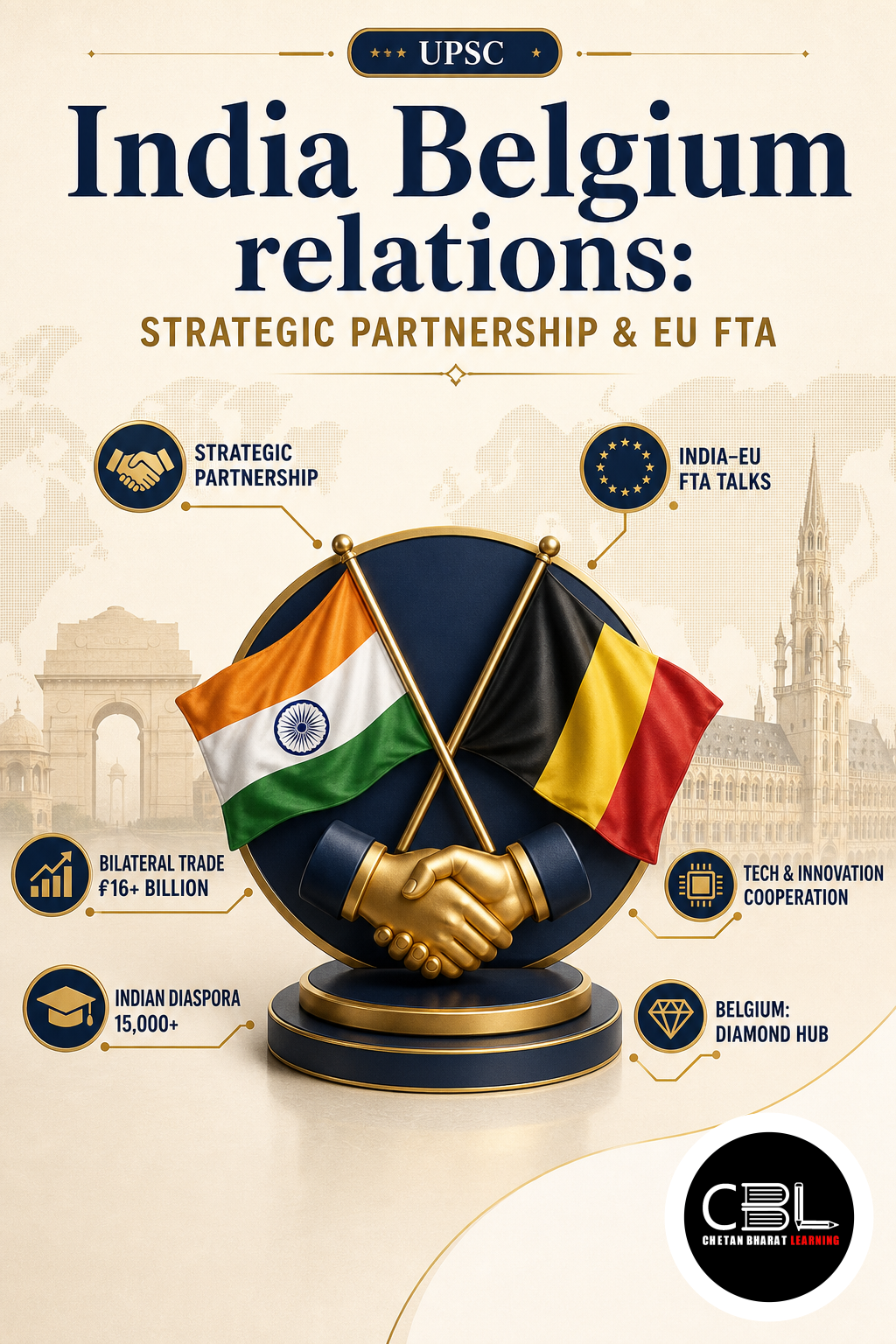
The framework of India Belgium relations operates as a vital gateway for New Delhi into the broader European Union market. Belgium hosts the headquarters of both the European Union and NATO, granting it outsized diplomatic influence globally. Historically, bilateral ties focused primarily on traditional commerce and cultural exchanges. Today, the partnership encompasses advanced sectors like semiconductors, clean energy, pharmaceuticals, and defence cooperation. The Antwerp-Bruges port serves as a critical logistical node for Indian exports entering the European continent.
Furthermore, Belgium holds a dominant position in the global diamond-processing and trading ecosystem. This specific industry creates deep economic interdependence between the two nations. Indian diamond cutters and polishers rely heavily on Belgian markets for rough diamond sourcing and finished goods export. The relationship has matured from mere transactional trade into a strategic economic alliance. Both governments actively encourage joint ventures in high-tech manufacturing and research. This institutional backing ensures sustained momentum in bilateral engagements.
Why are India Belgium Relations in News?
The trajectory of India Belgium relations recently gained prominence following the Belgian Prime Minister’s official visit to New Delhi. The visiting leader explicitly praised the ongoing India-EU Free Trade Agreement negotiations while cautioning against arbitrary global tariffs. This high-level engagement underscores the mutual desire to build resilient supply chains amid global geopolitical uncertainties. The discussions specifically highlighted cooperation in critical minerals processing and component manufacturing.
Additionally, the visit addressed the complexities of the Carbon Border Adjustment Mechanism. Belgian officials acknowledged the need for balanced environmental standards that do not disproportionately penalize developing economies. The dialogue emphasized that the larger objective extends beyond mere trade volume expansion. Both nations aim to achieve greater economic security, technological resilience, and strategic autonomy. This alignment of interests positions Belgium as a key advocate for India within broader EU policy discussions.
Key Features
The architecture of India Belgium relations incorporates several innovative design elements to ensure mutual economic benefit.
- Strategic Geographic Location: Belgium serves as the primary logistical and diplomatic gateway to the entire European Union market.
- Diamond Ecosystem Integration: Deep interdependence exists in the global diamond-processing and trading sectors, linking Indian polishers with Belgian traders.
- Critical Minerals Cooperation: Both nations actively collaborate across mineral processing, refining, recycling, and advanced component manufacturing.
- FTA Catalyst Role: Belgium actively supports the conclusion of the India-EU Free Trade Agreement to unlock diversified supply-chain opportunities.
- Technology and Research: Bilateral agreements increasingly focus on semiconductors, clean energy transitions, and advanced pharmaceutical research.
Challenges in India Belgium Relations
Despite strong foundations, India Belgium relations face several structural and operational hurdles requiring immediate diplomatic attention.
- EU Environmental Standards: Stringent regulatory frameworks often create compliance burdens for Indian exporters entering the European market.
- CBAM Requirements: The Carbon Border Adjustment Mechanism risks imposing hidden tariffs on Indian manufacturing sectors, affecting export competitiveness.
- Rules of Origin: Complex certification processes for determining the national source of goods frequently delay customs clearances and increase costs.
- Agricultural Sensitivities: European protectionist policies in the agricultural sector remain a major sticking point in broader trade negotiations.
- Geopolitical Friction: Divergent views on certain global conflicts occasionally strain the broader strategic partnership dynamics.
Way Forward
To maximize the strategic utility of India Belgium relations, the government must prioritize comprehensive economic security frameworks. Completing the India-EU Free Trade Agreement is vital for unlocking new markets and technologies. Strengthening the technical capabilities of joint research initiatives will ensure India remains competitive in the global semiconductor and clean energy sectors. The Ministry of Commerce must actively promote Indian startups within the Belgian innovation ecosystem.
Additionally, diplomatic channels should focus on harmonizing environmental standards to prevent trade disruptions. Policymakers must establish clear guidelines to mandate transparent reporting of supply chain sustainability. A robust, transparent, and inclusive system will ultimately drive India’s strategic autonomy forward. Continuous academic research will further refine the operational guidelines for bilateral cooperation. Future iterations of the policy must remain adaptable to emerging geopolitical realities.
Prelims Practice Corner
Q1. With reference to India Belgium relations, consider the following statements:
- Belgium hosts the headquarters of both the European Union and NATO.
- The Antwerp-Bruges port is a critical logistical node for Indian exports.
- Bilateral ties are now limited strictly to traditional diamond trading.
Which of the statements given above is/are correct?
- (a) 1 only
- (b) 1 and 2 only
- (c) 2 and 3 only
- (d) 1, 2 and 3
Answer: (b) Statement 3 is incorrect because the partnership now encompasses advanced sectors like semiconductors and clean energy.
Q2. Which mechanism was recently discussed as a potential challenge for Indian exporters in the EU market?
- (a) Generalized System of Preferences
- (b) Carbon Border Adjustment Mechanism (CBAM)
- (c) Most Favoured Nation clause
- (d) Regional Comprehensive Economic Partnership
Answer: (b) The CBAM risks imposing hidden tariffs on Indian manufacturing sectors, affecting export competitiveness.
Q3. The larger objective of India Belgium relations extends beyond trade volume to include:
- (a) Military alliance formation
- (b) Economic security and technological resilience
- (c) Shared currency adoption
- (d) Complete border demarcation
Answer: (b) Both nations aim to achieve greater economic security, technological resilience, and strategic autonomy.
Q4. Consider the following sectors of cooperation in India Belgium relations: 1. Semiconductors 2. Clean energy 3. Pharmaceuticals. Which of the above are included?
- (a) 1 and 2 only
- (b) 2 and 3 only
- (c) 1 and 3 only
- (d) 1, 2 and 3
Answer: (d) All three sectors are explicitly included in the modern strategic economic partnership.
Q5. Belgium’s significance in the global diamond industry primarily benefits India through:
- (a) Mining rough diamonds domestically
- (b) Sourcing rough diamonds and exporting finished goods
- (c) Banning all synthetic diamond production
- (d) Providing free mining equipment
Answer: (b) Indian diamond cutters and polishers rely heavily on Belgian markets for rough diamond sourcing and finished goods export.
Mains Practice Questions
Q1. Discuss the significance of India Belgium relations in the context of the broader India-EU strategic partnership. (150 words, 10 marks)
- Intro: Define the relationship as a vital gateway for New Delhi into the broader European Union market.
- Body: Discuss significance (strategic location, diamond ecosystem, critical minerals cooperation, FTA catalyst role) and its contribution to India’s strategic autonomy.
- Conclusion: Suggest a way forward focusing on harmonizing environmental standards and completing the FTA.
Q2. The larger objective of this bilateral partnership is not merely higher trade but greater economic security and technological resilience. Critically analyze. (250 words, 15 marks)
- Intro: Contextualize the shift from traditional transactional trade to a comprehensive strategic economic alliance.
- Body: Analyze the dimensions of economic security (diversified supply chains, critical minerals) and technological resilience (semiconductors, clean energy, pharmaceuticals). Discuss challenges like CBAM, rules of origin, and agricultural sensitivities.
- Conclusion: Conclude that overcoming non-tariff barriers through mutual recognition and sustained dialogue is essential for achieving true strategic autonomy.
FAQs on India Belgium Relations
Why is Belgium strategically important to India?
Belgium hosts the headquarters of the EU and NATO, granting it outsized diplomatic influence. Additionally, the Antwerp-Bruges port serves as a critical logistical gateway for Indian exports entering the European market.
How does the diamond industry connect India and Belgium?
Belgium holds a dominant position in the global diamond-processing ecosystem. Indian diamond cutters and polishers rely heavily on Belgian markets for rough diamond sourcing and the export of finished goods.
What are the main challenges in the India-EU FTA negotiations involving Belgium?
Key challenges include stringent EU environmental standards, the Carbon Border Adjustment Mechanism (CBAM), complex rules of origin, and European protectionist policies in the agricultural sector.
Related Current Affairs
Preparing for UPSC, PCS or HCS?
Talk to a mentor at Chetan Bharat Learning, Chandigarh. Free guidance on choosing the right exam and building a study plan.
Chat on WhatsAppCall 97793 53345UPSC / IAS / PCS coaching in Chandigarh · Trusted by aspirants across Punjab & Haryana
Leave a Reply
You must be logged in to post a comment.