
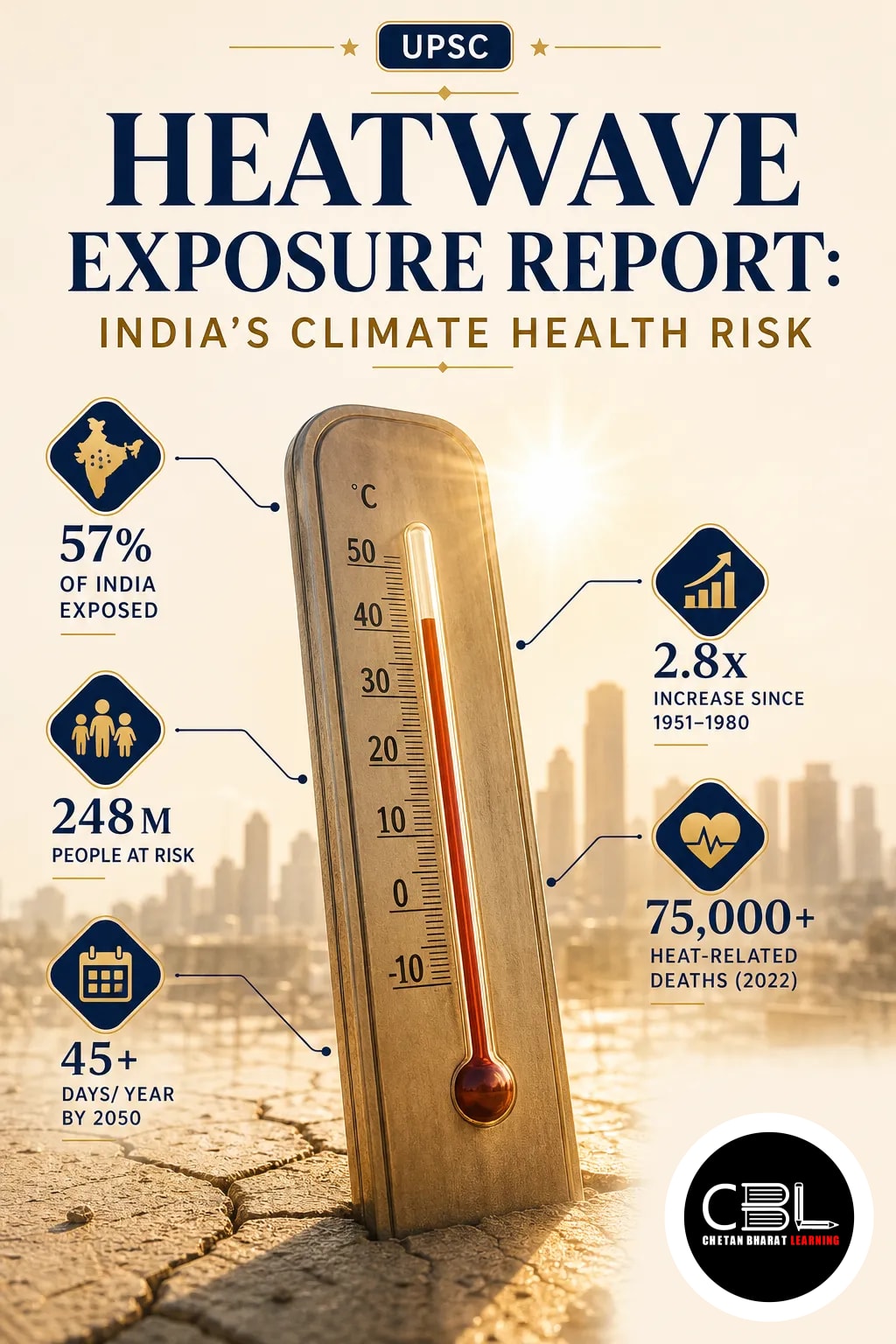

Heatwave exposure is emerging as a major climate-health concern for India, with climate equity becoming more relevant for vulnerable groups. A new report places India among the countries with the highest exposure for infants and older adults.
What is Heatwave Exposure?
Heatwave exposure refers to the number of heatwave days experienced by a population group. In this report, the measure is expressed in person-days, which captures both the duration of heatwaves and the number of people affected.
The focus is on infants and older adults, because both groups face higher physiological stress during extreme heat. Their vulnerability makes heat exposure a public health issue, not only a weather event.
Why in News?
The tenth indicator report of the Lancet Countdown says India is among the countries with the highest heatwave exposure for the two vulnerable age groups. The report also notes that global total heatwave days fell from the 2024 historical high, though 2025 still remained the second highest on record.
The authors argue that climate action is moving forward, but not fast enough to match the pace of warming-related health harms. They have called for stronger climate governance with health placed at the centre of policy choices.
Key Features
- High exposure in India: India appears among the top countries for heatwave exposure for both infants and older adults.
- Global decline from 2024 peak: Total heatwave days fell from the previous year’s historical high, but remained very large.
- Older adults at higher absolute exposure: The report records 10.8 billion person-days of heatwave exposure for older adults in 2025.
- Infant vulnerability remains severe: Infants experienced 1.1 billion person-days of heatwave exposure in 2025.
- Population-normalised risk: On average, older adults faced 12.8 heatwave days per person, while infants faced 8.7 days per person.
- Health framing of climate change: The report treats heat exposure as a health emergency linked to climate change.
Challenges
- Unequal vulnerability: Infants and older adults need different protection measures, but climate planning often treats populations as uniform.
- Health system pressure: Recurrent heat stress can increase admissions, strain emergency response, and complicate care delivery.
- Adaptation gap: The report says climate action and health protection are not keeping pace with warming.
- Finance constraints: Many countries still face limited resources for cooling, early warning systems, and public health preparedness.
- Emissions trajectory: Without deeper cuts in greenhouse gases, exposure risk can continue to rise even where local adaptation improves.
Way Forward
Policy responses must integrate public health and climate action. This includes heat action plans, early warning systems, urban cooling measures, and better protection for children and the elderly.
The report also calls for a formal global health emergency framing, a new WHO instrument for coordinated action, and climate finance for health as grants rather than loans. For India, heat adaptation should be linked to state disaster management, local health systems, and urban planning.
Long-term prevention still depends on fair emissions cuts, stronger science-based planning, and investments that reduce exposure at the household and community levels.
Source: The Hindu, 28 October 2026
- Climate Equity: India’s Case for Fair Climate Action (21 Sep 2026)
- Climate Overshoot: 1.5°C Threshold, Impacts & Way Forward (5 Sep 2026)
- European Wildfires: Unexploded Ordnance Risk, UPSC Notes (29 Aug 2026)
Heat-related mortality, urban planning, and disaster preparedness are relevant for state PCS questions on governance and public health. In Punjab and Haryana, repeated heat stress can be linked to agriculture, labour welfare, water stress, and district-level heat action planning.
FAQ
Why are infants and older adults more at risk during heatwaves?
They have lower heat tolerance and may face faster dehydration or heat stress. Older adults may also have chronic illnesses that worsen during extreme temperatures.
What does the report suggest governments should do?
The report calls for stronger emissions cuts, climate finance for health, and better health-centred climate decisions. It also wants coordinated global action through a new WHO instrument.
How can this topic appear in UPSC and state PCS exams?
It can be asked under environment, disaster management, and public health. Questions may focus on vulnerability, adaptation planning, and climate justice.
Related Current Affairs
Preparing for UPSC, PCS or HCS?
Talk to a mentor at Chetan Bharat Learning, Chandigarh. Free guidance on choosing the right exam and building a study plan.
Chat on WhatsAppCall 97793 53345UPSC / IAS / PCS coaching in Chandigarh · Trusted by aspirants across Punjab & Haryana
Leave a Reply
You must be logged in to post a comment.