

UPSC Mapping
- Prelims: Indian Polity, Constitutional Bodies and Elections
- Mains: GS Paper 2 – Constitution, Governance and Electoral Reforms
What is the Election Commission of India?
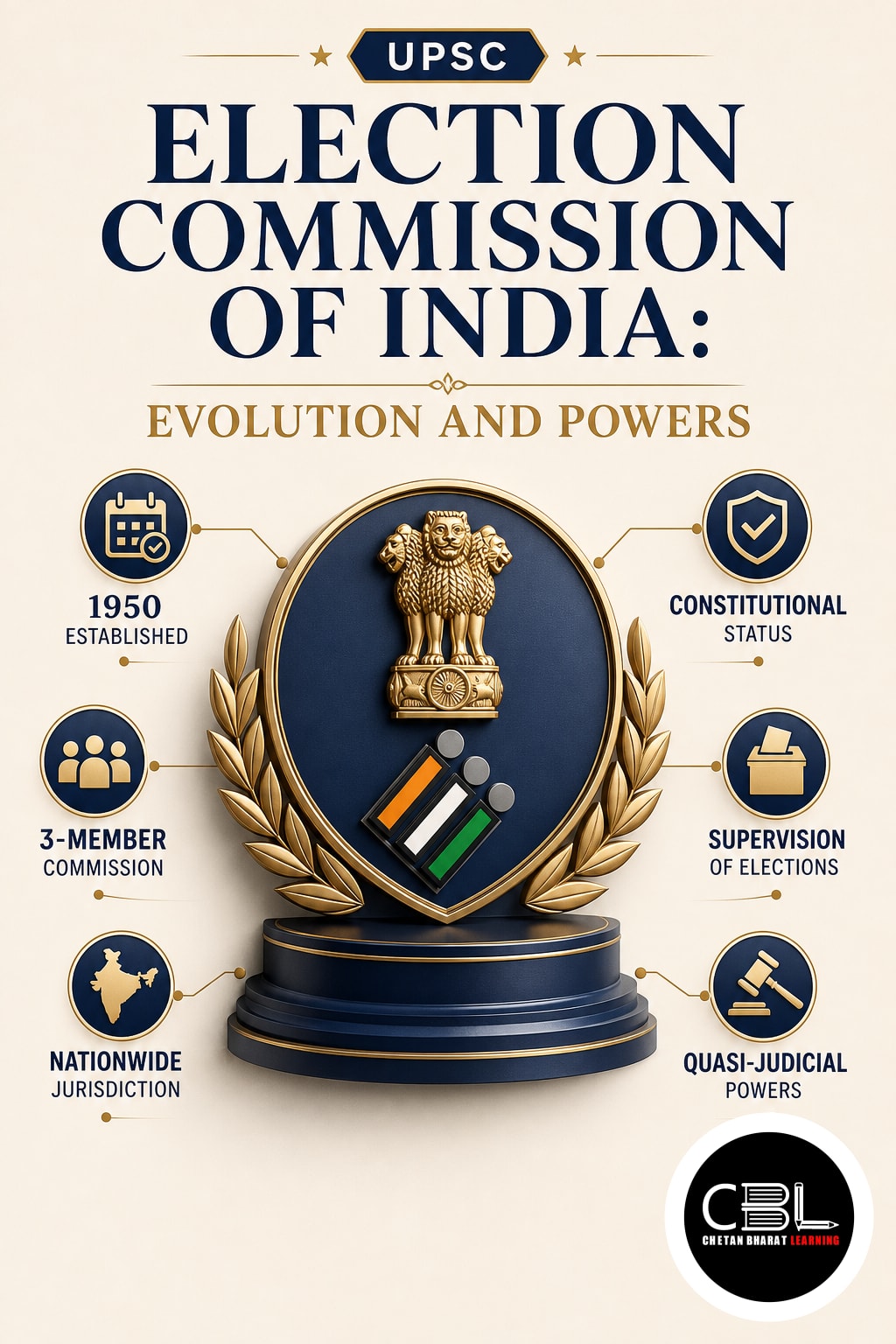
The Election Commission of India is a permanent and independent constitutional body established on 25 January 1950 under Article 324 of the Constitution. It has the superintendence, direction and control of elections to Parliament, State Legislatures and the offices of President and Vice-President of India. Its core responsibility is to ensure free, fair and credible elections under constitutional and statutory frameworks.
Important Facts
| Established | Constitutional Provision | Structure | Headquarters |
|---|---|---|---|
| 25 January 1950 | Article 324 | Chief Election Commissioner & Two Election Commissioners | Nirvachan Sadan, New Delhi |
Evolution of the Commission
| Period | Development |
|---|---|
| 1950–1989 | Single-member body under the Chief Election Commissioner. |
| October 1989 | Two additional Election Commissioners appointed. |
| January 1990 | Returned to single-member structure. |
| October 1993 | Restored permanent three-member structure; upheld by Supreme Court in T.N. Seshan v. Union of India (1995). |
| 2023 | New Act regulating appointments, service conditions and tenure. |
Constitutional and Legal Provisions
| Article/Act | Provision |
|---|---|
| Article 324 | Superintendence, direction & control of elections. |
| Representation of the People Act, 1950 | Electoral rolls & constituency framework. |
| Representation of the People Act, 1951 | Conduct of elections, qualifications & disputes. |
| CEC and Other ECs Act, 2023 | Appointment mechanism, service conditions & term of office. |
Appointment and Tenure
The President appoints the Chief Election Commissioner (CEC) and other Election Commissioners on the recommendation of a Selection Committee comprising:
- Prime Minister (Chair)
- Leader of Opposition in the Lok Sabha
- Union Cabinet Minister nominated by the Prime Minister
Commissioners serve for six years or until age 65, whichever is earlier. The CEC’s removal follows the same procedure as a Supreme Court Judge. Other ECs can be removed only on the CEC’s recommendation. Salaries are pari passu with Supreme Court Judges. Commissioners have equal decision-making powers, with a majority vote deciding disagreements.
Key Powers and Functions
- Superintendence, direction & control of elections to Parliament, State Legislatures, President & Vice-President
- Preparation, revision & maintenance of electoral rolls
- Election scheduling & coordination of polling
- Implementation of the Model Code of Conduct
- Registration & regulation of political parties
- Advisory opinions under Articles 103 & 192
- Monitoring of election expenditures
- Administration of electronic voting systems & VVPAT
Important Supreme Court Judgments
S.S. Dhanoa v. Union of India (1991)
Upheld the government’s abolition of additional EC posts created in 1989.
T.N. Seshan v. Union of India (1995)
Validated the three-member Commission and majority decision-making.
Mohinder Singh Gill v. CEC (1978)
Affirmed the broad scope of Article 324 when statutes are silent.
Anoop Baranwal v. Union of India (2023)
Directed an interim selection committee until the 2023 Act was enacted.
Implications and Way Forward
- Strengthen appointment transparency and independent selection
- Enhance electoral roll safeguards and grievance redressal
- Improve financial autonomy and institutional resources
- Ensure transparent use of electoral technology and audits
- Promote stakeholder consultations with political parties and civil society
Prelims Practice Corner
-
Q1. The Election Commission of India was established under which Article of the Constitution?
- (a) Article 280
- (b) Article 315
- (c) Article 324
- (d) Article 356
Answer: (c) Article 324.
-
Q2. Consider the following statements:
1. The Election Commission functioned as a single-member body from 1950 until 1989.
2. The three-member structure was restored in October 1993.
3. The Supreme Court declared the multi-member structure unconstitutional in 1995.
Which are correct?- (a) 1 and 2 only
- (b) 2 and 3 only
- (c) 1 and 3 only
- (d) 1, 2 and 3
Answer: (a) 1 and 2 only.
-
Q3. Under the 2023 Act, who is NOT on the Selection Committee for the CEC?
- (a) Prime Minister
- (b) Leader of Opposition in Lok Sabha
- (c) A nominated Union Cabinet Minister
- (d) Chief Justice of India
Answer: (d) Chief Justice of India.
-
Q4. Which describes the removal of the CEC?
- (a) Removed directly by the Prime Minister.
- (b) Same manner and grounds as removal of a Supreme Court Judge.
- (c) By a simple majority resolution of a State Assembly.
- (d) By majority vote of other ECs.
Answer: (b) Same as a Supreme Court Judge.
-
Q5. Consider:
1. The ECI conducts elections to Parliament & State Legislatures.
2. The ECI directly conducts Panchayat & Municipal elections.
3. State Election Commissions supervise local body elections under separate provisions.
Which are correct?- (a) 1 only
- (b) 2 and 3 only
- (c) 1 and 3 only
- (d) 1, 2 and 3
Answer: (c) 1 and 3 only.
Mains Practice Questions
-
Q1. Trace the evolution of the Election Commission of India from a single-member institution to a multi-member constitutional body. Examine how this has influenced electoral administration and institutional independence. (15 marks)
Answer Structure: Intro – Article 324 & establishment; Body – 1989 expansion, 1990 reversal, 1993 restoration, T.N. Seshan judgment, 2023 framework; Conclusion – impartiality, collective decision-making & accountability.
-
Q2. Institutional independence and electoral transparency are essential for public trust in democracy. Critically examine the appointment framework and constitutional safeguards of the Election Commission of India. (10 marks)
Answer Structure: Intro – role as independent body; Body – Article 324(5), 2023 committee, removal safeguards, financial autonomy, roll transparency & judicial review; Conclusion – recommend transparent appointments, voter safeguards & credibility.
Frequently Asked Questions
When was the Election Commission of India established?
It was established on 25 January 1950 under Article 324 of the Constitution to supervise elections to Parliament, State Legislatures, President and Vice-President.
How did it become a three-member body?
Two additional commissioners were first appointed in 1989, reversed in 1990, and permanently restored in October 1993; upheld by the Supreme Court in 1995.
How are the CEC and other ECs appointed?
Under the 2023 Act, the President appoints them on the recommendation of a Selection Committee of the Prime Minister, Leader of Opposition in Lok Sabha and a nominated Union Cabinet Minister.
Related Current Affairs
Preparing for UPSC, PCS or HCS?
Talk to a mentor at Chetan Bharat Learning, Chandigarh. Free guidance on choosing the right exam and building a study plan.
Chat on WhatsAppCall 97793 53345UPSC / IAS / PCS coaching in Chandigarh · Trusted by aspirants across Punjab & Haryana
Leave a Reply
You must be logged in to post a comment.