

UPSC Mapping
Prelims
Economy / Labour
Mains
GS Paper III – Economy, Inclusive Growth
Quick Facts
| Indicator | Value |
|---|---|
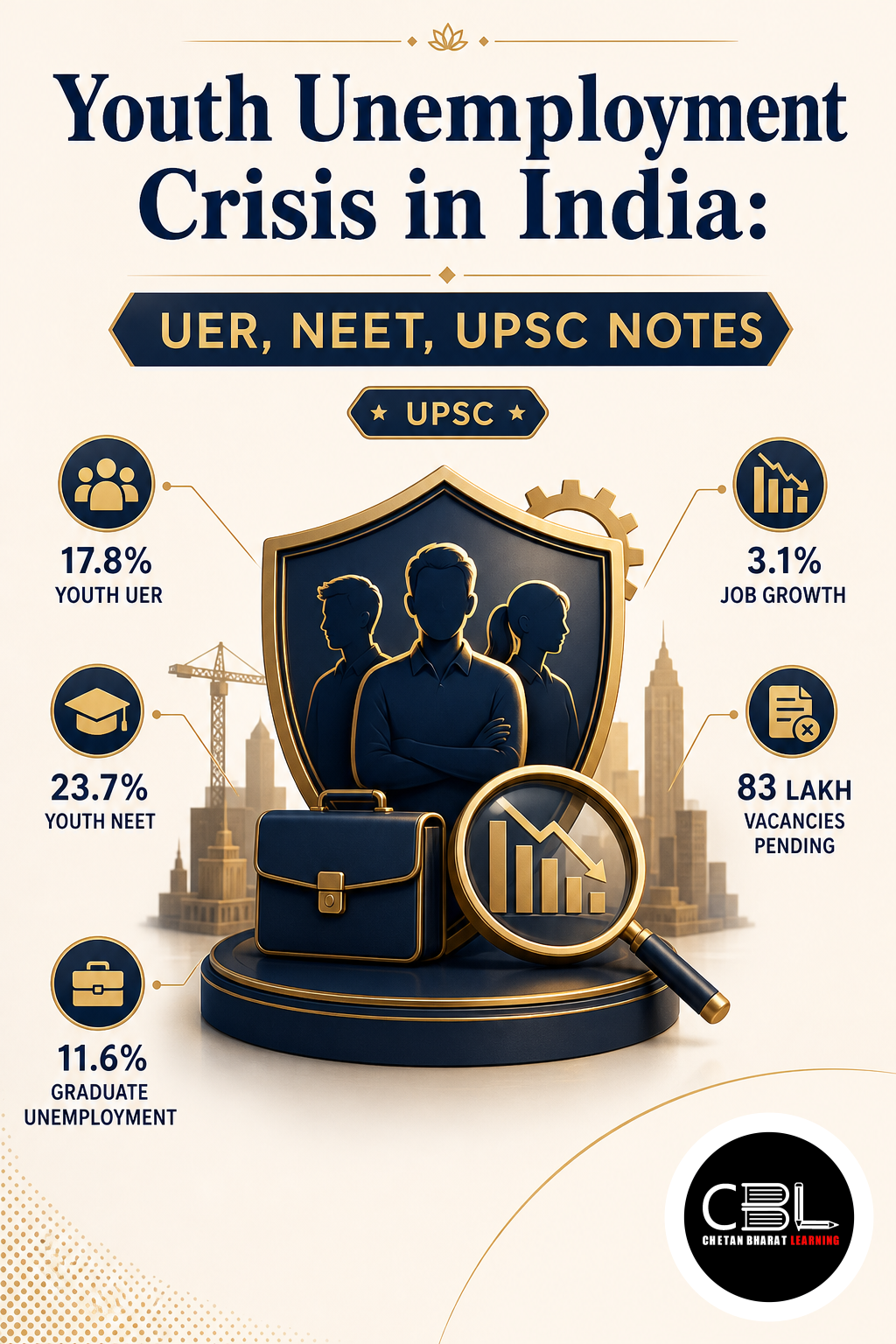
| UER (15+) 2025 | 3.1% |
| Youth NEET share | 25% |
| Youth NEET number | 9.2 crore |
| Graduate unemployment | Close to 40% |
| Survey | PLFS |
Article
What is Youth Unemployment Crisis?
Youth unemployment crisis in India refers to the persistent gap between young people who seek work and the limited number of adequate jobs available to them. It affects the age group of 15 to 29 years, where the unemployment rate has remained around 10% since 2022-23. Nearly 40% of graduates aged 25 who look for work are unable to find employment.
The Unemployment Rate or UER measures unemployed people as a share of the labour force, which includes only those who are working or actively searching for work. Many young Indians, especially women, do not appear in this count because social norms and family responsibilities keep them out of active job seeking.
Why is Youth Unemployment Crisis in News?
The issue gained attention after the State of Working India 2026 report revealed that about 25% of Indian youth are classified as NEET. The report uses official PLFS data and shows that educated unemployment in 2023 was higher than in 1983. This pattern challenges the claim that India’s jobs market has fully recovered.
India has the largest youth population in the world, estimated at 36.8 crore in 2026. A large NEET pool can weaken growth, increase social unrest and waste demographic potential. The Ministry of Statistics and Programme Implementation publishes the PLFS data that underpins these estimates.
Key Features
- Falling overall unemployment: UER for persons aged 15 and above declined from 6.1% in 2017-18 to 3.1% in 2025.
- Sticky youth unemployment: Unemployment in the 15–29 age group fell from almost 18% to about 10% and then plateaued.
- High educated unemployment: The unemployment rate for 25-year-old graduates is close to 40%, indicating a serious mismatch between degrees and jobs.
- Rise in agriculture jobs: Of the 8.3 crore jobs added between 2021-22 and 2023-24, about 4 crore came from agriculture, often low-productivity work.
- Large NEET pool: Around 25% of young Indians are neither in education, employment nor training.
Challenges
- Weak job creation: Non-farm sectors have not generated enough formal and productive employment for rising educated youth.
- Skill mismatch: Many graduates lack industry-relevant skills, so vacancies persist even as unemployment stays high.
- Quality of work: Much new employment is own-account self-employment or agricultural work with stagnant earnings.
- Gender gaps: Educated women often stay outside the labour force due to social norms and lack of suitable local opportunities.
- Measurement weakness: UER hides discouraged workers and non-searching women, underestimating labour distress.
For more coverage of economic and social issues, check the economy current affairs section.
Way Forward
Replace headline unemployment with broader indicators such as NEET, labour force participation and earnings growth. Publish state and district-level NEET data quarterly to track youth exclusion. Focus on creating formal non-farm jobs in manufacturing, services and digital work for educated job seekers.
Expand vocational training, paid apprenticeships and career counselling in schools and colleges. As per the Azim Premji University report, strengthen women’s access to safe transport, childcare and skill programmes to boost labour force participation. India’s demographic dividend will materialise only if quality jobs grow at scale.
Prelims Practice Corner
Q1. What was India’s unemployment rate in 2025 for persons aged 15 and above?
- (a) 6.1%
- (b) 5.2%
- (c) 3.1%
- (d) 2.2%
Answer: (c) 3.1% in 2025 according to PLFS data.
Q2. What does NEET stand for in labour market analysis?
- (a) National Employment and Education Test
- (b) Not in Education, Employment, or Training
- (c) New Employment and Training
- (d) National Economic Employment Target
Answer: (b) Not in Education, Employment, or Training.
Q3. About how many young Indians are estimated to be NEET?
- (a) 5.2 crore
- (b) 7.4 crore
- (c) 9.2 crore
- (d) 11.8 crore
Answer: (c) 9.2 crore based on 25% of a 36.8 crore youth population.
Q4. What is the unemployment rate close to among 25-year-old graduates?
- (a) 10%
- (b) 20%
- (c) 30%
- (d) 40%
Answer: (d) Close to 40%.
Q5. Which survey provides the unemployment data discussed above?
- (a) National Family Health Survey
- (b) Periodic Labour Force Survey
- (c) Economic Census
- (d) India Human Development Survey
Answer: (b) Periodic Labour Force Survey.
Mains Practice Questions
Q1. Discuss the limitations of the unemployment rate in capturing India’s labour market distress. (15 marks)
Answer Structure:
- Intro: Define UER and mention the falling headline trend.
- Body: Explain excluded categories, youth unemployment, educated unemployment, gender gaps and the NEET measure.
- Conclusion: Suggest broader labour market metrics for policy.
Q2. Examine the causes and consequences of high youth unemployment in India. (10 marks)
Answer Structure:
- Intro: Mention India’s large youth population and sticky unemployment.
- Body: Cover skill mismatch, low quality job creation, agriculture absorption, educated unemployment and social impact.
- Conclusion: Link to demographic dividend and need for structural reforms.
FAQs on Youth Unemployment Crisis
What is the Unemployment Rate and what does it measure?
The UER measures the number of unemployed people as a share of the labour force, which includes those working or actively looking for work.
What is India’s current unemployment rate?
The UER fell from 6.1% in 2017-18 to 3.1% in 2025 for those aged 15 and above.
How many young Indians are estimated to be NEET?
Around 9.2 crore young Indians are estimated to be NEET, based on 25% of a youth population of 36.8 crore in 2026.
Related Current Affairs
Preparing for UPSC, PCS or HCS?
Talk to a mentor at Chetan Bharat Learning, Chandigarh. Free guidance on choosing the right exam and building a study plan.
Chat on WhatsAppCall 97793 53345UPSC / IAS / PCS coaching in Chandigarh · Trusted by aspirants across Punjab & Haryana
Leave a Reply
You must be logged in to post a comment.