
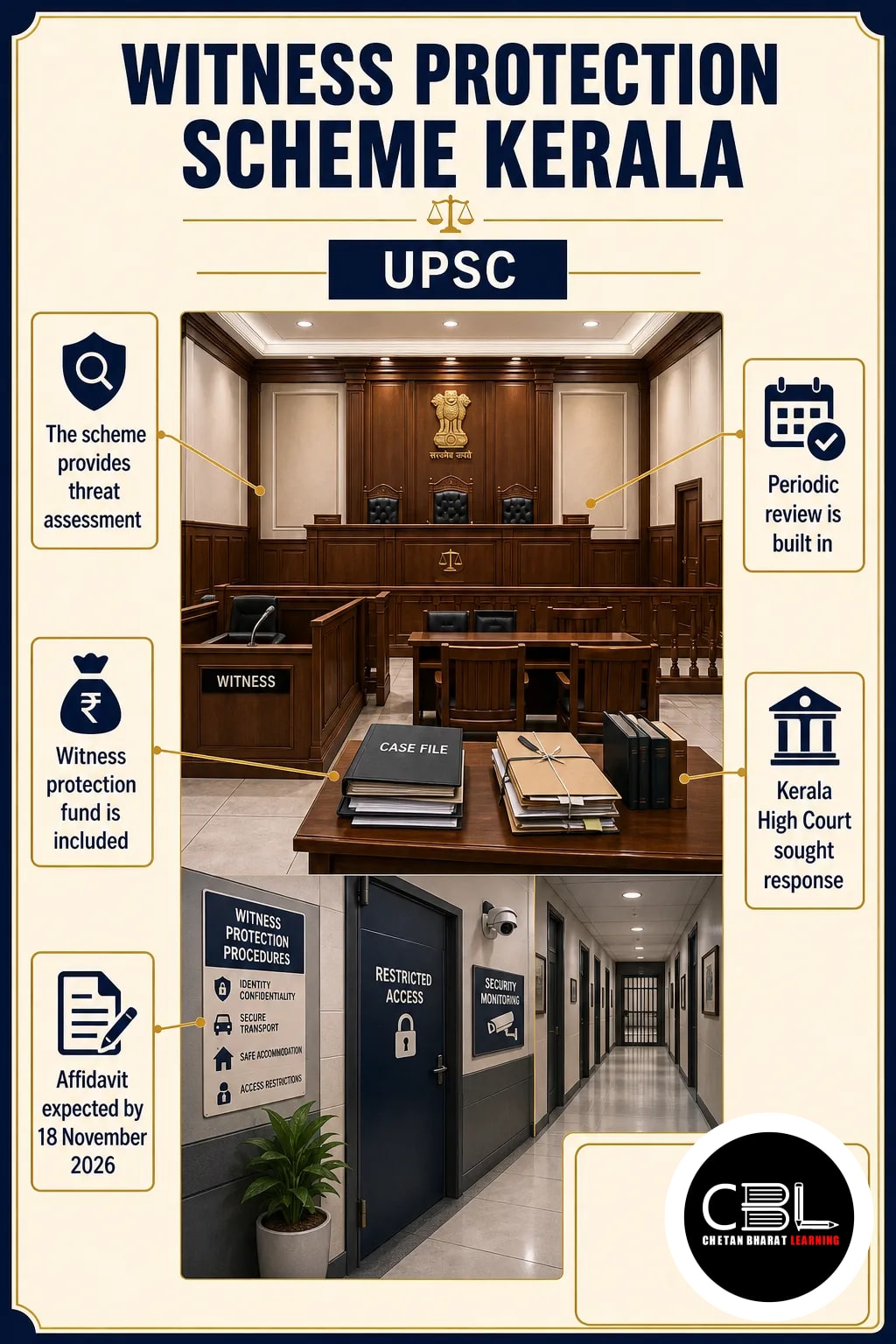
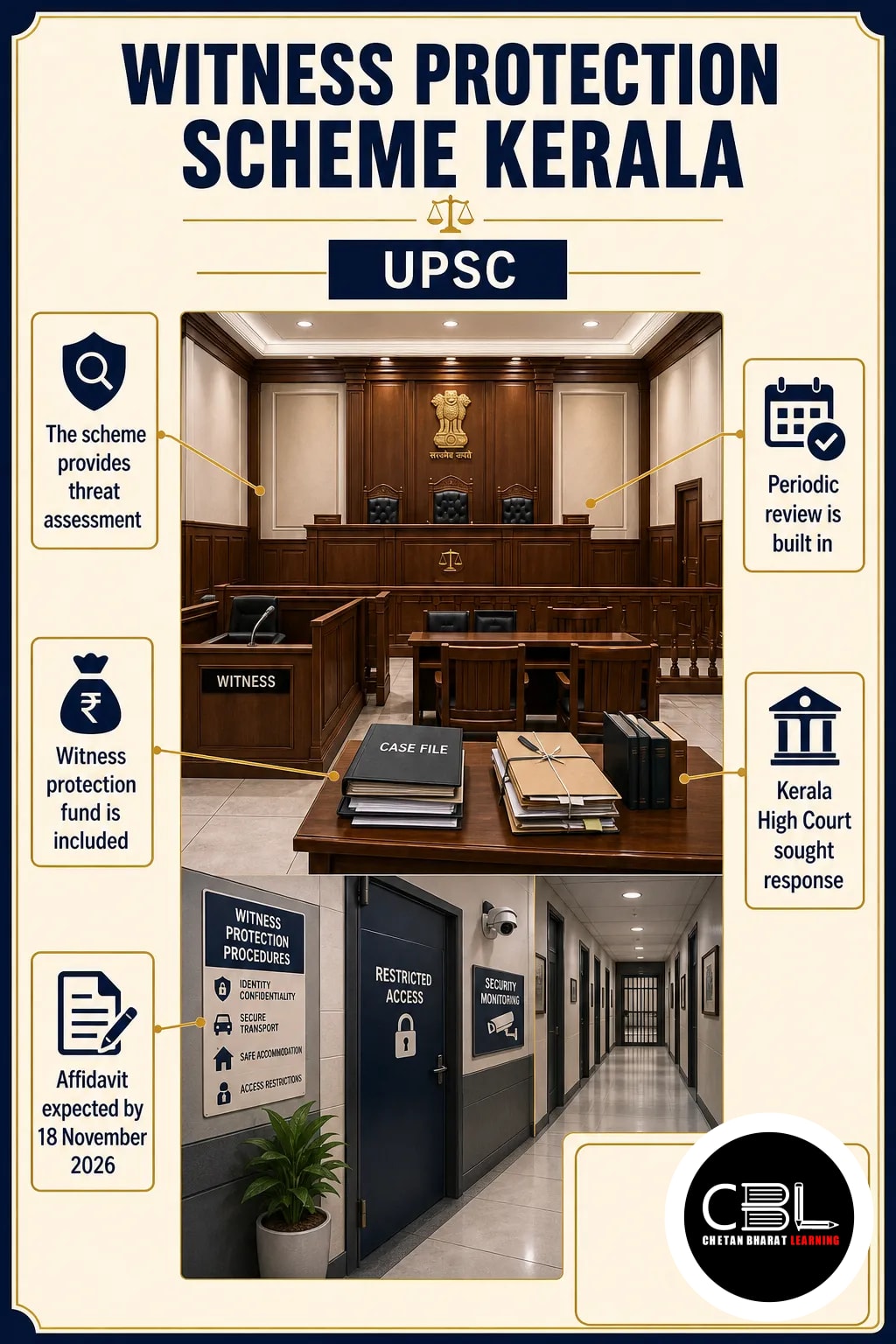
Witness protection scheme Kerala is under judicial scrutiny after the High Court sought the State government’s response to an implementation challenge. The case connects witness safety with constitutional governance and justice delivery.
Quick answer: The Kerala High Court sought the government’s response to a public interest litigation on the witness protection scheme Kerala. The petition says the 2018 scheme remains unimplemented in the State. A draft Kerala scheme is under consideration, and the State is expected to file a detailed affidavit by 18 November 2026.
What did the Kerala High Court say?
The High Court sought the State’s response and expected it to finalise implementation urgently. The Division Bench comprised Chief Justice Soumen Sen and Justice V.M. Syam Kumar.
The Bench observed that the State was lagging in implementation. However, the court has sought a response rather than delivered a final ruling on the petition. The State’s detailed affidavit is expected by 18 November 2026.
Why was the petition filed?
Retired Superintendent of Police P.M. Joseph Saju filed the public interest litigation (PIL), alleging that the scheme remained unimplemented in Kerala. The petitioner said the Supreme Court approved the scheme in 2019 and ordered its implementation nationwide.
The petitioner approached the State Police Chief, the Home department and the Kerala State Legal Services Authority (KeLSA). Their responses highlight a distinction between preparing a framework and bringing it into operation.
| Authority or stage | Position in the report |
|---|---|
| State Police Chief | A draft Kerala Witness Protection Scheme 2026 had been sent to the government and remained under consideration. |
| Home department | It said the State had issued no order or circular on the scheme and the matter was under consideration. |
| KeLSA | It gave a similar response and transferred several enquiries to the Public Information Officer. |
| Standard operating procedure | The police response also referred to a procedure on witness attendance, examination, statements and summons. |
The petitioner cited the Attapady Madhu murder case, proceedings against former Bishop Franco Mulakkal and the Nenmara double murder. These examples concerned situations where witness protection was granted or required; the report does not assign the same outcome to each case.
What does the witness protection scheme provide?
The scheme provides a framework for assessing threats and organising protection for witnesses. It also identifies institutional and financial components needed to support that protection.
- Threat assessment: Assessing risk helps determine whether a witness needs protection.
- Protection measures: These address safety concerns associated with participation in criminal proceedings.
- Competent authorities and protection cells: The framework provides for institutions to support decisions and implementation.
- Periodic review: Review allows authorities to reconsider protection as circumstances change.
- Witness protection fund: The scheme also provides for a fund to support protection.
A procedure for attendance and summons addresses courtroom participation; it does not by itself establish that the complete protection framework is operational. Therefore, the affidavit may clarify which institutions and arrangements the State has put in place.
Which constitutional provisions are relevant?
Articles 21, 39A and 226 provide useful constitutional context for analysing safety, access to justice and judicial oversight. Their relevance here is analytical; the report does not say the Bench decided the case under specific articles.
| Provision | What it says and why it matters |
|---|---|
| Article 21 | Protects life and personal liberty except according to procedure established by law; witness safety engages these interests. |
| Article 39A | Directs the State to promote equal justice and free legal aid; effective access to justice is the broader policy context. |
| Article 226 | Empowers High Courts to issue specified writs for fundamental rights and other purposes. |
Witness safety also intersects with protections for vulnerable communities. For related statutory context, see the Scheduled Castes and Scheduled Tribes Atrocities Act guide; that law is distinct from the general scheme discussed here.
Why does implementation matter for criminal justice?
Effective protection can help witnesses participate without intimidation and support the integrity of evidence. However, protection is not a guarantee of a particular testimony or trial outcome.
- Access to justice: A threatened witness may find it difficult to attend proceedings; timely support can reduce that barrier.
- Institutional coordination: Police, competent authorities and protection cells need clear responsibilities; otherwise, a request may move slowly between offices.
- Funding and continuity: A fund and periodic review can support sustained measures; a paper framework alone cannot demonstrate delivery.
- Fair-trial balance: Protection must preserve the accused person’s opportunity to contest evidence; safety and procedural fairness should operate together.
What should Kerala’s response address?
The response should clarify the status of notification, institutions, funding and review under the witness protection scheme Kerala. These are governance questions for the State’s affidavit, not findings that each component is absent.
First, the government could set out a timeline for the draft and identify responsible authorities. Second, it could explain how witnesses seek help and how threat assessments lead to decisions. Finally, it could disclose arrangements for funding, coordination and review while protecting sensitive information.
Such clarification would allow the court and the public to distinguish individual protection measures from a functioning State-wide system. Moreover, it would make administrative accountability easier to assess.
Source: The Hindu, 30 October 2026
- Atrocities Act 1989: UPSC Notes on Protection & Relief (13 Aug 2026)
Punjab PCS and Haryana HCS may test witness safety through questions on criminal justice and state administration. In addition, aspirants should connect High Court writ jurisdiction with implementation of public policy.
Prelims Practice Corner
Mains Practice Questions
Frequently Asked Questions
Why is the Kerala High Court examining witness protection?
The court is examining a petition alleging that the scheme remains unimplemented in Kerala. Therefore, it sought the State government’s response.
Has Kerala issued its witness protection scheme?
The Home department said no State order or circular on the scheme had been issued. Meanwhile, the draft Kerala Witness Protection Scheme 2026 remained under consideration.
What are the main components of the witness protection scheme?
The scheme provides for threat assessment, protection measures, competent authorities, protection cells, review and a fund. Together, these elements create a framework for organising witness safety.
Related Current Affairs
Preparing for UPSC, PCS or HCS?
Talk to a mentor at Chetan Bharat Learning, Chandigarh. Free guidance on choosing the right exam and building a study plan.
Chat on WhatsAppCall 97793 53345UPSC / IAS / PCS coaching in Chandigarh · Trusted by aspirants across Punjab & Haryana
Leave a Reply
You must be logged in to post a comment.