
UPSC Syllabus Mapping
- GS Paper: GS-II & GS-III
- Subject: International Relations, International Law and Maritime Security
- Syllabus Pointers: Prep with our comprehensive UPSC Current Affairs Hub analysis guidelines.
Article
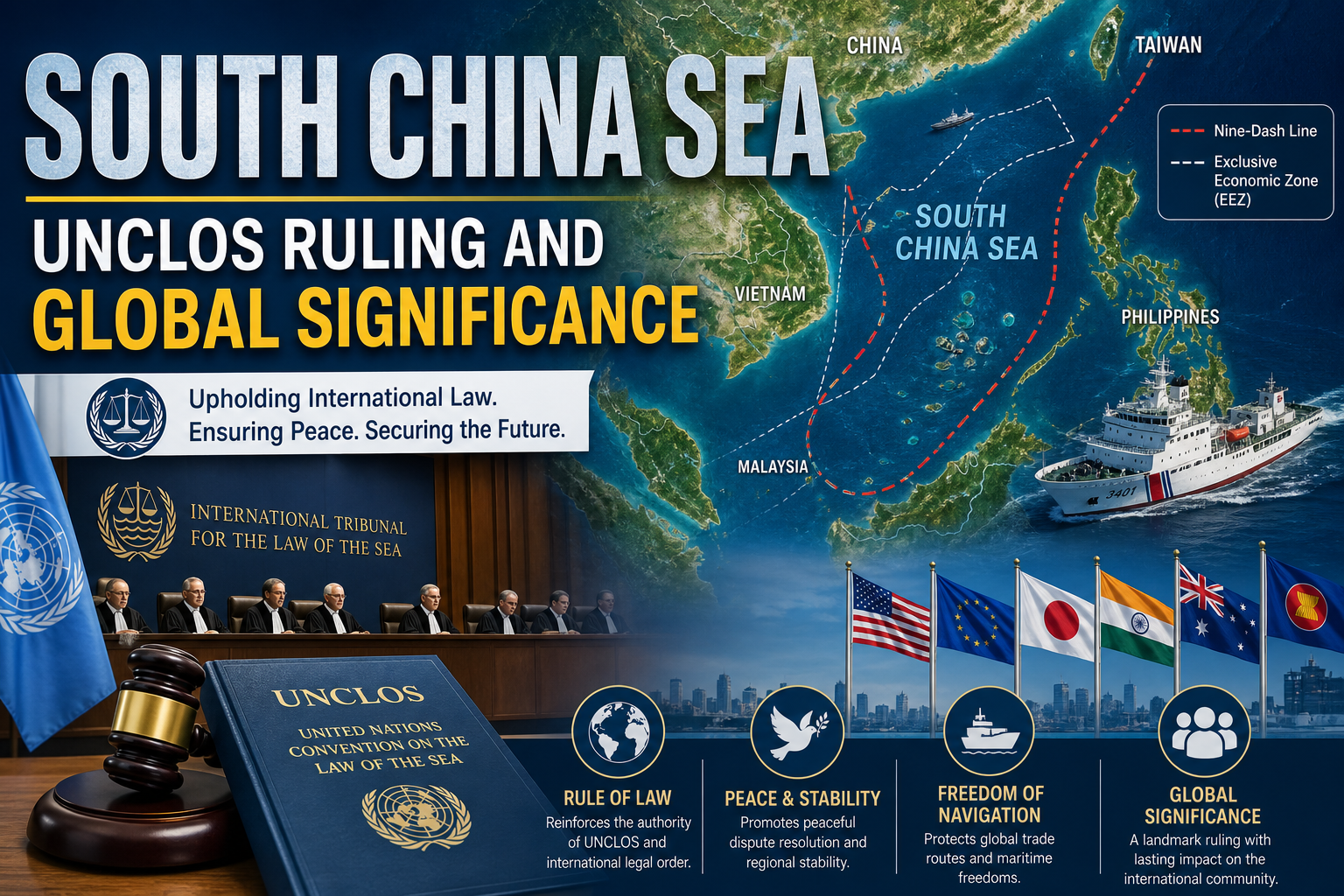
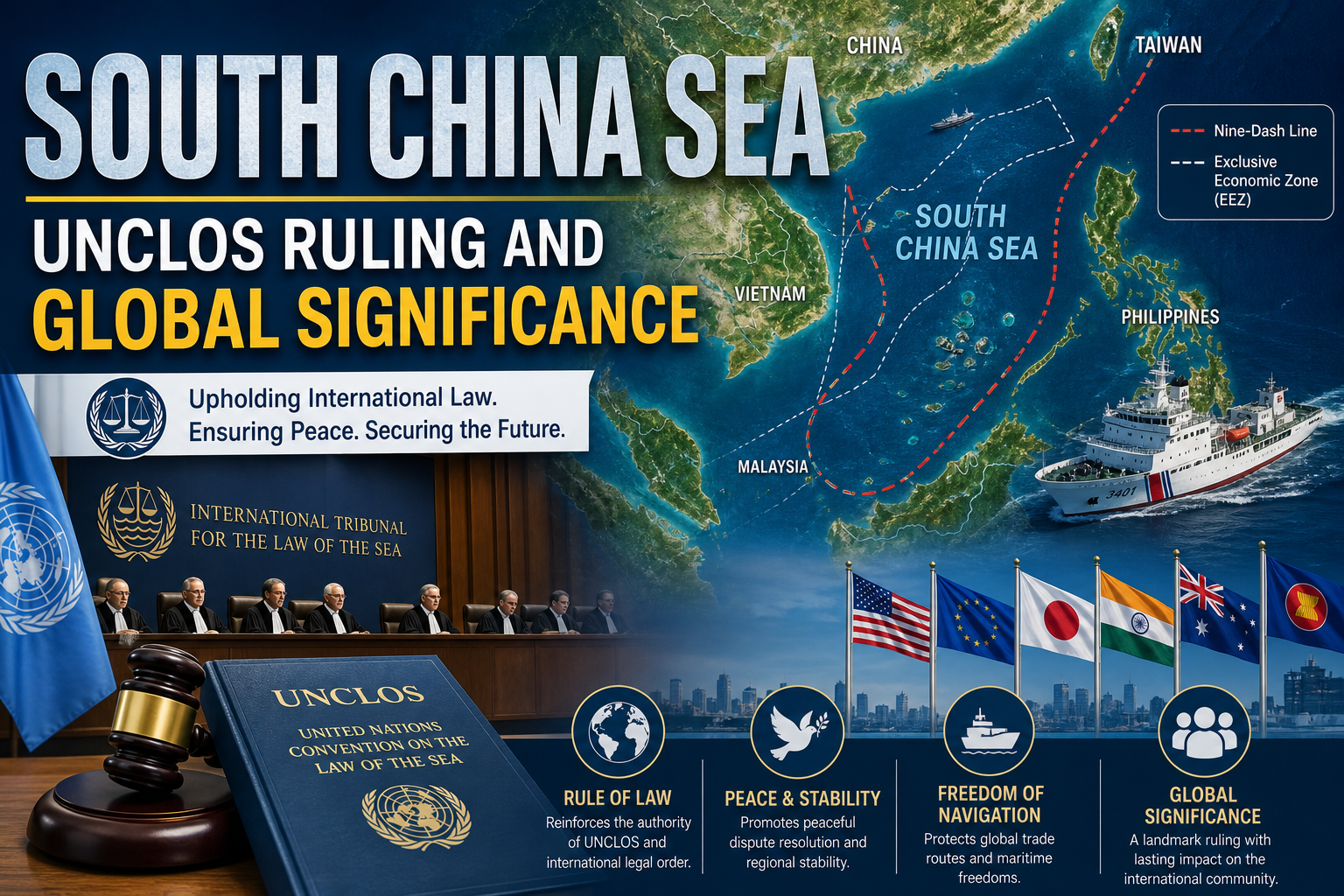
Recent developments regarding South China Sea have brought renewed international attention after 14 countries and the European Union reaffirmed the 2016 arbitral ruling under the United Nations Convention on the Law of the Sea (UNCLOS), stating that China’s expansive maritime claims have no legal basis. The issue highlights the continuing contest between a rules-based international order and competing maritime claims.
Key Dimensions of the South China Sea
The South China Sea is a strategically important semi-enclosed sea linking the Pacific Ocean with the Indian Ocean through the Strait of Malacca. It is one of the world’s busiest maritime trade routes, carrying a substantial share of global merchandise trade and energy shipments.
The region is rich in fisheries, hydrocarbons and other marine resources. It is also central to regional geopolitics because it influences maritime security, naval deployments and economic connectivity across the Indo-Pacific.
The Maritime Dispute
China claims a large portion of the South China Sea through the Nine-Dash Line, asserting what it describes as historic rights. These claims overlap with the maritime zones claimed by several coastal states, including the Philippines, Vietnam, Malaysia, Brunei and Taiwan.
In 2013, the Philippines initiated arbitration under UNCLOS. In 2016, the Permanent Court of Arbitration at The Hague concluded that China’s claims based on historic rights within the Nine-Dash Line had no legal basis under UNCLOS. The tribunal also clarified that maritime entitlements must conform to the Convention rather than unilateral historic claims.
Understanding UNCLOS
UNCLOS, often described as the ‘Constitution of the Oceans’, establishes the legal framework governing maritime zones, navigation rights, resource utilisation and dispute settlement. It defines territorial seas, Exclusive Economic Zones (EEZs), continental shelves and the freedoms enjoyed on the high seas.
An Exclusive Economic Zone (EEZ) extends up to 200 nautical miles from a coastal state’s baseline, within which the coastal state enjoys sovereign rights over natural resources while other states retain freedoms of navigation and overflight.
Freedom of Navigation is a fundamental principle of international maritime law that allows commercial and military vessels to navigate international waters without arbitrary interference, consistent with UNCLOS.
Why is the South China Sea Important for India?
The South China Sea is vital for India’s trade and energy security because a significant share of India’s merchandise trade and energy imports passes through these waters. Stability in the region is therefore important for uninterrupted supply chains.
India supports peaceful resolution of disputes, adherence to international law, respect for UNCLOS, freedom of navigation and freedom of overflight. India does not take positions on competing sovereignty claims but consistently advocates a rules-based maritime order in the Indo-Pacific.
For additional background on UNCLOS, refer to global developmental tracking frameworks.
Way Forward
Long-term stability in the South China Sea requires adherence to international law, confidence-building measures, peaceful dispute resolution, respect for UNCLOS and continued diplomatic engagement among claimant states. Strengthening regional cooperation through ASEAN-led mechanisms and maintaining open sea lanes are essential for preserving a free, open and inclusive Indo-Pacific.
Prelims Practice Corner
Q1. The 2016 South China Sea arbitral award was delivered under:
- (a) World Trade Organization
- (b) United Nations Convention on the Law of the Sea (UNCLOS)
- (c) International Court of Justice
- (d) International Maritime Organization
Answer: (b) The arbitration was initiated under the dispute-settlement provisions of UNCLOS.
Q2. An Exclusive Economic Zone (EEZ) under UNCLOS extends up to:
- (a) 12 nautical miles
- (b) 24 nautical miles
- (c) 200 nautical miles
- (d) 350 nautical miles
Answer: (c) An EEZ extends up to 200 nautical miles from the baseline, granting sovereign rights over natural resources while preserving navigation freedoms for other states.
Mains Practice Question
“The South China Sea dispute is a test of the rules-based international maritime order in the Indo-Pacific.” Discuss the strategic significance of the region and examine India’s approach towards the dispute. (150 Words, 10 Marks)
FAQs
Why is the South China Sea important for India?
It is crucial for India’s trade, energy security, maritime connectivity and Indo-Pacific strategic interests, making freedom of navigation and adherence to international law important national priorities.
Related Current Affairs
Preparing for UPSC, PCS or HCS?
Talk to a mentor at Chetan Bharat Learning, Chandigarh. Free guidance on choosing the right exam and building a study plan.
Chat on WhatsAppCall 97793 53345UPSC / IAS / PCS coaching in Chandigarh · Trusted by aspirants across Punjab & Haryana
Leave a Reply
You must be logged in to post a comment.