

UPSC Mapping
| Exam | Topics |
|---|---|
| Prelims | Plant Diseases, Fungi, Climate Change, Species in News |
| Mains | GS Paper III – Environment, Biodiversity & Climate Change |
What is Sooty Bark Disease?
Sooty Bark Disease is a serious fungal disease that primarily affects maple trees, causing rapid wilting, bark damage and eventual tree mortality. It is caused by the fungus Cryptostroma corticale, which can remain dormant within trees for several years before becoming active under favourable environmental conditions.
The disease is endemic to the Great Lakes region of North America but has spread to several European countries where it is regarded as an introduced disease. Besides affecting forests, fungal spores released by infected trees may pose health risks to humans if inhaled.
Why is Sooty Bark Disease in News?
Researchers in British Columbia, Canada, have reported fresh cases of Sooty Bark Disease in maple trees and are studying methods to reduce its spread. The increasing incidence is linked to prolonged periods of hot and dry weather, which favour fungal activation.
The disease has attracted scientific attention because climate change may increase the frequency of conditions that promote fungal outbreaks. Official information on plant health research is available through the Food and Agriculture Organization (FAO).
Key Features of Sooty Bark Disease
- Causative organism: The fungal pathogen Cryptostroma corticale infects the internal tissues of maple trees.
- Climate dependence: The fungus becomes active after prolonged periods of hot and dry weather, while remaining dormant for years under less favourable conditions.
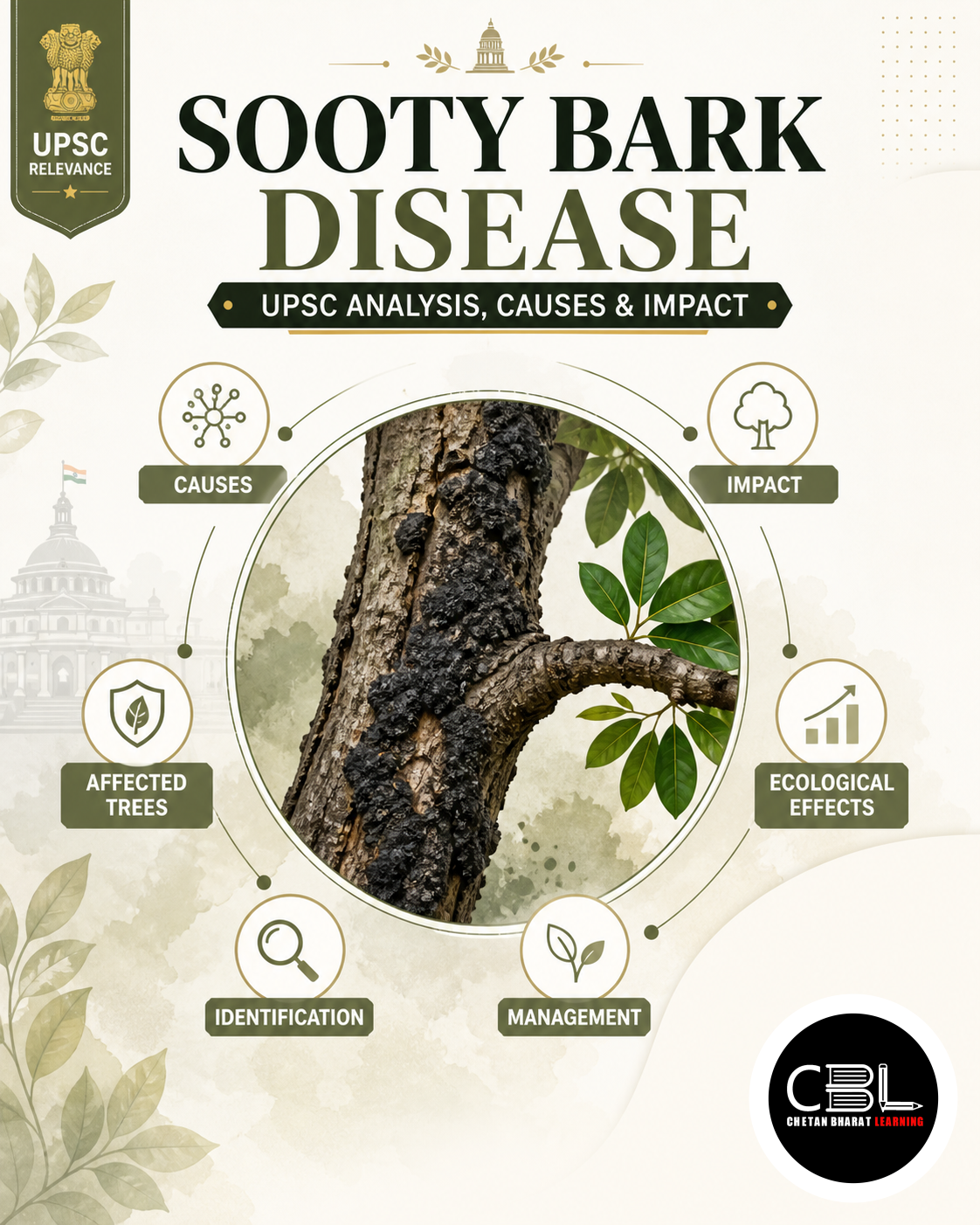
- Characteristic symptom: Infected trees develop black sooty patches beneath the bark due to massive fungal spore production.
- Rapid mortality: Once activated, the disease may kill affected trees within approximately three years.
- Human health concern: Airborne fungal spores may cause respiratory problems in individuals exposed during forestry or wood-processing activities.
Challenges
- No effective treatment: There is currently no proven control measure or cure for infected trees.
- Climate change: Rising temperatures and prolonged droughts may increase disease outbreaks.
- Forest biodiversity loss: Large-scale mortality of maple trees can alter forest ecosystems and wildlife habitats.
- Occupational exposure: Forestry workers and arborists may inhale fungal spores during tree removal or processing.
- Monitoring difficulties: The fungus may remain dormant for years before visible symptoms appear.
Way Forward
Early detection, continuous forest surveillance and scientific monitoring are essential for limiting the spread of Sooty Bark Disease. Improving understanding of fungal ecology under changing climatic conditions can support better forest management strategies.
Research into disease-resistant tree varieties, safe disposal of infected wood and awareness among forestry personnel will help minimise ecological damage and health risks. Additional information on global forest health is available through the International Union of Forest Research Organizations.
Prelims Practice Corner
- Q1. Sooty Bark Disease primarily affects which trees?
- a) Oak
- b) Maple
- c) Pine
- d) Teak
Answer: (b) Maple trees are the primary hosts of Sooty Bark Disease.
- Q2. Sooty Bark Disease is caused by:
- a) Phytophthora infestans
- b) Cryptostroma corticale
- c) Fusarium oxysporum
- d) Puccinia graminis
Answer: (b) The disease is caused by the fungus Cryptostroma corticale.
- Q3. Which climatic conditions favour activation of the fungus?
- a) Cold and wet
- b) Hot and dry
- c) Humid coastal
- d) Snowfall
Answer: (b) Extended periods of hot and dry weather activate the fungus.
- Q4. Cryptostroma corticale is endemic to which region?
- a) Amazon Basin
- b) Great Lakes region of North America
- c) Siberia
- d) Mediterranean Basin
Answer: (b) The fungus is endemic to the Great Lakes region of North America.
- Q5. Which statement is correct regarding Sooty Bark Disease?
- a) An effective vaccine exists
- b) It affects only crops
- c) No effective control currently exists
- d) It spreads only through insects
Answer: (c) There is currently no effective control for Sooty Bark Disease.
Mains Practice Questions
Q1. Discuss the ecological impact of fungal diseases on forest ecosystems with reference to Sooty Bark Disease. (10 marks)
Answer Structure
- Intro: Introduce fungal diseases in forests.
- Body: Explain causes, ecological effects, climate linkages and conservation measures.
- Conclusion: Highlight the need for scientific forest management.
Q2. Examine how climate change may influence the emergence and spread of forest diseases. (15 marks)
Answer Structure
- Intro: Explain climate–disease interactions.
- Body: Discuss temperature, drought, biodiversity impacts, surveillance and adaptation strategies.
- Conclusion: Emphasise resilient forest ecosystems.
FAQs on Sooty Bark Disease
What is Sooty Bark Disease?
Sooty Bark Disease is a fungal disease of maple trees caused by Cryptostroma corticale that leads to wilting, bark discoloration and eventual tree death.
Why is Sooty Bark Disease associated with hot weather?
The fungus remains dormant for years but becomes active during prolonged periods of hot and dry weather, allowing rapid disease progression.
Why is Sooty Bark Disease important for UPSC?
It is relevant because it connects biodiversity conservation, plant pathology, climate change, forest health and environmental governance, making it useful for both Prelims and GS Paper III.
Related Current Affairs
Preparing for UPSC, PCS or HCS?
Talk to a mentor at Chetan Bharat Learning, Chandigarh. Free guidance on choosing the right exam and building a study plan.
Chat on WhatsAppCall 97793 53345UPSC / IAS / PCS coaching in Chandigarh · Trusted by aspirants across Punjab & Haryana
Leave a Reply
You must be logged in to post a comment.