
UPSC Mapping
Prelims
Polity & Social Justice
Mains
GS Paper 1 (Social Issues) & GS Paper 2 (Polity)
Quick Facts
| Key Act | Muslim Personal Law (Shariat) Act, 1937 |
|---|---|
| BNS Section | Section 82 (Bigamy) |
| NFHS Data (Polygamy) | Muslims 1.9%, Hindus 1.3% |
What is the Legality of Polygamy?
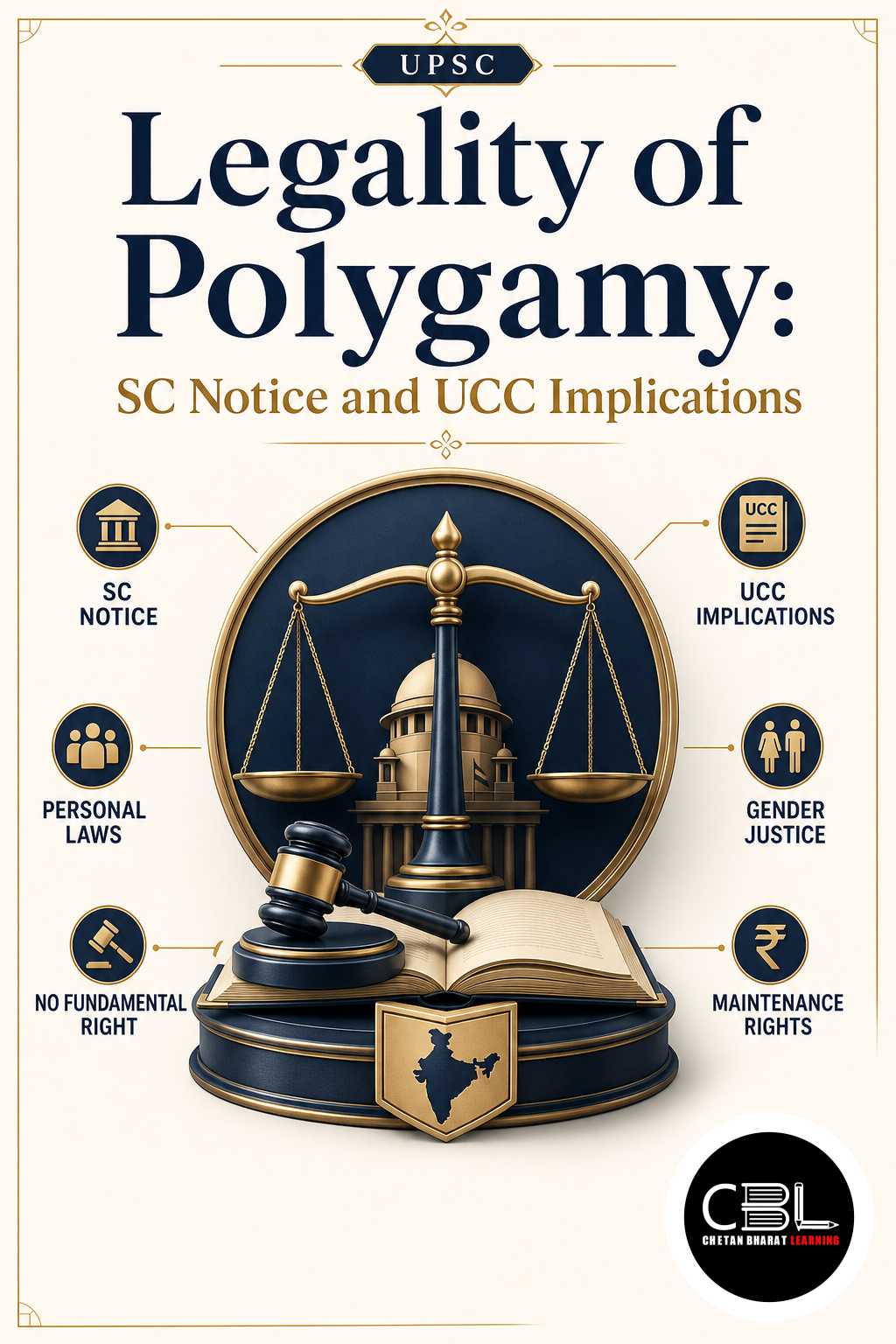
The Legality of Polygamy in India is governed by personal laws, with Muslim personal law permitting up to four wives under Section 2 of the Shariat Act, 1937. For non-Muslims, bigamy is a criminal offence under Section 82 of the Bharatiya Nyaya Sanhita (BNS), 2023, punishable by up to seven years in prison. Uttarakhand became the first state to implement a Uniform Civil Code (UCC) banning bigamy and polygamy, with Scheduled Tribes exempted.
The Supreme Court has previously held in Javed (2003) that polygamy is not an ‘essential religious practice’ protected under Article 25. In Shayara Bano (2017), the Court invalidated instant triple talaq but left polygamy open for future adjudication. According to NFHS 2019-21, polygamy prevalence is highest among Christians (2.1%), followed by Muslims (1.9%) and Hindus (1.3%).
Why is Legality of Polygamy in News?
The Legality of Polygamy is in the news because the Supreme Court issued notice to the Union Government on a PIL seeking a ban on polygamy among Muslims and asked it to consider abolishing the practice for all citizens. The Court has also questioned the constitutional validity of Muslim personal law permitting polygamy, potentially paving the way for a Uniform Civil Code.
The petition argues that polygamy violates the fundamental rights to equality (Article 14), non-discrimination (Article 15), and equal opportunity (Article 16). For more details, refer to the PIB release.
Key Features of Legality of Polygamy
- Personal Law: Muslim personal law permits up to four wives; non-Muslims face bigamy charges under BNS.
- Constitutional Challenge: Alleged violation of Articles 14, 15, and 16.
- Essential Religious Practice: Supreme Court held that polygamy is not essential under Article 25.
- UCC Precedent: Uttarakhand has banned polygamy through UCC; other states may follow.
- Data: NFHS 2019-21 shows polygamy prevalence across communities.
Challenges in Legality of Polygamy
- Religious Sentiments: Any reform in personal law faces opposition from religious conservatives.
- Constitutional Complexity: Balancing fundamental rights with religious freedom under Article 25.
- Enforcement: Despite legal provisions, polygamy persists in some communities.
- Gender Justice: Polygamy disproportionately affects women’s rights and dignity.
- Federalism: Personal law is a state subject; a uniform code requires broad consensus.
Way Forward for Legality of Polygamy
To resolve the Legality of Polygamy debate, Parliament should consider a Uniform Civil Code that ensures gender justice and equality for all citizens, irrespective of religion. The Supreme Court’s guidance on constitutional validity will set the legal framework.
A phased approach—starting with public consultation and building consensus among religious communities—can ease the transition. Strengthening women’s rights and awareness about existing legal protections is essential. For international best practices, refer to the UNHRC.
Prelims Practice Corner
Q1. Which Act permits polygamy among Muslims in India?
(a) Muslim Personal Law (Shariat) Application Act, 1937 (b) Muslim Women (Protection of Rights on Marriage) Act (c) Dissolution of Muslim Marriages Act (d) Wakf Act
Answer: (a) The Shariat Act, 1937, permits up to four wives.
Q2. Under which section of BNS is bigamy a criminal offence?
(a) Section 76 (b) Section 82 (c) Section 85 (d) Section 89
Answer: (b) Section 82 of BNS deals with bigamy.
Q3. What did the Supreme Court hold in Javed (2003)?
(a) Polygamy is an essential religious practice (b) Polygamy is not essential under Article 25 (c) Polygamy is constitutional (d) Polygamy is a fundamental right
Answer: (b) The Court held that polygamy is not essential.
Q4. Which state has implemented a UCC banning polygamy?
(a) Goa (b) Uttarakhand (c) Himachal Pradesh (d) Kerala
Answer: (b) Uttarakhand is the first state to implement UCC.
Q5. According to NFHS 2019-21, which community has the highest polygamy prevalence?
(a) Hindus (b) Muslims (c) Christians (d) Sikhs
Answer: (c) Christians have the highest at 2.1%.
Mains Practice Questions
Q1. Critically examine the constitutional and social dimensions of the debate on polygamy in India, with reference to the recent Supreme Court notice. (250 words, 15 marks)
Answer Structure:
- Intro: Introduce the polygamy debate and the SC’s intervention.
- Body: Discuss the legal framework—personal laws, BNS, and judicial precedents. Analyse constitutional issues (Articles 14, 15, 25) and gender justice. Address the UCC dimension and the challenges of reform.
- Conclusion: Suggest a consensus-based approach towards a Uniform Civil Code.
Q2. What is the significance of the Supreme Court’s ruling in Shayara Bano (2017) for the polygamy debate? (150 words, 10 marks)
Answer Structure:
- Intro: Mention Shayara Bano as the instant triple talaq case.
- Body: Explain that the Court invalidated triple talaq but left polygamy open for future adjudication. This signals that polygamy may be examined on similar constitutional grounds.
- Conclusion: Conclude that the ruling sets the stage for a comprehensive review of Muslim personal law.
FAQs on Legality of Polygamy
What is the legal status of polygamy in India?
It is permitted under Muslim personal law but is a criminal offence for non-Muslims under BNS Section 82.
Is polygamy an essential religious practice?
The Supreme Court in Javed (2003) held that polygamy is not an essential religious practice under Article 25.
What is the Uniform Civil Code?
It is a proposal to replace personal laws with a common set of laws governing all citizens, as envisaged under Article 44.
Related Current Affairs
Preparing for UPSC, PCS or HCS?
Talk to a mentor at Chetan Bharat Learning, Chandigarh. Free guidance on choosing the right exam and building a study plan.
Chat on WhatsAppCall 97793 53345UPSC / IAS / PCS coaching in Chandigarh · Trusted by aspirants across Punjab & Haryana
Leave a Reply
You must be logged in to post a comment.