
UPSC Mapping
Important For
- Prelims: RBI, Repo Rate, CPI, Core Inflation
- Mains: GS Paper III – Indian Economy and Monetary Policy
Quick Facts
| RBI Inflation Target | 4% with a 2%–6% tolerance band |
|---|---|
| Headline CPI | 4.3% as shown in the uploaded material |
| Core Inflation | Excludes food and fuel |
What is Inflation Targeting?
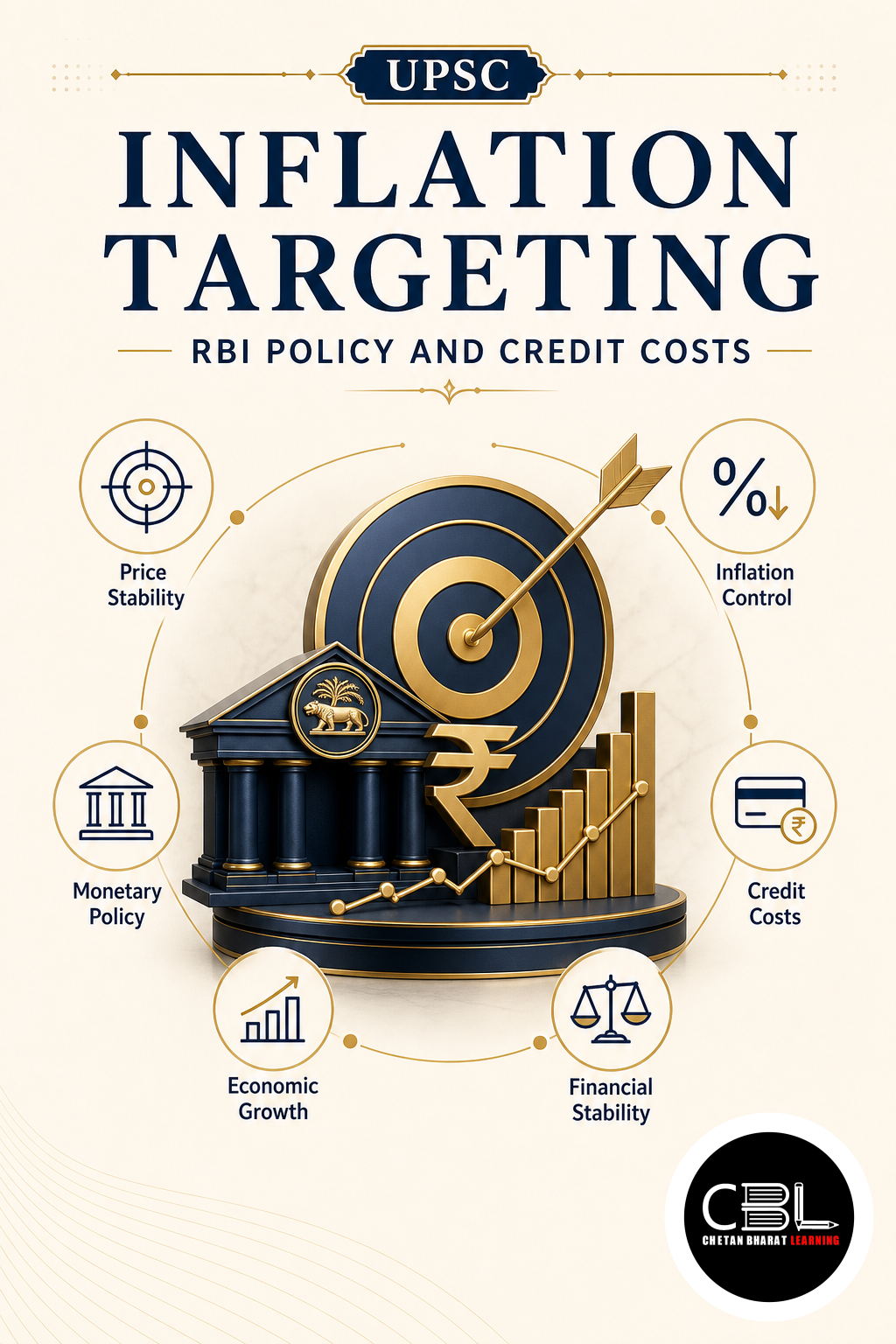
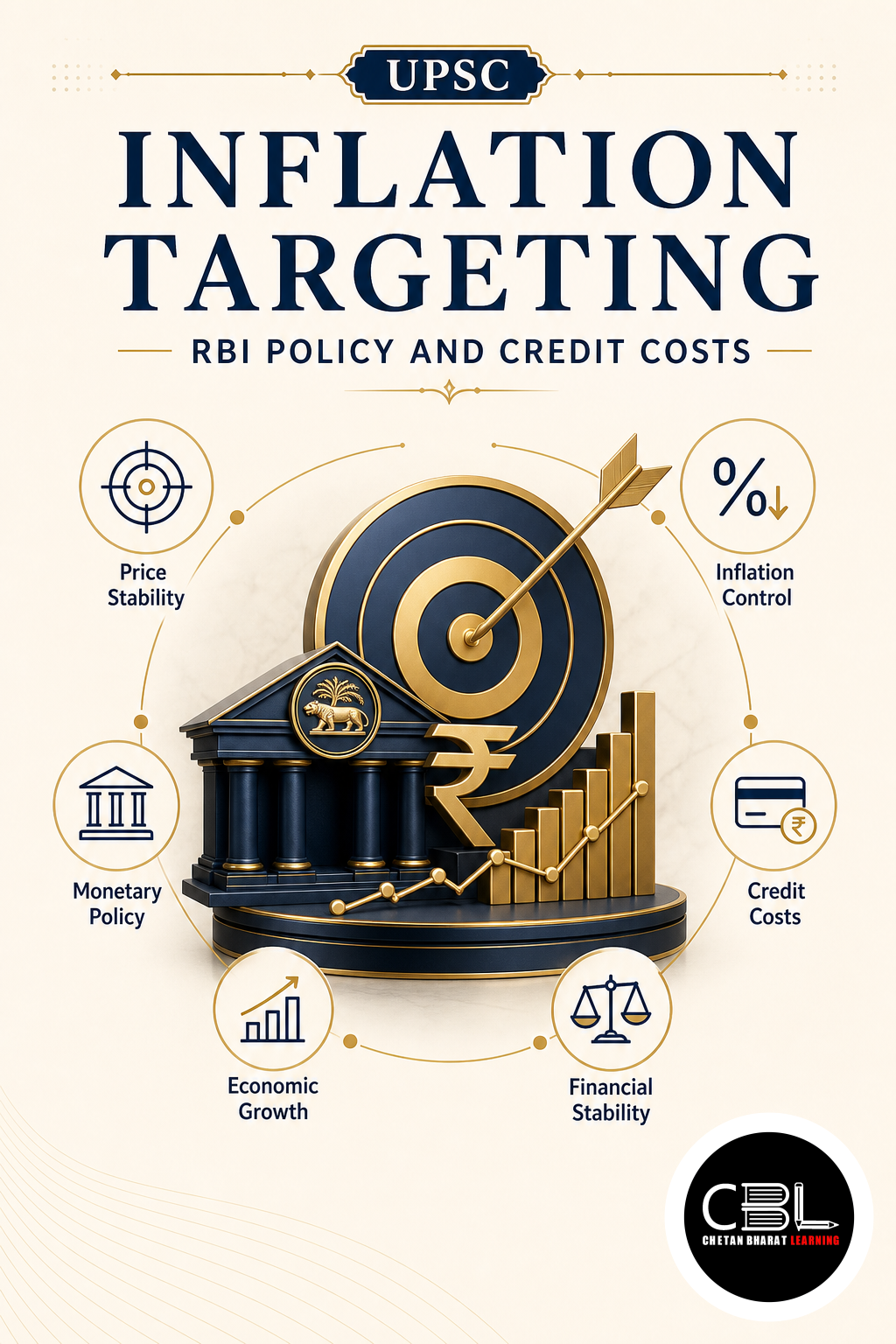
Inflation Targeting is the monetary-policy framework under which the Reserve Bank of India aims to keep consumer price inflation around a specified target while maintaining broader macroeconomic stability. The passage highlights an inflation target of 4% with a tolerance band of 2%–6%.
The framework gives price stability a clear role in monetary-policy decisions. The RBI therefore monitors inflation indicators while assessing the broader economic environment, including growth conditions and the transmission of policy decisions to households and businesses.
The uploaded material distinguishes between headline CPI and core inflation. Headline CPI captures the overall consumer basket, while core inflation excludes food and fuel to help assess underlying price pressures.
Why is Inflation Targeting in News?
According to the passage, headline inflation has moderated, leading to debate over whether the RBI’s more dovish policy stance is appropriate. A dovish stance generally gives greater weight to supporting economic activity through easier financial conditions, whereas a hawkish stance places stronger emphasis on containing inflationary pressures.
Headline moderation does not necessarily mean that inflationary pressure has disappeared. It points to the breadth of price increases across the Consumer Price Index basket and the importance of examining underlying inflation conditions.
The article also raises a second question: whether reductions in the repo rate automatically translate into cheaper borrowing. Its answer is that lending rates depend on several factors, including borrower risk, information asymmetry and costs within the banking and credit system.
This makes the issue important for UPSC because monetary policy has effects beyond the policy rate itself. The effectiveness of a rate cut depends partly on how efficiently financial institutions transmit changes in the policy environment to borrowers.
Key Features
- Dovish and hawkish stances: A dovish approach gives greater emphasis to growth-supportive financial conditions, while a hawkish approach prioritises stronger control of inflationary pressures.
- Headline and core inflation: Policymakers examine both overall consumer inflation and underlying price trends when assessing price stability.
- Repo rate: The policy rate influences borrowing conditions, but it does not mechanically determine every lending rate in the economy.
- Inflation breadth: Price pressure affecting a wider range of CPI components may indicate that inflation is not confined to a few volatile items.
- Credit-market frictions: Information asymmetry and uncertainty about borrowers can influence lending decisions and the cost of credit.
The distinction between headline and core inflation is particularly useful for Prelims revision. Headline inflation reflects the full consumer basket, while the core measure discussed in the passage removes food and fuel to focus more closely on persistent underlying movements.
The repo rate should similarly be understood as one part of the monetary-transmission mechanism. A policy-rate change can influence the broader cost of funds, but banks and other lenders also consider credit risk, operating costs and information available about borrowers.
Challenges
- Persistent core inflation: Underlying price pressures may remain significant even when headline inflation moderates.
- Broad-based price pressures: Inflation affecting many CPI components can make the task of maintaining price stability more complex.
- Transmission gap: Changes in the repo rate may not immediately or fully appear in borrowing rates faced by households and firms.
- Information asymmetry: Lenders may lack complete information about borrowers, increasing uncertainty and influencing credit pricing.
- Affordable credit: Sustained reductions in borrowing costs require efficient financial institutions and better credit infrastructure in addition to suitable monetary policy.
The challenge is therefore not simply whether the central bank should lower or raise the policy rate. It is also whether the financial system can transmit the intended signal efficiently while maintaining credit quality and financial stability.
For UPSC Mains, the topic can be linked with monetary-policy transmission, financial inclusion, banking-sector efficiency and macroeconomic stability. Aspirants can revise these themes through the CBL current affairs archive.
Another challenge arises from the different time horizons of monetary policy and inflation. Policy decisions influence economic conditions with lags, while some price movements can change quickly. This makes careful assessment of both current inflation and expected future conditions important.
Way Forward
Improving credit access requires more than reductions in the policy rate. It emphasises better credit information systems, stronger financial infrastructure and reduced information asymmetry so that lenders can assess borrowers more effectively.
Efficient credit markets can strengthen monetary-policy transmission by reducing uncertainty between lenders and borrowers. At the same time, monetary policy must continue to balance price stability with broader macroeconomic conditions rather than relying on a single inflation indicator.
For India, the policy framework should therefore be supported by improvements in financial infrastructure, responsible lending practices and wider access to reliable credit information. Such measures can make monetary-policy signals more effective without treating the repo rate as the sole determinant of borrowing costs.
Prelims Practice Corner
Practice Questions
-
What is the RBI’s inflation target mentioned in the uploaded material?
- (a) 2% (b) 3% (c) 4% (d) 6%
Answer: (c) 4% — the material specifies a 4% target with a 2%–6% tolerance band.
-
Core inflation, as described in the uploaded material, excludes:
- (a) Housing and transport (b) Food and fuel (c) Clothing and housing (d) Education and health
Answer: (b) Food and fuel — the measure is used to examine underlying price trends.
-
Which policy rate is discussed in the passage?
- (a) Bank Rate (b) Repo Rate (c) Reverse Repo Rate (d) Marginal Standing Facility Rate
Answer: (b) Repo Rate — the passage discusses its relationship with borrowing costs.
-
Which statement best reflects the passage’s discussion of monetary transmission?
- (a) Repo-rate cuts automatically reduce every lending rate (b) Lending rates depend only on inflation (c) Lending rates are influenced by several factors beyond the repo rate (d) Banks do not consider borrower risk
Answer: (c) Lending rates are influenced by several factors beyond the repo rate — the passage highlights borrower risk, information asymmetry and banking-sector costs.
-
Information asymmetry in credit markets primarily affects:
- (a) Monsoon rainfall (b) Lending decisions and credit pricing (c) Currency denomination (d) Fiscal deficit accounting
Answer: (b) Lending decisions and credit pricing — uncertainty about borrower quality can influence the terms of credit.
Mains Practice Questions
-
Explain the significance of inflation targeting in maintaining macroeconomic stability in India. (10 Marks)
Answer Structure:
- Intro: Define inflation targeting and identify price stability as its central objective.
- Body: Cover the RBI framework, 4% target, tolerance band, headline versus core inflation, monetary-policy transmission and the growth-inflation balance.
- Conclusion: A credible framework can support price stability while allowing monetary policy to respond to changing macroeconomic conditions.
-
Discuss why reducing policy rates alone may not significantly lower borrowing costs in the economy. (15 Marks)
Answer Structure:
- Intro: Explain that monetary-policy transmission links the central bank’s policy rate with market and lending rates.
- Body: Discuss information asymmetry, borrower risk, banking-sector costs, credit-market frictions and the need for stronger financial infrastructure.
- Conclusion: Effective transmission requires both appropriate monetary policy and efficient financial markets.
FAQs on Inflation Targeting
What is inflation targeting?
According to the passage, it is the framework through which the RBI seeks to keep consumer price inflation around a specified target while supporting macroeconomic stability. The material identifies a 4% target with a 2%–6% tolerance band.
What is the difference between headline and core inflation?
Headline CPI covers the overall consumer basket. The uploaded material describes core inflation as a measure that excludes food and fuel to assess underlying price pressures.
What is a dovish monetary-policy stance?
A dovish stance generally places greater emphasis on supporting economic activity through easier financial conditions. The passage discusses this stance in the context of moderating headline inflation.
Does a repo-rate cut automatically reduce lending rates?
No. Lending rates also depend on borrower risk, information asymmetry and banking-sector costs, so transmission may not be immediate or complete.
Why is core inflation important?
Core inflation can help policymakers assess underlying price trends by excluding food and fuel from the measure discussed in the passage. It can therefore provide a different perspective from headline inflation.
What is monetary-policy transmission?
It refers to the process through which changes in the central bank’s policy stance influence financial conditions, borrowing costs and economic activity. The passage focuses on why this process may be affected by credit-market frictions.
How does information asymmetry affect credit?
Information asymmetry arises when lenders and borrowers do not possess the same information about credit risk. This uncertainty can influence lending decisions and borrowing costs.
Why is this topic important for UPSC?
It connects inflation, RBI monetary policy, the repo rate, credit markets and macroeconomic stability. These themes are central to GS Paper III and frequently support both conceptual Prelims and analytical Mains preparation.
Related Current Affairs
Preparing for UPSC, PCS or HCS?
Talk to a mentor at Chetan Bharat Learning, Chandigarh. Free guidance on choosing the right exam and building a study plan.
Chat on WhatsAppCall 97793 53345UPSC / IAS / PCS coaching in Chandigarh · Trusted by aspirants across Punjab & Haryana
Leave a Reply
You must be logged in to post a comment.