

UPSC Mapping
| Prelims | Mains |
|---|---|
| SBM-G, ODF Plus and GOBARdhan | GS Papers II & III: Health and Environment |
What is Rural Sanitation?
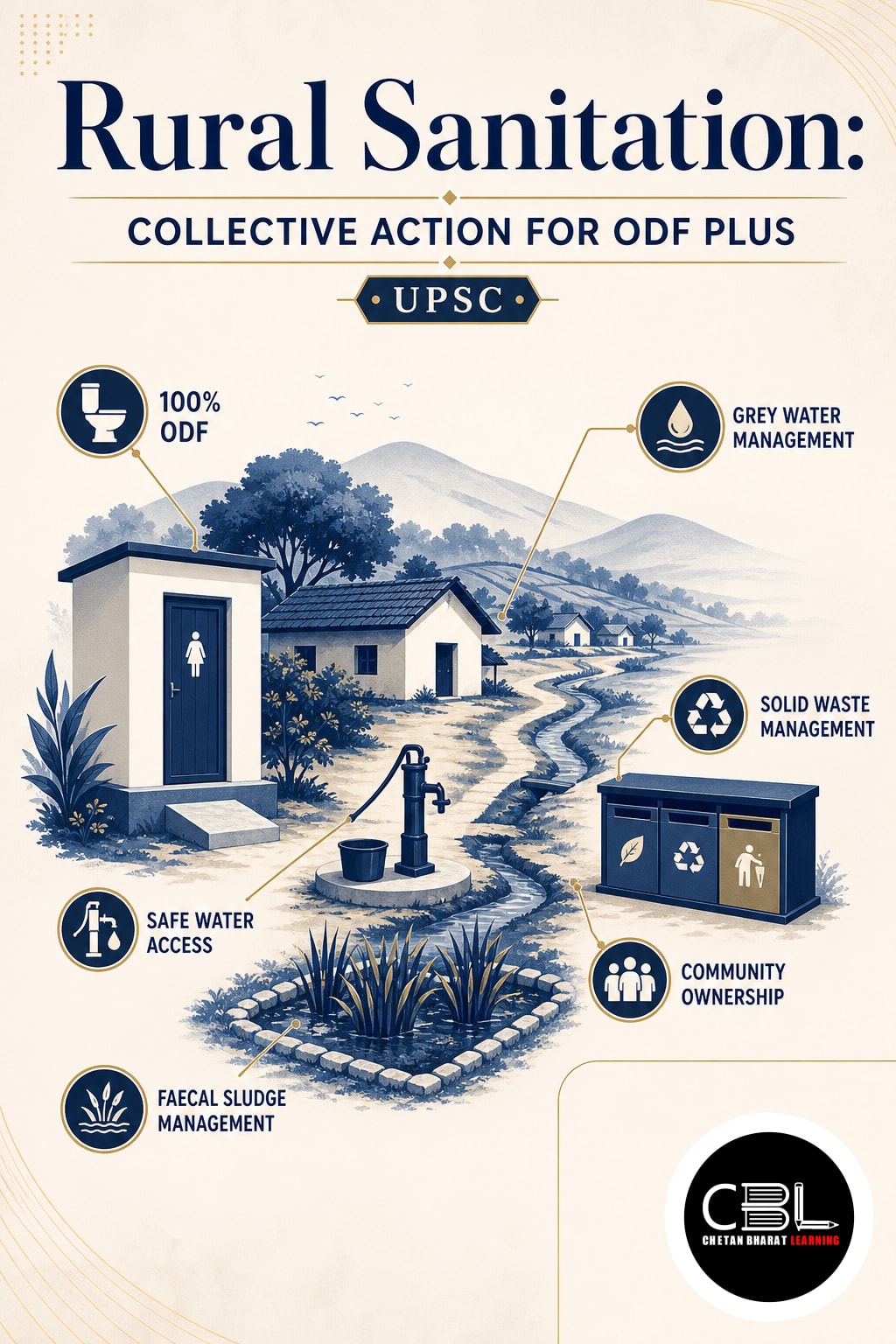
Rural Sanitation covers the services, facilities and daily practices that safely separate people from human waste and maintain clean settlements. It includes toilet access and use, safe containment, collection, treatment and disposal, alongside solid and liquid waste management. Effective systems also address handwashing, menstrual hygiene, greywater, biodegradable waste, plastics, animal waste and the cleanliness of shared village spaces.
Swachh Bharat Mission-Grameen Phase I prioritised toilet construction, usage and the elimination of open defecation. Phase II pursues Sampoorn Swachhata by sustaining ODF behaviour and converting villages into ODF Plus settlements with waste-management arrangements and visual cleanliness. The shift recognises that infrastructure delivers lasting health and dignity only when households, panchayats and frontline workers continuously operate, finance and monitor it.
Why is Rural Sanitation in News?
A September 2026 government review highlighted the transition from constructing toilets to building durable habits and community-managed waste systems. As of 17 September 2026, the government reported 5.69 lakh ODF Plus villages, including 5.25 lakh ODF Plus Model villages. It also reported solid-waste arrangements in 5.38 lakh villages and liquid-waste systems in 5.65 lakh villages, reflecting the wider scope of Phase II.
The review connected progress with women’s groups, schools, village committees, local leadership and Swachhagrahis rather than infrastructure alone. It recorded 1,314 operational GOBARdhan plants across 582 districts and explained how communities convert organic waste into useful resources. The official PIB rural cleanliness feature also placed collective action and behaviour change at the centre of sustained outcomes.
Key Features
- Progressive ODF Plus classification: Aspiring villages manage either solid or liquid waste, Rising villages manage both streams, and Model villages additionally demonstrate visual cleanliness and display ODF Plus messages.
- Behaviour Change Communication: Swachhagrahis, panchayat representatives and community organisations promote regular toilet use, safe disposal, source segregation, composting and the maintenance of common sanitation assets.
- Women-led participation: Self-Help Groups conduct awareness activities, organise waste collection, manage recovery facilities and connect sanitation services with local livelihoods and household-level decision-making.
- Waste-to-wealth approach: GOBARdhan converts cattle dung, crop residue and biodegradable waste into biogas, compressed biogas and nutrient-rich bio-slurry or organic manure.
- Decentralised village planning: Gram panchayats and Village Water and Sanitation Committees identify local gaps, mobilise residents, supervise assets and coordinate finance from converging public programmes.
Challenges
- Behavioural slippage: Seasonal migration, damaged toilets, water scarcity or weak follow-up can cause some households to return to unsafe disposal practices despite earlier gains.
- Operations and maintenance: Panchayats often need predictable user charges, trained personnel, repair systems and technical support to keep collection vehicles, drains and treatment assets functional.
- Greywater and plastic pressure: Dispersed habitations require context-specific soak pits, drainage or treatment solutions, while multilayered plastics often lack viable local processing markets.
- Worker safety and dignity: Sanitation workers need protective equipment, mechanised handling, fair remuneration, social security and strict safeguards against hazardous manual cleaning.
- Monitoring quality: Dashboard declarations must accompany independent verification, citizen feedback and outcome tracking because functional services matter more than merely counting constructed assets.
Water availability remains inseparable from sanitation because households cannot maintain toilets and handwashing without dependable supply. Poorly designed pits, overflowing drains and unmanaged faecal sludge can shift contamination from one location to another. The environment current affairs section helps connect these concerns with groundwater quality, waste rules and circular-economy policy.
Inclusion also demands attention to women, children, older persons, persons with disabilities and remote households. Facilities must remain accessible, private and safe throughout their operating life. Panchayats need disaggregated information and grievance systems to identify excluded families rather than assuming that village-level status guarantees universal access.
Financing remains another operational test because capital grants may create assets without securing their full maintenance costs. Panchayats need ring-fenced budgets for electricity, consumables, repairs, collection staff and periodic desludging, supported by realistic service standards and transparent local accounts. Where communities introduce user charges, authorities should protect poor households, explain the purpose of payments and publicly report whether the collected revenue keeps services functional.
Way Forward
India should treat sanitation as a continuous public service with clear roles for households, gram panchayats, district administrations and technical agencies. Village plans should map waste flows, water availability, vulnerable households, climate risks and maintenance costs before selecting technologies suited to settlement density and local soil conditions; functionality audits, public dashboards, water-quality checks and social audits can then measure usage, cleanliness, equity and environmental outcomes. Schools, Anganwadi centres, Self-Help Groups and youth clubs should reinforce daily behaviour through repeated local engagement, practical demonstrations, child-led campaigns and rapid follow-up when monitoring reveals slippage rather than relying on occasional messaging.
Rural Sanitation can become financially durable when communities connect compost, recyclable materials, biogas and safely treated wastewater with viable local demand, while service fees and public grants cover essential operations that resource sales cannot finance, especially in small or geographically dispersed villages where collection routes and treatment facilities carry higher per-household costs. The government should expand district-level technical support for panchayats, ensure worker protection, standardise safe desludging and converge Finance Commission grants with relevant rural-development, water and livelihood funds, using performance grants to reward verified functionality without disadvantaging poorer or remote settlements. The official SBM-Grameen programme portal provides the institutional framework, while Jan Bhagidari converts that framework into lasting village ownership through participatory planning, shared monitoring and locally accountable service delivery and long-term environmental protection for surrounding land and water.
Prelims Practice Corner
-
Which statement best describes an ODF Plus Model village?
- (a) It has toilets in every school only
- (b) It manages one waste stream only
- (c) It manages both waste streams and demonstrates visual cleanliness
- (d) It processes only plastic waste
Answer: (c) A Model village manages solid and liquid waste, demonstrates visual cleanliness and displays ODF Plus messaging.
-
GOBARdhan primarily promotes the conversion of organic waste into:
- (a) Biogas and organic manure
- (b) Cement and glass
- (c) Synthetic fibres
- (d) Nuclear fuel
Answer: (a) It converts dung and other biodegradable material into biogas, compressed biogas and bio-slurry or manure.
-
Under the ODF Plus classification, a Rising village:
- (a) Manages neither waste stream
- (b) Manages either solid or liquid waste
- (c) Manages both solid and liquid waste
- (d) Requires only visual-cleanliness certification
Answer: (c) A Rising village has arrangements for managing both solid waste and liquid waste.
-
Swachh Bharat Mission-Grameen is administered by which Union ministry?
- (a) Ministry of Rural Development
- (b) Ministry of Jal Shakti
- (c) Ministry of Environment, Forest and Climate Change
- (d) Ministry of Panchayati Raj
Answer: (b) The Department of Drinking Water and Sanitation under the Ministry of Jal Shakti implements SBM-G.
-
Which institution supports community-level village sanitation planning and supervision?
- (a) Monetary Policy Committee
- (b) Village Water and Sanitation Committee
- (c) Finance Commission Secretariat
- (d) National Green Tribunal registry
Answer: (b) Village Water and Sanitation Committees support planning, mobilisation, implementation and local supervision.
Mains Practice Questions
-
Q1. Infrastructure alone cannot sustain sanitation outcomes without collective action and behavioural change. Discuss. (250 words, 15 marks)
Answer Structure:
- Intro: Frame sanitation as both a public service and a repeated social practice.
- Body: Examine toilet usage, SHGs, schools, panchayats, Swachhagrahis, waste systems, financing and monitoring.
- Conclusion: Emphasise institutionalised community ownership supported by functional infrastructure.
-
Q2. Evaluate the role of ODF Plus and GOBARdhan in advancing a circular rural economy. (150 words, 10 marks)
Answer Structure:
- Intro: Link sanitation with resource recovery and environmental health.
- Body: Cover waste segregation, biogas, manure, greywater reuse, livelihoods, local capacity and market constraints.
- Conclusion: Support decentralised systems that remain safe, inclusive and financially viable.
FAQs on Rural Sanitation
What is the difference between ODF and ODF Plus?
ODF status focuses on eliminating open defecation through toilet access and sustained usage. ODF Plus adds solid and liquid waste management, continued ODF behaviour and progressively stronger visual cleanliness standards.
Why is behaviour change essential after toilet construction?
Households must consistently use, clean and maintain toilets for infrastructure to deliver health benefits. Community norms and local follow-up also prevent behavioural slippage and unsafe waste disposal.
How do Self-Help Groups support village cleanliness?
Self-Help Groups spread awareness, organise collection and segregation, and sometimes operate recovery facilities. Their local networks can connect household practices with accountable community services and livelihoods.
Related Current Affairs
Preparing for UPSC, PCS or HCS?
Talk to a mentor at Chetan Bharat Learning, Chandigarh. Free guidance on choosing the right exam and building a study plan.
Chat on WhatsAppCall 97793 53345UPSC / IAS / PCS coaching in Chandigarh · Trusted by aspirants across Punjab & Haryana
Leave a Reply
You must be logged in to post a comment.