
UPSC Mapping
Prelims
- REER, Exchange Rate, RBI, Forex Reserves
Mains
- GS Paper III – Indian Economy, External Sector & Monetary Policy
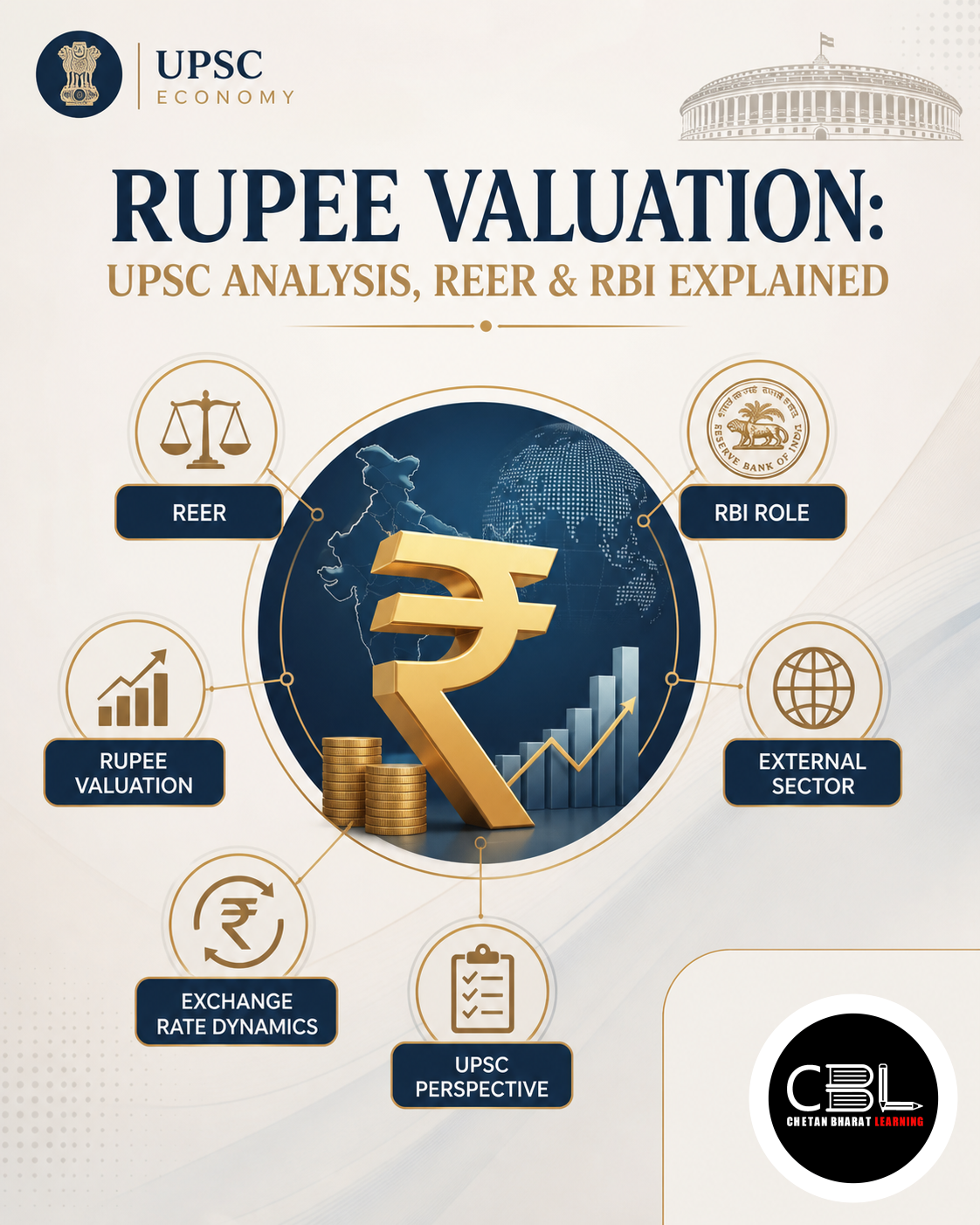
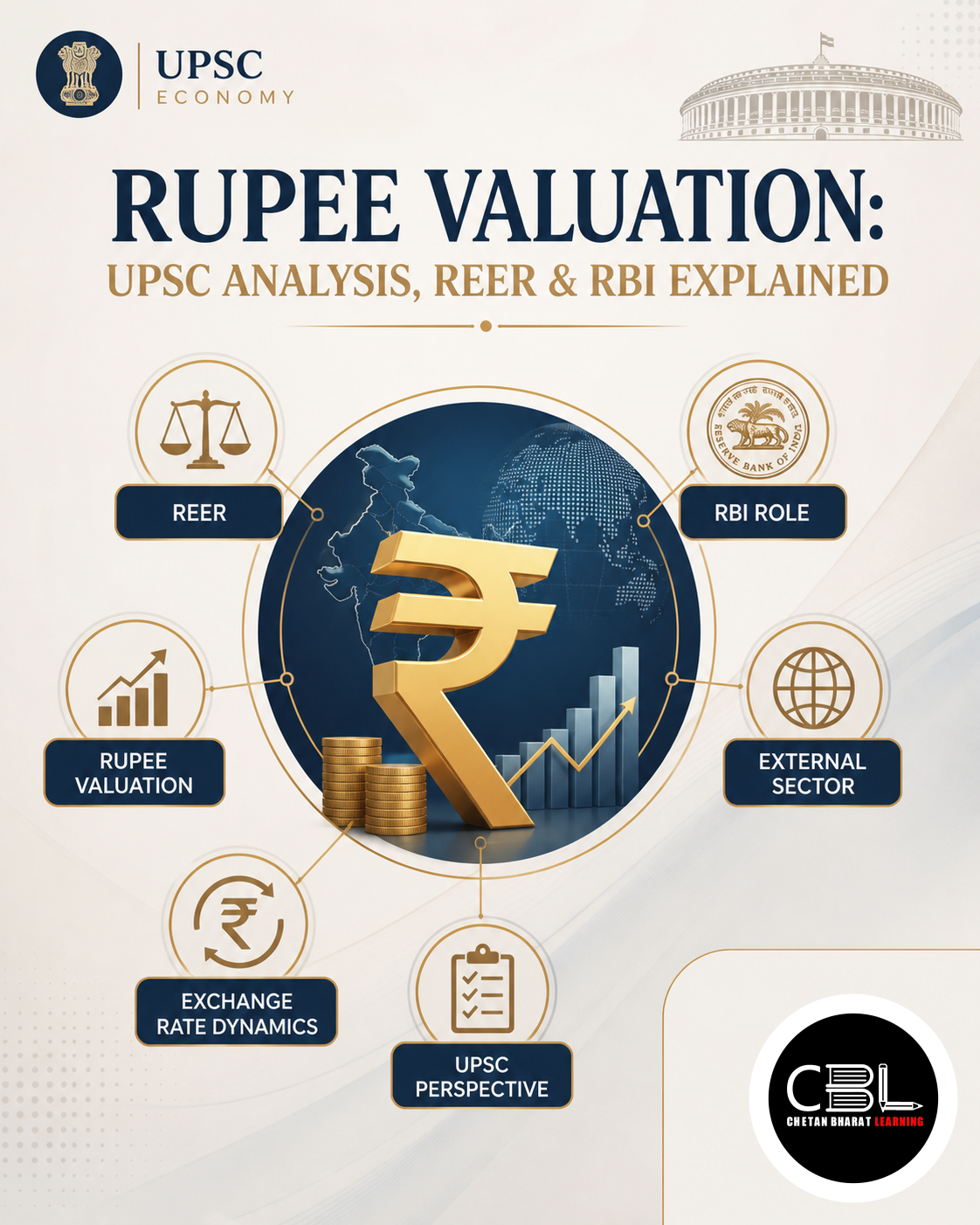
Rupee Valuation has come into focus after the Reserve Bank of India (RBI) Governor observed that the Indian rupee is undervalued rather than overvalued in both nominal and Real Effective Exchange Rate (REER) terms. The statement highlights India’s macroeconomic resilience while clarifying that recent exchange rate movements largely reflect global factors rather than domestic weaknesses. For more economy updates, visit the daily current affairs archive.
| Indicator | Real Effective Exchange Rate (REER) |
|---|---|
| Base Value | 100 |
| Institution | Reserve Bank of India |
What is Rupee Valuation?
Rupee Valuation refers to the assessment of the Indian Rupee’s exchange value relative to foreign currencies based on economic fundamentals such as inflation, productivity, trade competitiveness and external sector performance. It helps determine whether the rupee is fairly valued, undervalued or overvalued.
Economists commonly evaluate the rupee using the Nominal Exchange Rate and the Real Effective Exchange Rate (REER). While the nominal exchange rate reflects the market price of the rupee against another currency, the REER measures the rupee against a basket of trading partner currencies after adjusting for inflation.
Why is Rupee Valuation in News?
The RBI Governor recently stated that the Indian rupee is undervalued in both nominal and REER terms. The observation indicates that the rupee’s recent weakness largely reflects global developments rather than deterioration in India’s macroeconomic fundamentals.
The statement also reassures markets that the RBI continues to focus on limiting excessive exchange-rate volatility rather than maintaining a fixed exchange rate. Official information is available through the Reserve Bank of India.
Key Features of Rupee Valuation
- Nominal Exchange Rate: Represents the market exchange rate between the rupee and another currency such as the US dollar.
- Real Effective Exchange Rate (REER): Measures the inflation-adjusted value of the rupee against a basket of major trading partner currencies. A value above 100 generally indicates overvaluation, while a value below 100 suggests undervaluation.
- Macroeconomic fundamentals: GDP growth, inflation, fiscal stability and foreign exchange reserves influence investor confidence in the rupee.
- External sector factors: Crude oil imports, current account balance and capital flows significantly affect demand and supply of foreign exchange.
- Global financial conditions: US Federal Reserve policy, the US Dollar Index (DXY) and global risk sentiment influence capital flows into emerging markets.
Challenges
- Oil price volatility: India’s dependence on imported crude oil increases pressure on the rupee during global price spikes.
- Capital flow volatility: Sudden foreign portfolio investment outflows may weaken the domestic currency.
- Global monetary tightening: Higher interest rates in advanced economies attract capital away from emerging markets.
- Inflation differentials: Persistent inflation differences affect the REER and external competitiveness.
- Geopolitical uncertainty: Global conflicts and financial market instability can trigger exchange-rate volatility.
Way Forward
Maintaining strong macroeconomic fundamentals through prudent fiscal policy, inflation control and adequate foreign exchange reserves will support long-term currency stability. Structural reforms that enhance exports and improve productivity can also strengthen the rupee’s external competitiveness.
The RBI’s flexible exchange-rate management framework, combined with timely interventions to curb excessive volatility, remains essential for maintaining confidence in India’s external sector. Additional information is available on the Ministry of Finance.
Prelims Practice Corner
- Q1. The Real Effective Exchange Rate (REER) measures:
(a) Gold prices
(b) Inflation-adjusted value of a currency against a basket of currencies
(c) Fiscal deficit
(d) Stock market index
Answer: (b) REER adjusts the exchange rate for inflation against a basket of trading partner currencies. - Q2. A REER value below 100 generally indicates:
(a) Overvaluation
(b) Undervaluation
(c) Hyperinflation
(d) Currency peg
Answer: (b) A value below 100 generally indicates an undervalued currency. - Q3. Which institution manages India’s foreign exchange reserves?
(a) SEBI
(b) RBI
(c) NABARD
(d) SIDBI
Answer: (b) The Reserve Bank of India manages India’s foreign exchange reserves. - Q4. A sharp rise in global crude oil prices is most likely to:
(a) Strengthen the rupee immediately
(b) Increase demand for US dollars and put pressure on the rupee
(c) Reduce imports
(d) Increase REER automatically
Answer: (b) Higher oil imports increase dollar demand, exerting depreciation pressure on the rupee. - Q5. Which factor significantly influences capital flows into emerging markets?
(a) Monsoon rainfall
(b) US Federal Reserve interest rate policy
(c) Census operations
(d) MPLADS expenditure
Answer: (b) US monetary policy strongly influences global capital flows.
Mains Practice Questions
- Q1. Explain the concept of Real Effective Exchange Rate (REER). How does it help assess the valuation of the Indian rupee? (10 marks)
Answer Structure: Intro: Define REER; Body: Explain calculation, significance, factors affecting REER and policy relevance; Conclusion: Highlight its role in external sector assessment. - Q2. Discuss the major domestic and global factors influencing the valuation of the Indian rupee. (15 marks)
Answer Structure: Intro: Explain exchange-rate determination; Body: Cover macroeconomic fundamentals, capital flows, oil prices, monetary policy and RBI’s role; Conclusion: Emphasise balanced exchange-rate management.
FAQs on Rupee Valuation
- What is Rupee Valuation? It refers to assessing whether the Indian rupee’s exchange rate reflects the country’s economic fundamentals and external competitiveness.
- What is the difference between the nominal exchange rate and REER? The nominal exchange rate measures the rupee against a single currency, while REER measures its inflation-adjusted value against a basket of trading partner currencies.
- Why is Rupee Valuation important for UPSC? The topic is relevant for GS Paper III because it covers exchange-rate management, external sector stability, monetary policy and macroeconomic fundamentals.
Related Current Affairs
Preparing for UPSC, PCS or HCS?
Talk to a mentor at Chetan Bharat Learning, Chandigarh. Free guidance on choosing the right exam and building a study plan.
Chat on WhatsAppCall 97793 53345UPSC / IAS / PCS coaching in Chandigarh · Trusted by aspirants across Punjab & Haryana
Leave a Reply
You must be logged in to post a comment.