
Important for:
UPSC, Haryana HCS, Punjab PCS
Prelims: Urban segregation, health indicators
Mains: GS Paper 1, 2 & 3 — Society, Health, Urbanisation
Why in News?
A recent analysis highlights how residential segregation in Indian cities leads to unequal access to healthcare, disproportionately affecting marginalised communities.
What is Residential Segregation?
→ Separation of communities based on:
- Caste
- Religion
- Economic status
Key Findings
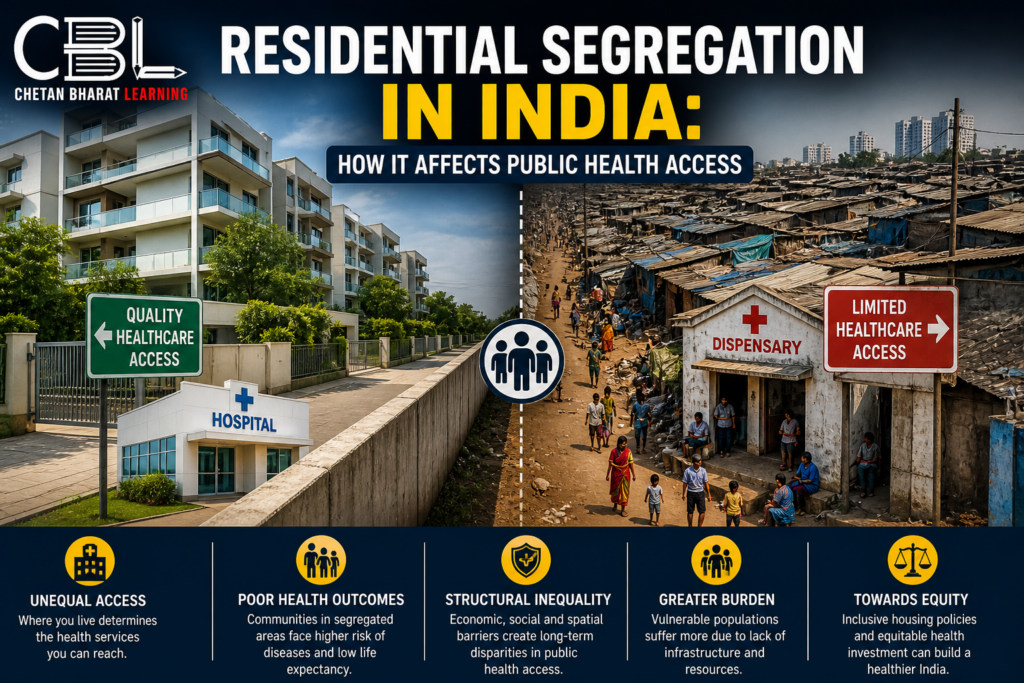
1. Unequal Access to Healthcare
- Fewer:
- Hospitals
- Clinics
- Medical staff
2. Poor Basic Infrastructure
- Lack of:
- Clean water
- Sanitation
- Electricity
3. Higher Disease Burden
- Increased:
- Infection rates
- Chronic diseases
Impact on Public Health
→ Results in:
- Delayed treatment
- Higher mortality
- Poor health outcomes
Structural Issues
1. Social Exclusion
- Discrimination limits access
2. Urban Planning Gaps
- Uneven development
3. Economic Inequality
- Poor communities lack resources
Why This Matters
- Health inequality:
→ A major development challenge - Affects:
- Productivity
- Human capital
India-Specific Significance
- Rapid urbanisation:
→ Increases segregation - Need for:
→ Inclusive urban planning
Key Insight for UPSC
➤ Health is not just a medical issue
✔ It is:
- Social
- Economic
- Spatial
Ethics Dimension (GS4)
➤ Key values:
- Equality
- Justice
- Inclusion
- Dignity
PRELIMS PRACTICE QUESTIONS
Q1. Residential segregation refers to:
A. Industrial growth
B. Separation of communities
C. Trade policy
D. Agriculture
✅ Answer: B
Q2. Health inequality is linked to:
A. Only hospitals
B. Social and economic factors
C. Only climate
D. Only industry
✅ Answer: B
Q3. Urbanisation leads to:
A. Equality
B. Segregation challenges
C. No change
D. Only growth
✅ Answer: B
Q4. Poor sanitation causes:
A. Better health
B. Disease spread
C. Trade growth
D. Tourism
✅ Answer: B
Q5. Which GS paper covers society?
A. GS1
B. GS2
C. GS3
D. GS4
✅ Answer: A
CBL Mains Practice Question
“Residential segregation is a key determinant of health inequality in urban India.”
Discuss.
FAQs
1. What is residential segregation?
Separation of communities based on social or economic factors.
2. How does it affect health?
Limits access to healthcare and infrastructure.
3. Who is most affected?
Marginalised communities.
4. Why is it important?
It leads to health inequality.
5. Which GS papers cover this?
GS1, GS2, GS3.
Related Current Affairs
Preparing for UPSC, PCS or HCS?
Talk to a mentor at Chetan Bharat Learning, Chandigarh. Free guidance on choosing the right exam and building a study plan.
Chat on WhatsAppCall 97793 53345UPSC / IAS / PCS coaching in Chandigarh · Trusted by aspirants across Punjab & Haryana
Leave a Reply
You must be logged in to post a comment.