

UPSC Syllabus Mapping
| GS Paper | GS-I, GS-II & GS-III |
|---|---|
| Subject | Geography, Infrastructure and International Relations — Hydropower, Chenab River and Indus Waters Treaty |
What is Ratle Hydroelectric Project?
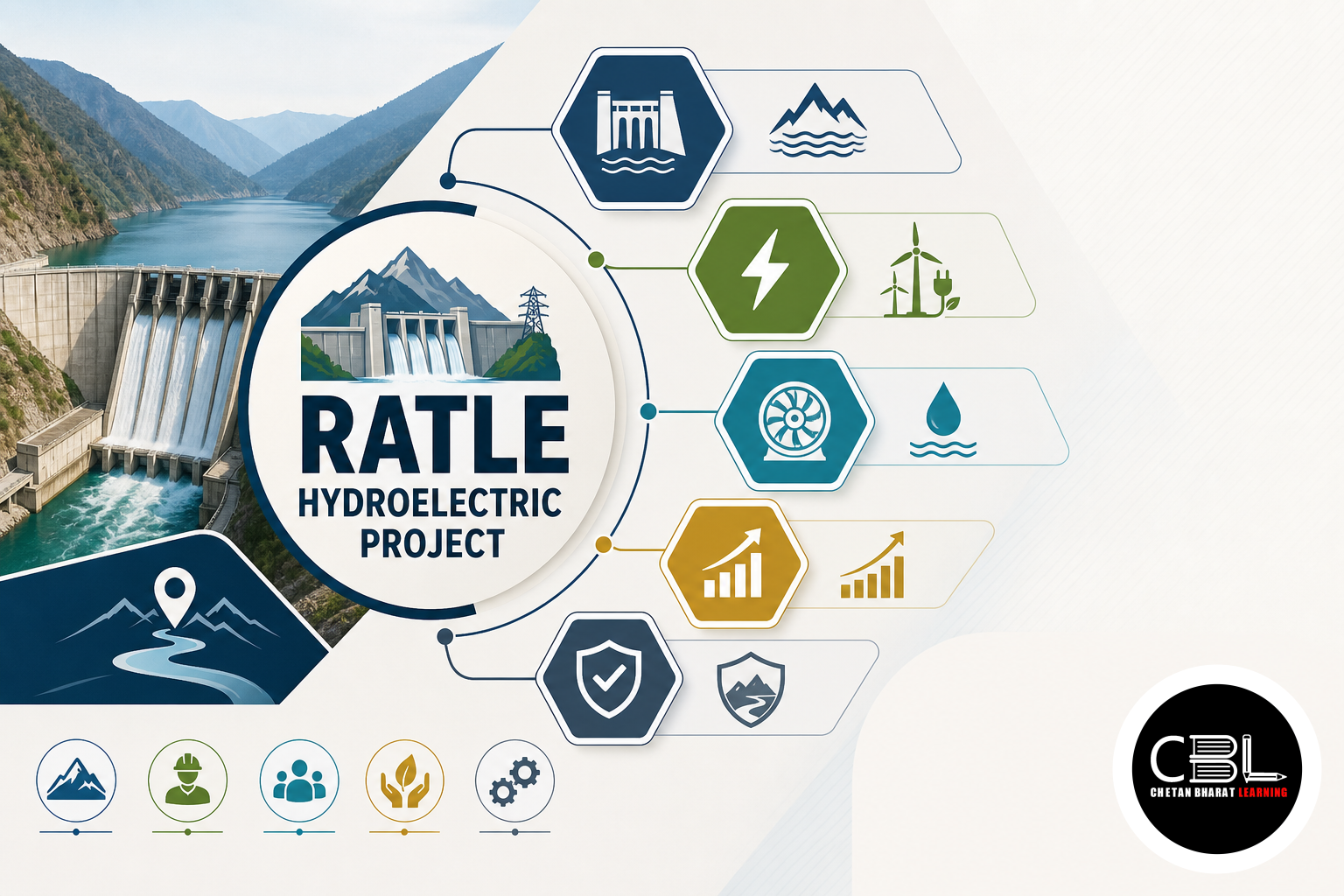
The project is being constructed on the Chenab River in the Kishtwar region of Jammu and Kashmir, with a planned installed capacity of 850 MW. It is classified as a run-of-river hydroelectric scheme, utilising natural river flow and elevation difference to generate electricity through dams, diversion structures, tunnels and limited pondage.
Located downstream of the Dulhasti hydropower station and upstream of Baglihar on the Chenab, Ratle offers map-based question relevance. It is implemented by Ratle Hydroelectric Power Corporation Limited, a joint venture of NHPC (51%) and JKSPDC (49%).
Why is Ratle Hydroelectric Project in News?
Recent heavy rainfall in Jammu and Kashmir caused the Chenab River to rise sharply, damaging a temporary cofferdam at the Ratle construction site. A cofferdam is a temporary barrier to keep water away from a construction area, distinct from the permanent dam of the project.
The incident highlights hydrological monitoring and safety challenges in Himalayan river construction. Official updates are available from NHPC Limited.
Key Features of Ratle Hydroelectric Project
| Installed capacity | 850 MW |
|---|---|
| River | Chenab (Indus basin) |
| Location | Kishtwar district, Jammu and Kashmir |
| Project type | Run-of-river hydroelectric |
| Dam | Concrete gravity dam, 133 metres high |
| Powerhouse | Underground on the right bank |
| Turbines | Four 205 MW Francis units and a 30 MW auxiliary unit |
| Implementation | Joint venture of NHPC (51%) and JKSPDC (49%) |
Francis turbines are reaction turbines suited to medium head and substantial flow, transferring energy from water through guide vanes and runner to the tailrace.
Challenges Related to Himalayan Hydropower
Steep slopes, landslides, erosion, high sediment loads and extreme rainfall complicate construction. Climate change affects precipitation and snowmelt patterns, requiring robust hydrological assessment, disaster preparedness and dam safety throughout the project lifecycle.
Run-of-river schemes impact aquatic habitats and sediment movement. Environmental-flow requirements, catchment management and planned disposal of excavated material are essential in fragile mountain landscapes.
The Chenab is governed by the Indus Waters Treaty (1960), allocating western rivers (Indus, Jhelum, Chenab) primarily to Pakistan, with India retaining hydroelectric rights subject to treaty provisions. Design disputes have arisen, with the World Bank serving as a dispute-resolution forum.
Way Forward for Sustainable Hydropower
Hydropower planning must incorporate climate and hydrological risks, real-time monitoring, improved flood forecasting, resilient temporary works and comprehensive dam-safety measures. Basin-based environmental management, catchment-area treatment, biodiversity protection and community consultation improve sustainability. Benefit-sharing and local infrastructure development address social costs.
Transboundary river management requires clear technical communication and dispute-resolution mechanisms. India aims to harness hydropower potential responsibly while ensuring engineering safety, environmental sustainability and shared basin management.
Prelims Practice Corner
- Ratle hydropower station is being constructed on which river? (a) Ravi (b) Chenab (c) Sutlej (d) Beas. Answer: (b) Chenab.
- Consider the following statements about the Ratle project:
1. It is located in Kishtwar district.
2. It is a run-of-river project.
3. It has a planned installed capacity of 850 MW.
Select the correct answer: (a) 1 only (b) 1 and 2 only (c) 2 and 3 only (d) 1, 2 and 3. Answer: (d) 1, 2 and 3. - Which of the following are western rivers under the Indus Waters Treaty?
1. Indus
2. Jhelum
3. Chenab
4. Ravi
Select the correct answer: (a) 1 and 2 only (b) 1, 2 and 3 only (c) 2, 3 and 4 only (d) 1, 2, 3 and 4. Answer: (b) 1, 2 and 3. - A cofferdam is primarily: (a) A permanent structure for generating electricity (b) A temporary barrier used to exclude water from a construction area (c) A device for measuring river discharge (d) An underground turbine chamber. Answer: (b).
- Which statement about run-of-river hydropower is most appropriate? (a) It necessarily requires no dam or diversion structure (b) It cannot affect river ecology (c) It primarily utilises river flow and hydraulic head for electricity generation (d) It can operate only on glacial rivers. Answer: (c).
Mains Practice Questions
- Hydropower development in the Himalayas involves a difficult balance between renewable energy requirements and ecological vulnerability. Discuss. (10 marks)
Outline: Renewable and flexible electricity; Himalayan hydropower potential; fragile geology; extreme rainfall; sediment and landslides; river ecology; cumulative impacts; climate-resilient design; basin-level assessment.
- Hydroelectric projects on transboundary rivers can simultaneously become questions of energy security, international law and regional diplomacy. Examine with reference to the Indus basin. (15 marks)
Outline: Transboundary rivers; Indus Waters Treaty; eastern and western rivers; India’s permitted uses; hydropower design disputes; technical mechanisms; India-Pakistan relations; treaty-based dispute resolution; sustainable basin management.
FAQs on Ratle Hydroelectric Project
Where is the Ratle project located?
It is being constructed on the Chenab River in Kishtwar district of the Union Territory of Jammu and Kashmir.
What type of hydropower project is Ratle?
It is an 850 MW run-of-river hydroelectric project that uses the Chenab’s flow and hydraulic head to generate electricity.
Why is the project relevant to the Indus Waters Treaty?
The Chenab is one of the western rivers governed by the treaty. India has specified rights to develop hydroelectric power on western rivers subject to applicable treaty provisions, while design aspects of such projects have periodically generated India-Pakistan disputes.
Related Current Affairs
Preparing for UPSC, PCS or HCS?
Talk to a mentor at Chetan Bharat Learning, Chandigarh. Free guidance on choosing the right exam and building a study plan.
Chat on WhatsAppCall 97793 53345UPSC / IAS / PCS coaching in Chandigarh · Trusted by aspirants across Punjab & Haryana
Leave a Reply
You must be logged in to post a comment.