
UPSC Mapping
| Prelims | Polity & Governance |
|---|---|
| Mains | GS Paper 2 (Parliament & State Legislatures) |
| Lok Sabha Productivity | 15% |
|---|---|
| Rajya Sabha Productivity | 33% |
| Lowest Since | 2016 Winter Session |
Article
What is Parliamentary Productivity?
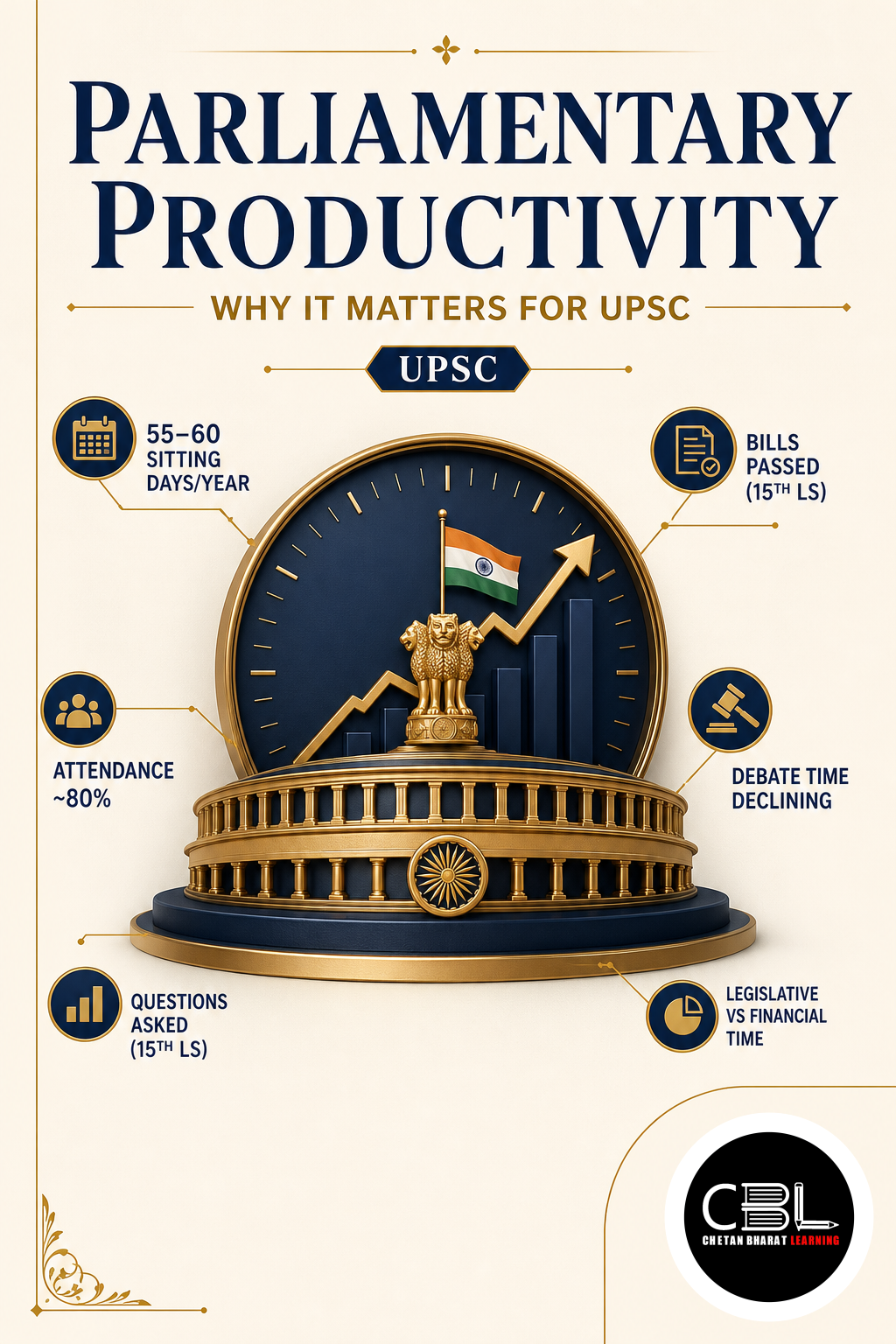
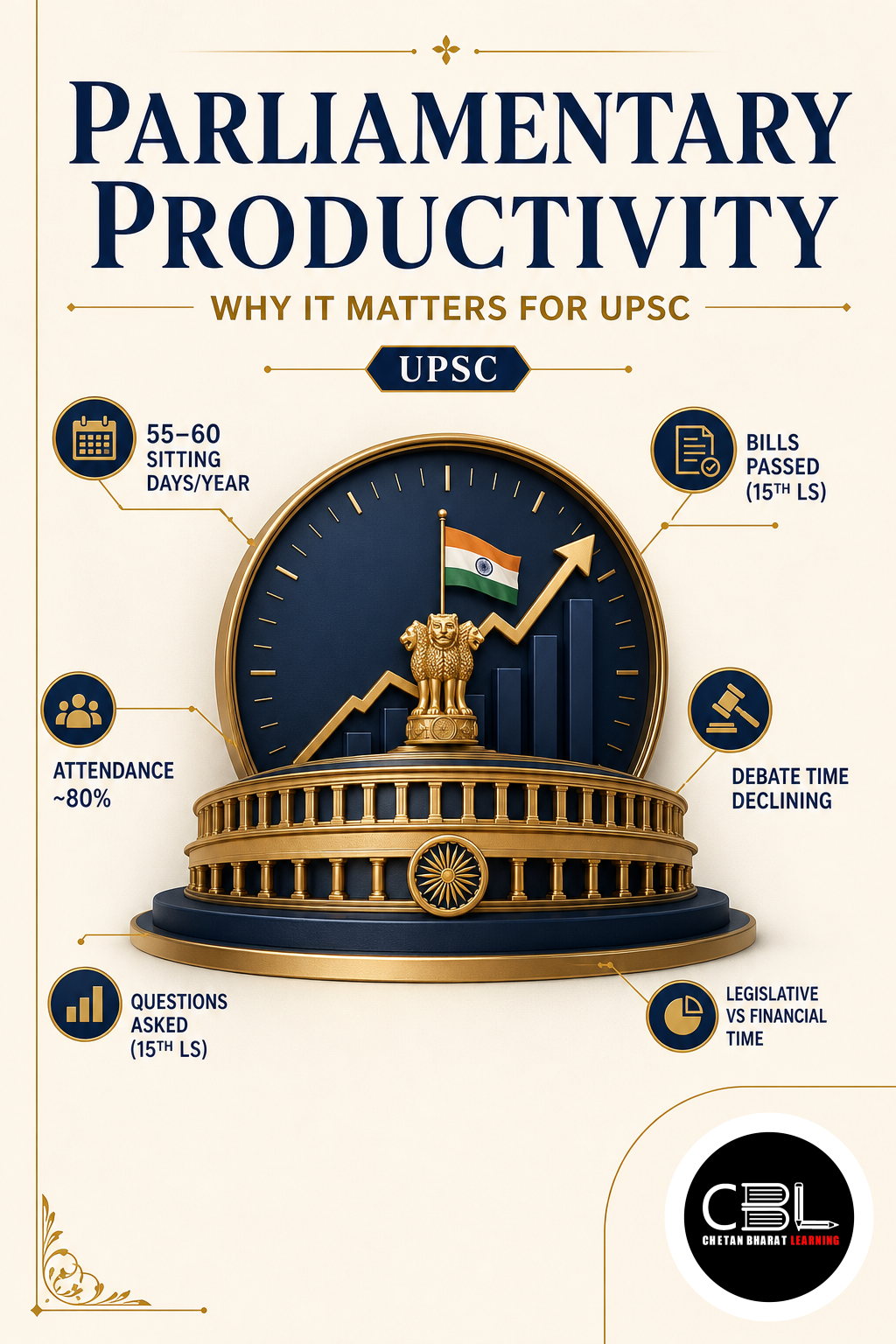
Parliamentary productivity broadly refers to the actual parliamentary work completed compared with the scheduled time available. For example, if Parliament is scheduled for 100 hours but conducts meaningful business for only 20 hours, productivity is 20%. It is a key indicator of the health of democratic institutions.
However, productivity does not simply mean the number of Bills passed. A Parliament may pass many Bills but still perform poorly if debate is inadequate, scrutiny is weak, committees are bypassed, Question Hour is disrupted, and executive accountability remains unfulfilled. Quantity of legislative output does not equal quality of parliamentary functioning.
Why is Parliamentary Productivity in News?
Parliamentary productivity is currently in the news because the Monsoon Session recorded the lowest productivity since 2016, with the Lok Sabha functioning for just 15% of its scheduled time. The Rajya Sabha fared slightly better at 33%, but both Houses suffered from persistent disruptions.
Historical data shows that this is not an isolated phenomenon. The 2010 Winter Session was a complete washout (5% Lok Sabha, 2% Rajya Sabha) over the 2G spectrum allocation controversy. The 2015 Monsoon Session saw the Lok Sabha at 46% and the Rajya Sabha at just 9% over the Lalit Modi and Vyapam controversies. For official data, refer to PIB releases.
Key Features of Parliamentary Productivity
- Measure of Time Utilisation: Calculates the percentage of scheduled time spent on legislative and deliberative business.
- Question Hour Importance: Disruption of Question Hour reduces executive accountability, as MPs cannot question ministers on policy implementation.
- Committee Scrutiny: Low productivity often correlates with reduced committee referrals, weakening detailed scrutiny of Bills.
- Legislative Output: High productivity does not guarantee quality—rushed legislation may have drafting problems and unintended consequences.
- Economic Cost: Disruption represents an opportunity cost—taxpayer-funded institutional capacity is under-utilised.
Challenges in Parliamentary Productivity
- Political Polarisation: Issues become high-stakes confrontations, leaving little room for constructive debate.
- Incentives for Visibility: Disruption often generates media attention, incentivising Opposition parties to disrupt proceedings.
- Weak Deadlock-Resolution Mechanisms: Limited institutional avenues for resolving major disagreements between Government and Opposition.
- Frequent Suspensions: Large-scale suspensions of MPs can deepen confrontation and boycott cycles.
- Trust Deficit: Each side often perceives the other as acting in bad faith, undermining cooperation.
Way Forward for Parliamentary Productivity
To improve parliamentary productivity, the Government and Opposition must adopt a cooperative approach. Greater consultation before major legislative business can reduce avoidable confrontation. Technology can enhance transparency by publishing data on attendance, questions, legislative participation, and committee work.
Rationalising disruption-related penalties—ensuring consequences for persistent obstruction without suppressing legitimate opposition—is essential. The goal should not simply be more hours, but more meaningful parliamentary work. A Parliament that sits for many hours is not automatically a good Parliament; what matters is the quality of debate, scrutiny, and accountability.
Prelims Practice Corner
Q1. What was the productivity of the Lok Sabha in the 2026 Monsoon Session?
- (a) 10%
- (b) 15%
- (c) 25%
- (d) 33%
Answer: (b) The Lok Sabha recorded 15% productivity.
Q2. Which session was a complete washout in 2010 over the 2G spectrum controversy?
- (a) Budget Session
- (b) Monsoon Session
- (c) Winter Session
- (d) Interim Session
Answer: (c) The 2010 Winter Session was a complete washout.
Q3. Why is Question Hour important for parliamentary productivity?
- (a) It passes laws quickly
- (b) It holds the Executive accountable
- (c) It discusses foreign policy
- (d) It reduces public scrutiny
Answer: (b) Question Hour allows MPs to question ministers, ensuring executive accountability.
Q4. What is the opportunity cost of parliamentary disruption?
- (a) Loss of public trust
- (b) Under-utilisation of taxpayer-funded institutional capacity
- (c) Reduced media coverage
- (d) Fewer elections
Answer: (b) Disruption represents the opportunity cost of parliamentary time and institutional capacity.
Q5. Which body publishes data on parliamentary productivity?
- (a) Election Commission
- (b) PRS Legislative Research
- (c) NITI Aayog
- (d) CAG
Answer: (b) PRS Legislative Research publishes data on parliamentary functioning and productivity.
Mains Practice Questions
Q1. Analyse the reasons for declining parliamentary productivity in India and suggest measures to strengthen the institution of Parliament. (250 words, 15 marks)
Answer Structure:
- Intro: Define parliamentary productivity and its significance.
- Body: Discuss reasons: political polarisation, disruption incentives, trust deficit; analyse consequences: reduced scrutiny, accountability gaps, economic costs; suggest measures: consultation, technology, rational penalties.
- Conclusion: Emphasise the need for a balanced approach—dissent without disruption.
Q2. What is the role of Question Hour in ensuring executive accountability, and why is its disruption a matter of concern? (150 words, 10 marks)
Answer Structure:
- Intro: Explain Question Hour as an accountability mechanism.
- Body: Discuss how MPs question ministers on expenditure, implementation, and performance; note that disruption reduces scrutiny, weakens democratic oversight, and undermines public trust.
- Conclusion: Conclude that preserving Question Hour is essential for parliamentary democracy.
FAQs on Parliamentary Productivity
What is parliamentary productivity?
It is the ratio of actual parliamentary work completed compared with the scheduled time available, indicating institutional health.
Why does low parliamentary productivity matter?
It reduces legislative scrutiny, weakens executive accountability, undermines democratic representation, and represents an economic opportunity cost.
What are the main causes of disruption?
Political polarisation, incentives for visibility through disruption, weak deadlock-resolution mechanisms, and a trust deficit between Government and Opposition.
Related Current Affairs
Preparing for UPSC, PCS or HCS?
Talk to a mentor at Chetan Bharat Learning, Chandigarh. Free guidance on choosing the right exam and building a study plan.
Chat on WhatsAppCall 97793 53345UPSC / IAS / PCS coaching in Chandigarh · Trusted by aspirants across Punjab & Haryana
Leave a Reply
You must be logged in to post a comment.