

UPSC Mapping
| Prelims | Art & Culture |
|---|---|
| Mains | GS Paper 1 (Indian Heritage & Culture) |
Quick Facts
| Built By | Kakatiya ruler Pratapa Rudra |
|---|---|
| Century | 12th century CE |
| Area | 100 acres |
What is Medak Fort?
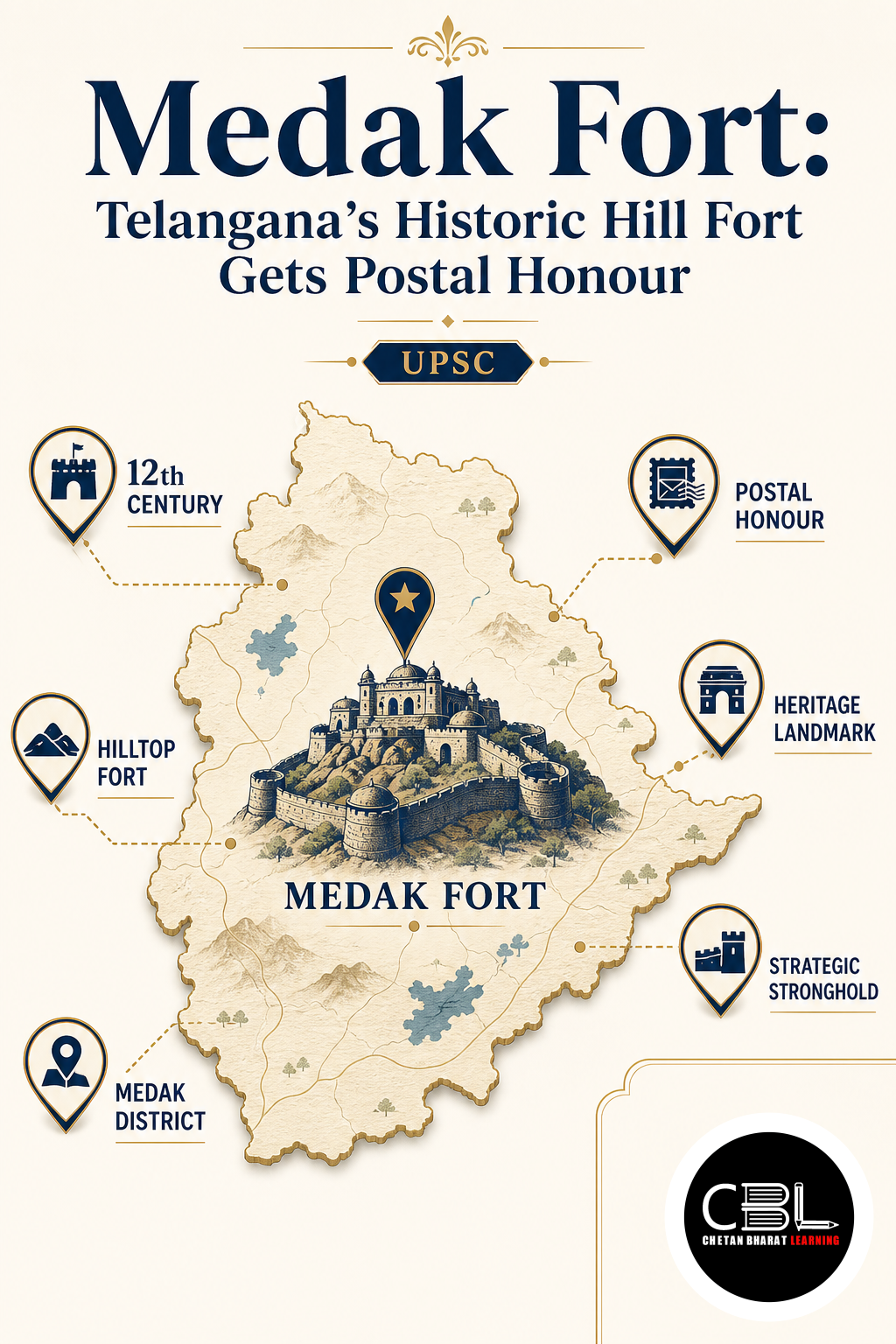
Medak Fort is a historic hill fort located in Medak town, Telangana, built during the 12th century under the reign of the Kakatiya ruler Pratapa Rudra. Initially called Methuku Durgam in Telugu, it served as a command post for the Kakatiyas and later for the Qutub Shahis. The fort covers 100 acres at an average elevation of 90 metres from ground level and houses a small lake, a barrack, a warehouse, and an 11-foot-long cannon from the 17th century CE.
The fort features three main entrances: the Prathama Dwaram, the Simha Dwaram with two snarling lions, and the Gaja Dwaram (Elephant’s Entrance) with two interlocked elephants. The main entrance features the double-headed Gandabherundam—the emblem of the Vijayanagara Empire built by Srikrishna Devaraya. A 17th-century mosque and granaries are also present on the premises.
Why is Medak Fort in News?
Medak Fort is in the news because the postal department issued a special postal cover and stamp to honour the historical fort, recognising its architectural and cultural significance. The rare honour has brought attention to the fort’s rich history and heritage.
The fort’s association with multiple dynasties—Kakatiyas, Qutub Shahis, and Vijayanagara—makes it a significant site for understanding the region’s medieval history. For more details, refer to the PIB release at pib.gov.in.
Key Features of Medak Fort
- Kakatiya Origins: Built by Pratapa Rudra in the 12th century; later used by Qutub Shahis.
- Architectural Entrances: Three main gates—Prathama Dwaram, Simha Dwaram, and Gaja Dwaram.
- Vijayanagara Emblem: Double-headed Gandabherundam at the main entrance.
- 17th-Century Cannon: An 11-foot-long cannon from the Qutub Shahi period.
- Qutub Shahi Mosque: A mosque and granaries within the fort premises.
Challenges in Medak Fort Preservation
- Weathering: Exposure to rain, wind, and temperature fluctuations causes structural decay.
- Vegetation Growth: Encroaching vegetation damages stonework and foundations.
- Lack of Awareness: Limited public awareness about the fort’s historical significance.
- Funding: Inadequate funds for conservation and maintenance.
- Tourism Pressure: Increasing tourist footfall without proper management can accelerate wear.
Way Forward for Medak Fort
To preserve Medak Fort, the Archaeological Survey of India (ASI) and the state government should undertake structural assessments and restoration work. Creating a comprehensive conservation plan, including regular maintenance and visitor management, is essential.
Promoting Medak Fort as a heritage tourism destination can generate funds for conservation while educating the public about its history. Digital documentation and virtual tours can enhance accessibility. For international best practices, refer to UNESCO at unesco.org.
Prelims Practice Corner
Question 1
Under which dynasty was Medak Fort built?
- (a) Chola
- (b) Kakatiya
- (c) Vijayanagara
- (d) Qutub Shahi
Answer: (b) The fort was built by the Kakatiya ruler Pratapa Rudra.
Question 2
Where is Medak Fort located?
- (a) Andhra Pradesh
- (b) Telangana
- (c) Karnataka
- (d) Maharashtra
Answer: (b) Medak Fort is located in Medak town, Telangana.
Question 3
What is the name of the elephant entrance?
- (a) Prathama Dwaram
- (b) Simha Dwaram
- (c) Gaja Dwaram
- (d) Vijaya Dwaram
Answer: (c) Gaja Dwaram is the Elephant’s Entrance.
Question 4
Which emblem is featured at the main entrance of Medak Fort?
- (a) Lion
- (b) Double-headed Gandabherundam
- (c) Elephant
- (d) Peacock
Answer: (b) The double-headed Gandabherundam, emblem of Vijayanagara, is featured.
Question 5
Which ruler built the Gandabherundam emblem at the fort?
- (a) Pratapa Rudra
- (b) Srikrishna Devaraya
- (c) Quli Qutub Shah
- (d) Aurangzeb
Answer: (b) The emblem was built by Srikrishna Devaraya of Vijayanagara.
Mains Practice Questions
Question 1
Discuss the historical and architectural significance of Medak Fort in the context of medieval Deccan history. (250 words, 15 marks)
Answer Structure:
- Intro: Introduce Medak Fort and its location.
- Body: Discuss its Kakatiya origins, later Qutub Shahi and Vijayanagara associations; analyse its architectural features: entrances, emblem, cannon, mosque; highlight its role as a command post and its cultural significance.
- Conclusion: Emphasise the need for conservation and heritage promotion.
Question 2
What is the significance of the Gandabherundam emblem in Deccan history? (150 words, 10 marks)
Answer Structure:
- Intro: Define Gandabherundam as the double-headed eagle emblem.
- Body: Explain its association with the Vijayanagara Empire under Srikrishna Devaraya; its presence at Medak Fort indicates Vijayanagara’s influence in the Deccan region during the 16th century.
- Conclusion: Conclude that such emblems reflect the political and cultural dynamics of medieval South India.
FAQs on Medak Fort
What is Medak Fort?
It is a 12th-century hill fort in Telangana built by the Kakatiyas, later used by Qutub Shahis and featuring Vijayanagara emblems.
What are the main architectural features?
Three main entrances, a double-headed Gandabherundam emblem, a 17th-century cannon, a mosque, and granaries.
Why was Medak Fort in the news?
The postal department issued a special postal cover and stamp honouring the historical fort.
Related Current Affairs
Preparing for UPSC, PCS or HCS?
Talk to a mentor at Chetan Bharat Learning, Chandigarh. Free guidance on choosing the right exam and building a study plan.
Chat on WhatsAppCall 97793 53345UPSC / IAS / PCS coaching in Chandigarh · Trusted by aspirants across Punjab & Haryana
Leave a Reply
You must be logged in to post a comment.