
UPSC Mapping
| Exam | Topics |
|---|---|
| Prelims | International Relations, Defence and Maritime Geography |
| Mains | GS Paper II — India and Its Neighbourhood |
Quick Facts
| Signed | Agreement Type | Article 10 Distance | Primary Objective |
|---|---|---|---|
| 6 April 1991 | Bilateral Confidence-Building Measure | Three Nautical Miles | Prevent Military Miscalculation |
Article
What is the 1991 India-Pakistan Agreement?
The 1991 India-Pakistan Agreement is formally called the Agreement on Advance Notice on Military Exercises, Manoeuvres and Troop Movements. India and Pakistan signed it on 6 April 1991 to reduce uncertainty surrounding large military activities. It requires prior information about specified exercises and deployments that could alarm the other country. The arrangement represents a military confidence-building measure rather than a defence or non-aggression treaty.
The agreement addresses land, air and naval activities through notification periods, geographical restrictions and channels for seeking clarification. Its purpose is to stop routine exercises from appearing like preparations for an attack. The framework also establishes minimum operational distances for military aircraft, naval ships and submarines. These safeguards are particularly important because geographical proximity gives decision-makers limited time to assess an unfolding incident.
Why is the 1991 India-Pakistan Agreement in News?
An Indian Navy warship and Pakistan Navy vessel PNS Hunain collided in the North Arabian Sea on 15 September 2026. India stated that the episode occurred in international waters and alleged that the Pakistani vessel approached at high speed before manoeuvring unsafely. The Indian vessel reportedly continued its surveillance mission without major damage, while the Pakistani ship returned to port. Both governments subsequently lodged diplomatic protests and presented competing accounts of responsibility.
India described the conduct as contrary to Article 10 of the 1991 India-Pakistan Agreement. That provision requires naval ships and submarines belonging to the two countries not to approach within three nautical miles of each other in international waters. Pakistan alleged that the Indian vessel had undertaken unsafe manoeuvres during its naval exercise, making attribution contested. A report on the diplomatic exchange records the claims presented by both sides. The incident revived memories of a 2011 encounter involving PNS Babur and INS Godavari in the Gulf of Aden.
Key Features
The agreement combines advance notification, geographical restraint and operational separation to reduce misperception during military activity.
- Restrictions near borders: India and Pakistan should avoid conducting major military exercises close to each other’s territory, while any permitted activity must follow agreed geographical limits and notification procedures.
- Advance-notice periods: The framework provides notice periods of 15 days for specified air and naval exercises, 60 days for corps-level exercises and 90 days for army-level exercises.
- Naval exercise threshold: A major naval exercise involves six or more ships of destroyer or frigate size and above exercising together and crossing into the other country’s exclusive economic zone.
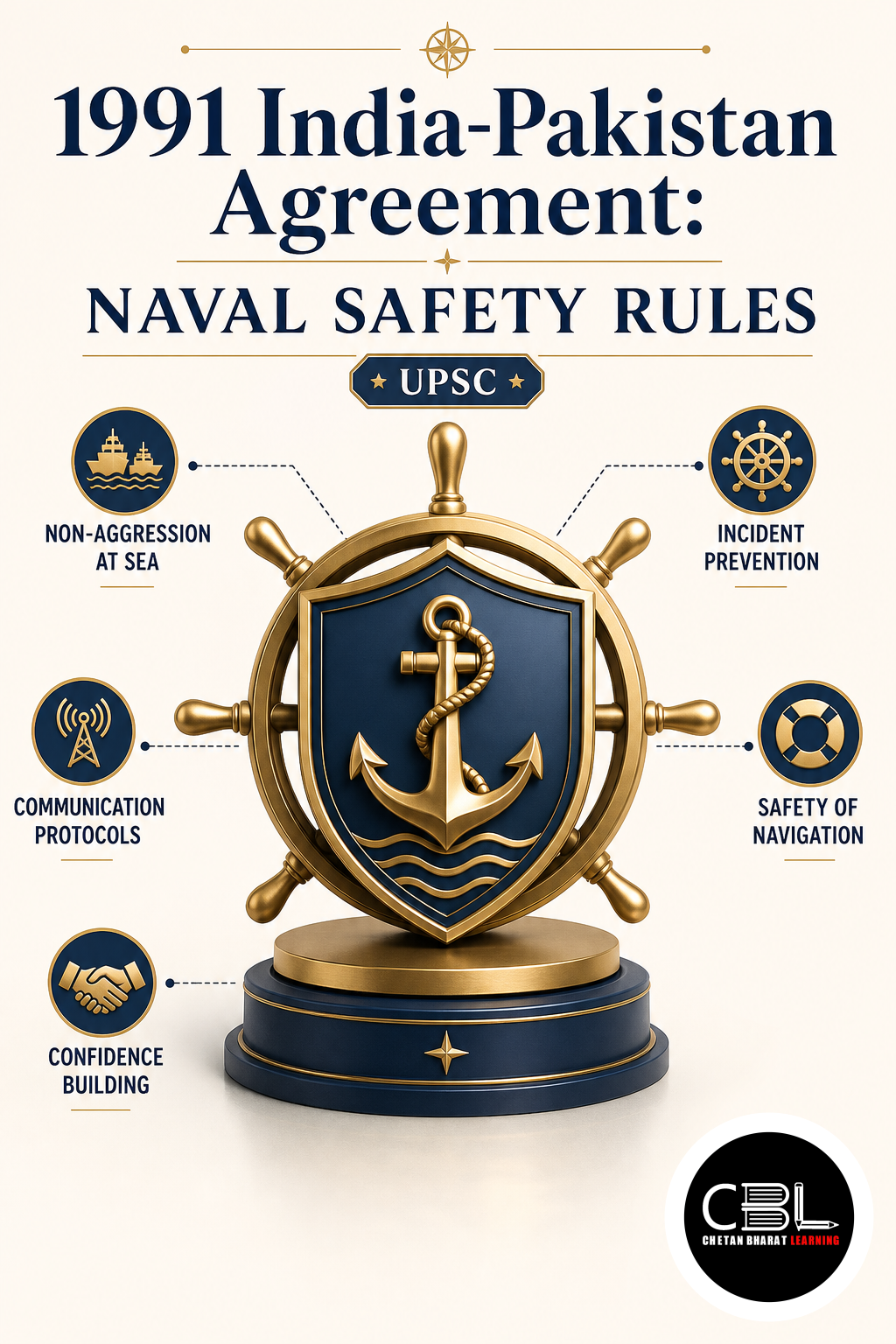
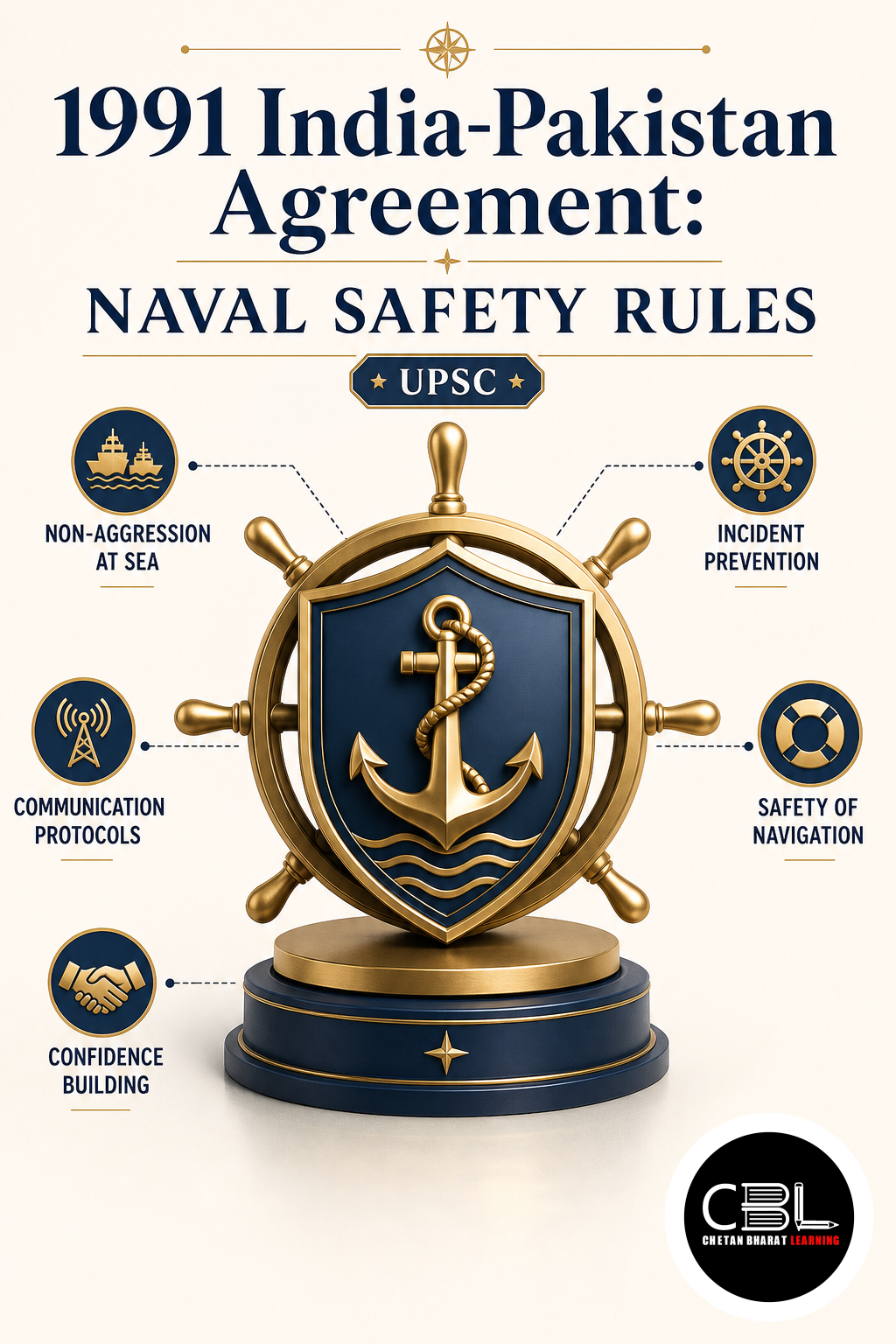
- Three-nautical-mile rule: Article 10 requires Indian and Pakistani naval ships and submarines to remain at least three nautical miles apart while operating in international waters to prevent accidents.
- Clarification mechanism: Either government may request information about the assembly, direction, geographical extent and duration of military exercises when movements create uncertainty or concern.
Challenges
The collision demonstrates that written safeguards require professional conduct, rapid communication and mutual political commitment to remain effective.
- Competing narratives: When both sides accuse each other of unsafe behaviour, factual disagreements over position, speed and intent can obstruct accountability and transform a navigational incident into a diplomatic confrontation.
- Grey-zone manoeuvring: Deliberately ambiguous actions below the threshold of armed conflict can test operational limits without triggering conventional retaliation, increasing the risk of collision and unintended escalation.
- Outdated operational context: Modern sensors, drones, long-range weapons and congested maritime routes have changed naval operations considerably since 1991, while the agreement provides limited guidance for several emerging technologies.
- Legal misunderstanding at sea: An exclusive economic zone grants the coastal state resource-related rights but does not equal territorial waters, making accurate knowledge of navigation freedoms and bilateral safety obligations essential.
- Weak enforcement mechanisms: The agreement depends primarily on diplomatic protests and voluntary compliance rather than independent investigation or binding dispute resolution. Related strategic developments are covered in CBL’s security current affairs section.
Way Forward
India and Pakistan should establish a dedicated naval incident hotline linking their operational commands. They can supplement it with standard bridge-to-bridge communication, automatic position reporting during notified exercises and mandatory preservation of navigation data after an incident. Periodic professional meetings could clarify safe distances, signalling procedures and responsibilities when vessels unexpectedly converge. Both countries should also consider extending the framework to maritime patrol aircraft, unmanned systems and coast guard vessels.
Any review of the 1991 India-Pakistan Agreement should preserve its core objective of preventing miscalculation while updating its technical procedures. Investigations should rely on voyage data, radar records and internationally accepted navigation standards rather than public accusations alone. The United Nations Convention on the Law of the Sea should remain the broader legal reference for maritime zones and navigation rights. Stronger communication and disciplined rules of engagement can prevent a minor collision from becoming a strategic crisis between nuclear-armed neighbours.
Prelims Practice Corner
-
Q1. The bilateral military agreement signed by India and Pakistan in April 1991 primarily deals with which subject?
(a) Nuclear material transfers (b) Advance notice of military exercises and troop movements (c) Maritime boundary delimitation (d) Joint naval patrols
Answer: (b) It establishes advance-notification and safety rules for specified military exercises, manoeuvres and troop movements.
-
Q2. What minimum separation does Article 10 prescribe for Indian and Pakistani naval ships and submarines in international waters?
(a) One nautical mile (b) Three nautical miles (c) Five nautical miles (d) Twelve nautical miles
Answer: (b) Article 10 prescribes a minimum separation of three nautical miles to avoid accidents.
-
Q3. Consider the following statements about maritime zones under UNCLOS: 1. The territorial sea may extend up to 12 nautical miles. 2. The exclusive economic zone may extend up to 200 nautical miles. 3. An exclusive economic zone has the same legal status as sovereign territorial waters. Which statements are correct?
(a) 1 and 2 only (b) 2 and 3 only (c) 1 and 3 only (d) 1, 2 and 3
Answer: (a) The coastal state has specified sovereign rights in its EEZ, but the zone does not have the same status as territorial waters.
-
Q4. One nautical mile is approximately equal to which distance?
(a) 1.252 kilometres (b) 1.500 kilometres (c) 1.852 kilometres (d) 2.252 kilometres
Answer: (c) One internationally recognised nautical mile equals 1.852 kilometres.
-
Q5. With reference to confidence-building measures, consider the following statements: 1. They aim to reduce uncertainty about another state’s military intentions. 2. They may include prior notification and communication mechanisms. 3. They necessarily constitute a military alliance. How many statements are correct?
(a) Only one (b) Only two (c) All three (d) None
Answer: (b) Statements 1 and 2 are correct, while a confidence-building arrangement does not create a military alliance.
Mains Practice Questions
-
Q1. Examine the role of military confidence-building measures in preventing accidental escalation between India and Pakistan. (10 marks)
Answer Structure:
- Intro: Define confidence-building measures as arrangements that improve transparency and reduce military misperception.
- Body: Discuss advance notification, minimum operational distances, clarification channels, crisis communication, implementation gaps and contested attribution.
- Conclusion: Emphasise updated protocols and sustained professional communication between military commands.
-
Q2. Recent maritime incidents demonstrate the need to modernise bilateral naval safety arrangements between India and Pakistan. Discuss. (15 marks)
Answer Structure:
- Intro: Refer to the three-nautical-mile rule and its crisis-prevention purpose.
- Body: Cover congested waters, grey-zone conduct, unmanned systems, competing narratives, UNCLOS, data preservation and naval hotlines.
- Conclusion: Recommend modernised procedures grounded in international law and verifiable operational evidence.
FAQs
Why was the 1991 India-Pakistan Agreement signed?
It emerged from efforts to reduce the danger of military exercises being misread as preparations for conflict. The 1987 Exercise Brass Tacks crisis demonstrated the risks created by large deployments and inadequate communication.
What does Article 10 require from the two navies?
It requires naval ships and submarines of India and Pakistan not to approach within three nautical miles of each other in international waters. The rule aims to prevent collisions and accidental escalation.
Does an exclusive economic zone form part of territorial waters?
No. A coastal state enjoys sovereign rights over natural resources and specified activities within its EEZ. Other states retain navigation and overflight freedoms subject to UNCLOS and applicable international law.
Related Current Affairs
Preparing for UPSC, PCS or HCS?
Talk to a mentor at Chetan Bharat Learning, Chandigarh. Free guidance on choosing the right exam and building a study plan.
Chat on WhatsAppCall 97793 53345UPSC / IAS / PCS coaching in Chandigarh · Trusted by aspirants across Punjab & Haryana
Leave a Reply
You must be logged in to post a comment.