
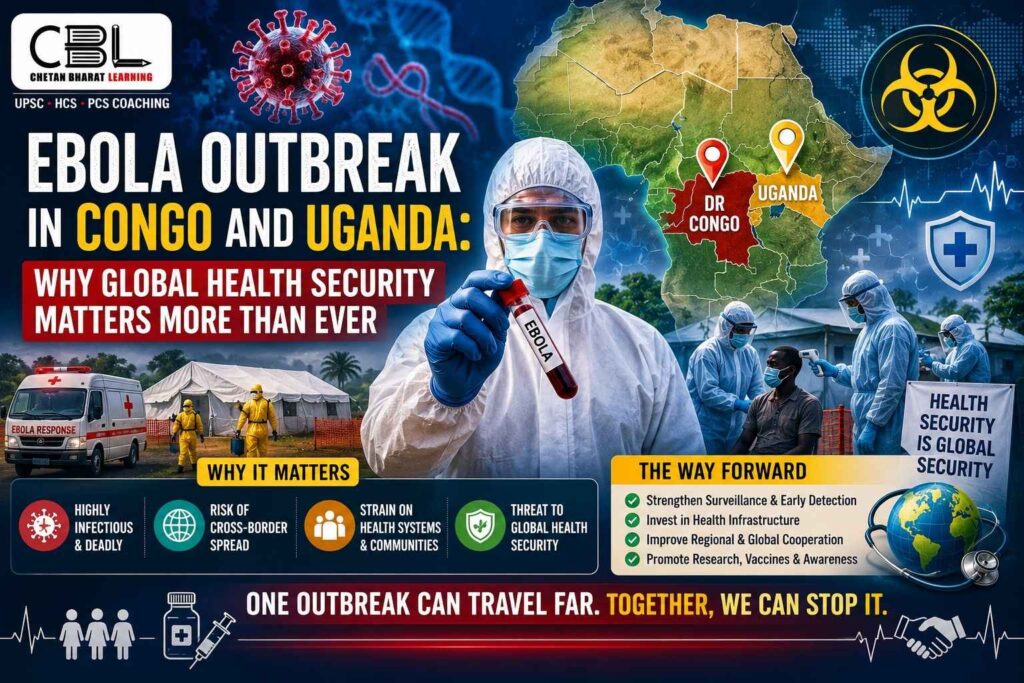
Why the Ebola Outbreak Is a Global Concern
The recent Ebola outbreak in the Democratic Republic of Congo (DRC) and Uganda has once again highlighted the vulnerability of the global health system to infectious disease outbreaks.
The World Health Organization (WHO) has described the situation as an “emergency of global concern” because of:
- Cross-border transmission risks
- Rising infection numbers
- Weak healthcare infrastructure in affected regions
- The possibility of wider regional spread
Although Ebola outbreaks are not new to Africa, the growing interconnectedness of the world means that regional health crises can rapidly become international challenges.
Students preparing through UPSC Coaching in Chandigarh and IAS Coaching in Chandigarh should closely follow topics like global health security, zoonotic diseases, pandemic preparedness, and international health governance because these themes are highly important for GS Paper 2, GS Paper 3, Essay, and UPSC Interview preparation.
What Is Ebola Virus Disease (EVD)?
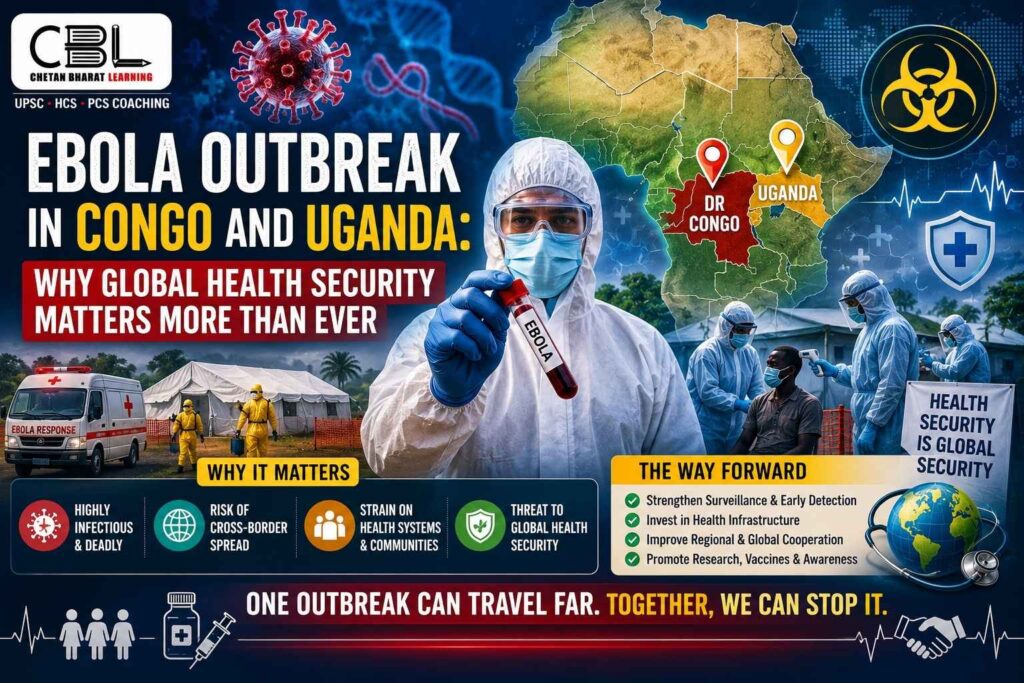
Ebola Virus Disease (EVD) is a severe and often fatal viral illness caused by the Ebola virus.
The disease was first identified in 1976 near the Ebola River in present-day Democratic Republic of Congo.
Ebola primarily spreads through:
- Direct contact with infected bodily fluids
- Contaminated surfaces
- Infected animals
The disease is known for causing:
✔ High fever
✔ Internal and external bleeding
✔ Organ failure
✔ Severe dehydration
Ebola outbreaks often have very high fatality rates if not contained quickly.
The Sudan Strain and Current Concerns
The present outbreak involves the Sudan strain of the Ebola virus.
This strain is particularly concerning because:
- There is currently no widely approved vaccine for it
- Rapid containment becomes difficult
- Healthcare systems face additional pressure
WHO and regional authorities are closely monitoring the spread to prevent wider transmission.
Why Africa Remains Vulnerable to Ebola Outbreaks
1. Weak Healthcare Infrastructure
Many affected regions face:
- Limited hospitals
- Shortage of medical staff
- Weak surveillance systems
- Inadequate diagnostic facilities
This delays outbreak detection and containment.
2. Cross-Border Population Movement
Frequent movement across borders between Congo and Uganda increases transmission risks.
Poor border surveillance and informal migration routes make containment more difficult.
3. Misinformation and Public Distrust
Outbreak management becomes harder when:
- Communities distrust authorities
- Misinformation spreads rapidly
- Fear discourages reporting
Public cooperation is critical for successful containment.
Global Health Security and WHO’s Role
The Ebola outbreak demonstrates why global health security is becoming increasingly important.
WHO plays a major role in:
✔ Coordinating international response
✔ Supporting surveillance systems
✔ Deploying medical assistance
✔ Managing emergency communication
✔ Assisting vaccination and containment efforts
The organization’s emergency declaration helps mobilize global attention and funding.
Why Zoonotic Diseases Are Increasing
Ebola is a zoonotic disease, meaning it spreads from animals to humans.
Experts increasingly warn that:
- Deforestation
- Wildlife-human interaction
- Climate change
- Ecological disruption
are increasing the risk of zoonotic disease emergence globally.
This links public health directly with environmental sustainability.
Lessons from the COVID-19 Pandemic
The Ebola outbreak also reflects broader lessons learned after COVID-19:
- Early detection is essential
- International coordination matters
- Strong healthcare systems are critical
- Public trust improves compliance
- Global cooperation is necessary
No country can manage infectious disease threats completely in isolation.
Prelims Pointers
Important Facts
- Ebola Virus Disease (EVD) is caused by the Ebola virus
- First identified in 1976
- Current outbreak linked to the Sudan strain
WHO’s Role
- Emergency response coordination
- Surveillance support
- Outbreak management
Key Concept
Zoonotic diseases spread from animals to humans.
Mains Perspective
Possible Question
“Global health security requires international cooperation, strong healthcare systems, and effective surveillance mechanisms.” Discuss in the context of recent Ebola outbreaks.
Key Dimensions to Include
- Pandemic preparedness
- Public health governance
- WHO coordination
- Healthcare infrastructure
- Climate-health linkage
- Zoonotic diseases
Frequently Asked Questions (FAQ)
What is Ebola Virus Disease (EVD)?
EVD is a severe viral disease that spreads through direct contact with infected bodily fluids and has a high fatality rate.
Why is the current outbreak concerning?
The outbreak involves the Sudan strain, for which there is no widely approved vaccine.
What are zoonotic diseases?
Zoonotic diseases are infections that spread from animals to humans.
Why is WHO involved in Ebola outbreaks?
WHO coordinates international outbreak response, surveillance, emergency assistance, and global health cooperation.
Conclusion: Health Security Is National Security
The Ebola outbreak in Congo and Uganda highlights an increasingly important reality:
Public health crises are no longer isolated medical events — they are global security challenges.
The outbreak demonstrates how:
- Weak healthcare systems
- Climate pressures
- Ecological disruption
- Global interconnectedness
can collectively increase vulnerability to infectious diseases.
As future outbreaks become more likely, strengthening healthcare resilience, surveillance systems, and international cooperation will remain central to global stability.
“In an interconnected world, disease outbreaks do not respect borders — and neither can solutions.”
Related Current Affairs
Preparing for UPSC, PCS or HCS?
Talk to a mentor at Chetan Bharat Learning, Chandigarh. Free guidance on choosing the right exam and building a study plan.
Chat on WhatsAppCall 97793 53345UPSC / IAS / PCS coaching in Chandigarh · Trusted by aspirants across Punjab & Haryana
Leave a Reply
You must be logged in to post a comment.