
UPSC Mapping
Prelims
- Indian Navy
- Mahe-class ASW-SWC
- ASW-SWC
- Cochin Shipyard
- Defence Technology
Mains
- GS Paper III – Defence Technology, Maritime Security & Indigenisation
Article
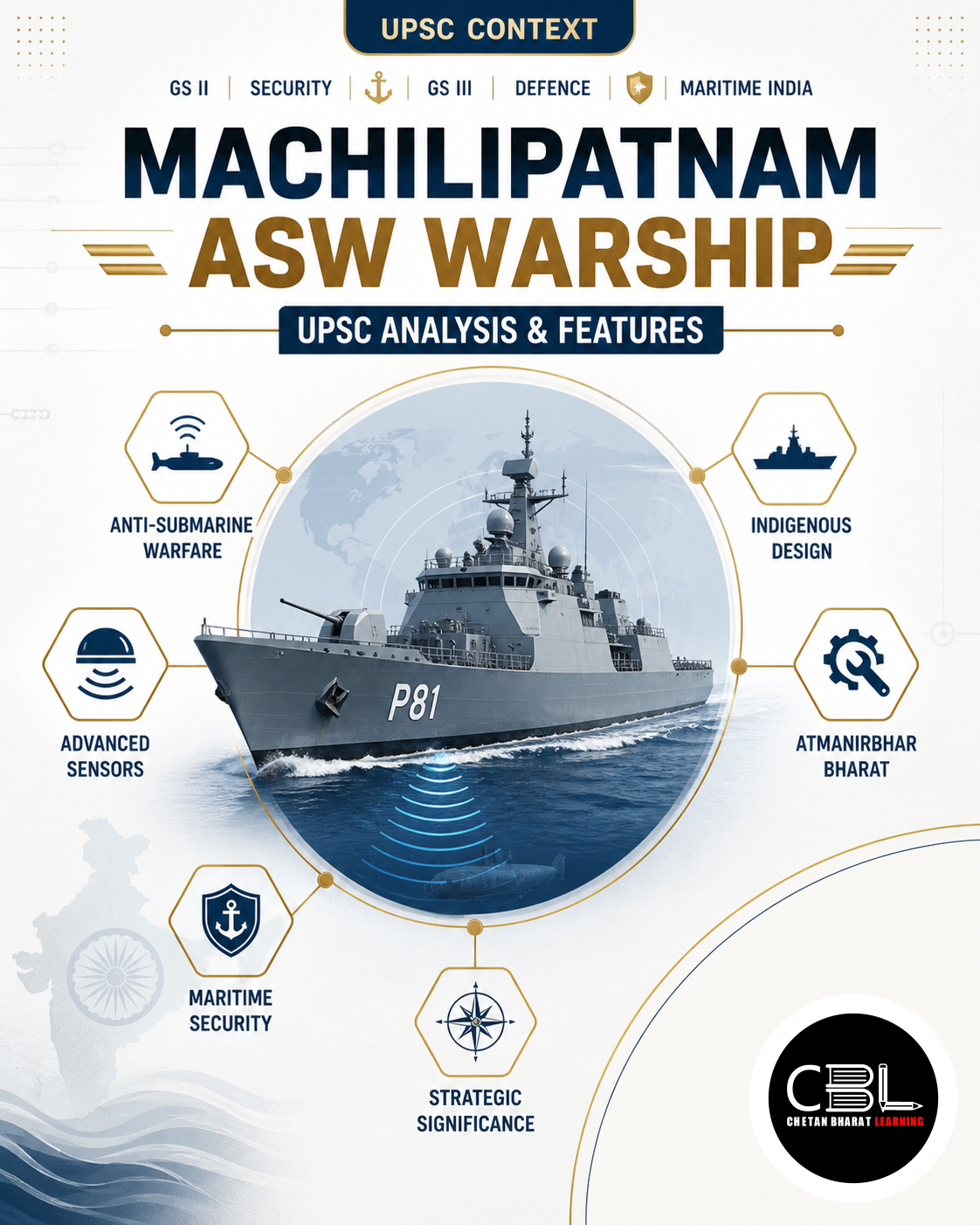
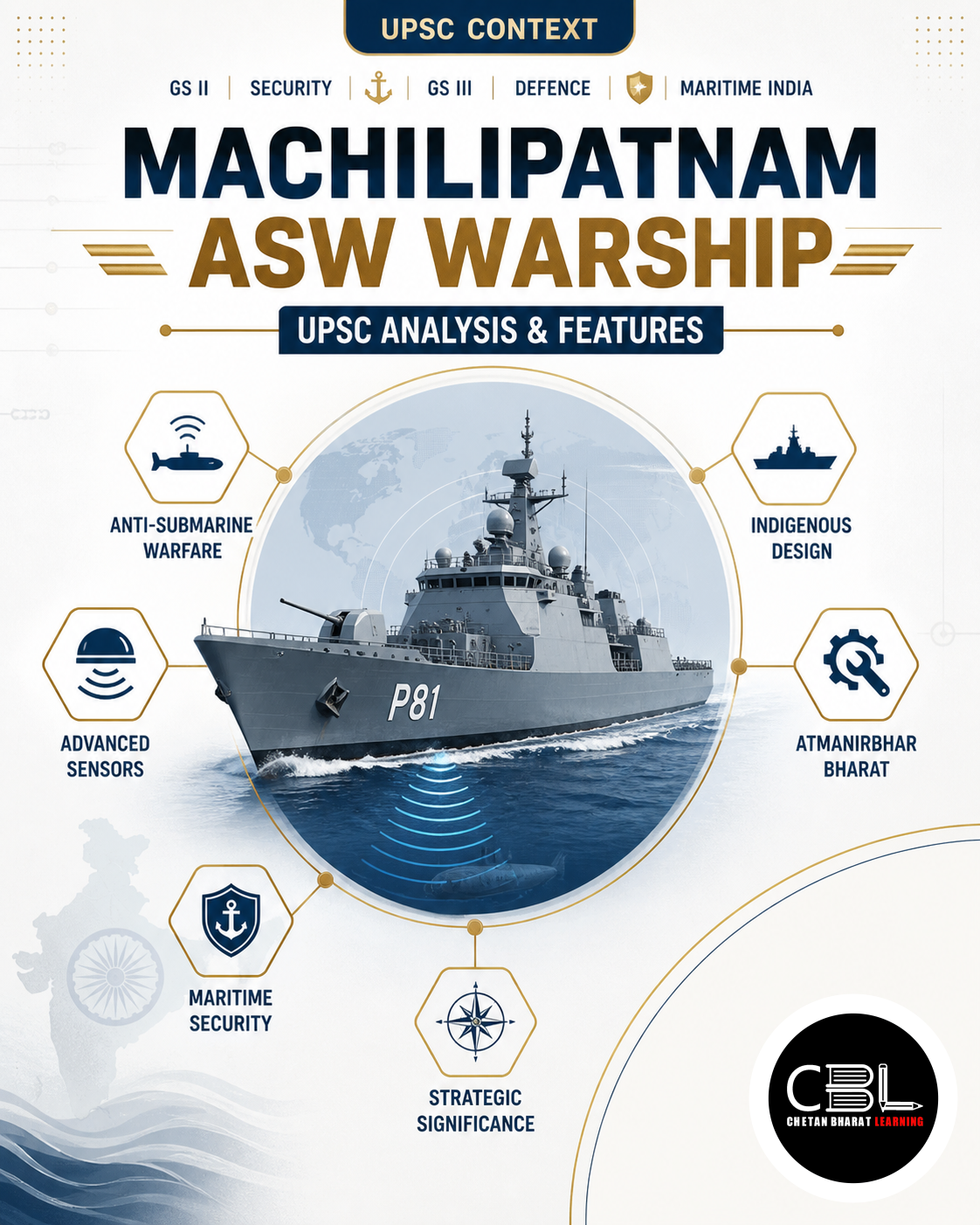
Machilipatnam ASW Warship has recently been launched as the seventh vessel of the Mahe-class Anti-Submarine Warfare Shallow Water Craft (ASW-SWC) for the Indian Navy. The induction of this indigenously built platform strengthens India’s coastal defence, underwater surveillance and maritime security capabilities. For more defence updates, visit the daily current affairs archive.
| Class | Mahe-class ASW-SWC |
|---|---|
| Builder | Cochin Shipyard Limited |
| Displacement | Around 900 tonnes |
| Indigenous Content | More than 80% |
What is Machilipatnam ASW Warship?
Machilipatnam ASW Warship is the seventh Mahe-class Anti-Submarine Warfare Shallow Water Craft (ASW-SWC) built for the Indian Navy by Cochin Shipyard Limited (CSL). It derives its name from the historic port city of Machilipatnam in Andhra Pradesh and has been designed primarily to detect and neutralise enemy submarines operating in India’s coastal waters.
The warship reflects India’s growing capability in indigenous naval shipbuilding under the Atmanirbhar Bharat initiative. With more than 80% indigenous content, it incorporates advanced sensors and combat systems developed within the country.
Why is Machilipatnam ASW Warship in News?
The Machilipatnam (BY 529) ASW Shallow Water Craft was recently launched, marking another milestone in the Indian Navy’s modernisation programme. The induction of Mahe-class vessels is aimed at strengthening underwater surveillance and anti-submarine warfare capabilities in India’s maritime domain.
The launch also demonstrates India’s emphasis on indigenous defence manufacturing and self-reliance in advanced naval platforms. Official information is available through the PIB release.
Key Features of Machilipatnam ASW Warship
The vessel is equipped with advanced technologies for modern coastal and underwater operations.
- Mahe-class platform: Seventh ship in the ASW-SWC series.
- Advanced sonar systems: Indigenous hull-mounted sonar and low-frequency variable depth sonar for detecting underwater threats.
- Operational capabilities: Underwater Surveillance, Anti-Submarine Warfare (ASW), Low Intensity Maritime Operations (LIMO) and Mine Warfare.
- Performance: Displacement of around 900 tonnes, maximum speed of 25 knots and endurance of about 1,800 nautical miles.
- High indigenisation: More than 80% indigenous content supports domestic defence manufacturing and self-reliance.
Significance
Machilipatnam ASW Warship enhances India’s maritime preparedness by improving surveillance and anti-submarine capabilities in shallow coastal waters. These platforms are increasingly important as underwater threats become more sophisticated in the Indo-Pacific region.
- Strengthens coastal defence: Improves monitoring of India’s coastline against hostile submarines.
- Enhances Maritime Domain Awareness: Supports continuous surveillance and rapid response.
- Supports Atmanirbhar Bharat: Encourages indigenous defence manufacturing and technology development.
- Force multiplier: Operates effectively in shallow waters alongside larger naval assets.
- Strategic deterrence: Improves the Indian Navy’s readiness in the Indian Ocean Region.
Challenges
Modern naval warfare demands continuous technological advancement and operational preparedness.
- Evolving submarine threats: Advances in stealth technologies require continuous sonar upgrades.
- High technology costs: Development and maintenance of advanced naval platforms involve substantial investment.
- Integration challenges: Seamless integration of sensors, weapons and communication systems remains essential.
- Operational training: Personnel require specialised training to utilise advanced ASW technologies effectively.
- Maintenance support: Indigenous systems require robust logistics and lifecycle support.
Way Forward
Continued investment in indigenous naval technologies, advanced sonar systems and AI-based maritime surveillance will strengthen India’s underwater warfare capabilities. Expanding domestic shipbuilding capacity will further reinforce strategic autonomy.
Greater collaboration between the Indian Navy, defence research institutions and domestic shipyards will accelerate innovation while supporting long-term maritime security objectives. More information is available through the Indian Navy.
Prelims Practice Corner
Q1. Machilipatnam ASW Warship belongs to which class?
- (a) Nilgiri-class
- (b) Visakhapatnam-class
- (c) Mahe-class
- (d) Shivalik-class
Answer: (c) It is the seventh vessel of the Mahe-class ASW Shallow Water Craft.
Q2. Machilipatnam ASW Warship has been built by:
- (a) Mazagon Dock Shipbuilders Limited
- (b) Garden Reach Shipbuilders & Engineers
- (c) Cochin Shipyard Limited
- (d) Hindustan Shipyard Limited
Answer: (c) It has been built by Cochin Shipyard Limited for the Indian Navy.
Q3. The primary role of the vessel is:
- (a) Aircraft operations
- (b) Anti-Submarine Warfare
- (c) Ballistic missile defence
- (d) Amphibious assault
Answer: (b) The vessel is designed primarily for Anti-Submarine Warfare operations.
Q4. Which initiative is supported by the ship’s high indigenous content?
- (a) Digital India
- (b) Make in India for Textiles
- (c) Atmanirbhar Bharat
- (d) Smart Cities Mission
Answer: (c) The vessel supports the Atmanirbhar Bharat initiative through more than 80% indigenous content.
Q5. Which advanced system is fitted on Machilipatnam ASW Warship for underwater detection?
- (a) Airborne radar only
- (b) Hull-mounted sonar
- (c) Weather radar
- (d) Satellite telescope
Answer: (b) The ship is equipped with an indigenous hull-mounted sonar and variable depth sonar.
Mains Practice Questions
Q1. Discuss the importance of Anti-Submarine Warfare capabilities in strengthening India’s maritime security. (10 marks)
Answer Structure:
- Intro: Explain the role of ASW in naval operations.
- Body: Discuss underwater threats, surveillance, indigenous technology and maritime security.
- Conclusion: Highlight the importance of continuous naval modernisation.
Q2. Evaluate the contribution of indigenous defence manufacturing towards India’s strategic autonomy with reference to Mahe-class ASW Shallow Water Craft. (15 marks)
Answer Structure:
- Intro: Introduce defence indigenisation.
- Body: Explain Atmanirbhar Bharat, indigenous shipbuilding, technological capabilities and strategic benefits.
- Conclusion: Emphasise self-reliance in defence preparedness.
FAQs on Machilipatnam ASW Warship
- What is Machilipatnam ASW Warship?
- It is the seventh Mahe-class Anti-Submarine Warfare Shallow Water Craft built by Cochin Shipyard Limited for the Indian Navy.
- What are the primary roles of Machilipatnam ASW Warship?
- The vessel is designed for underwater surveillance, anti-submarine warfare, low-intensity maritime operations and mine warfare.
- Why is Machilipatnam ASW Warship important for UPSC?
- The topic is relevant for GS Paper III because it covers defence technology, naval modernisation, maritime security and the Atmanirbhar Bharat initiative.
Related Current Affairs
Preparing for UPSC, PCS or HCS?
Talk to a mentor at Chetan Bharat Learning, Chandigarh. Free guidance on choosing the right exam and building a study plan.
Chat on WhatsAppCall 97793 53345UPSC / IAS / PCS coaching in Chandigarh · Trusted by aspirants across Punjab & Haryana
Leave a Reply
You must be logged in to post a comment.