
Important for:
UPSC, Haryana HCS, Punjab PCS
Prelims: ASI, Ancient Monuments Act, heritage conservation
Mains: GS Paper 1 — Indian Heritage & Culture
Essay & Interview: Urbanisation vs Heritage Protection
Why in News?
A recent CAG report revealed that many historical monuments linked to Awadh culture in Uttar Pradesh are facing severe encroachment and neglect.
Experts warn that without immediate intervention:
→ The historical and cultural identity of Awadh may be permanently damaged.
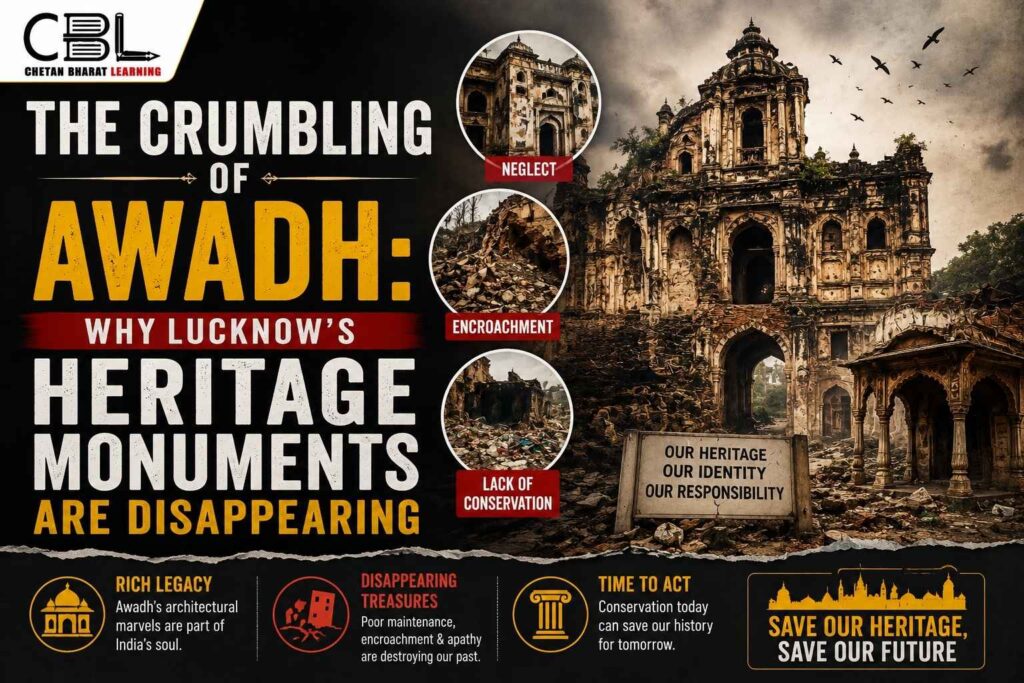
What Is Awadh?
Awadh was:
→ A major historical-cultural region in North India
→ Closely associated with Lucknow and Nawabi culture
Known for:
✔ Architecture
✔ Poetry & music
✔ Tehzeeb (etiquette)
✔ Composite culture
What Did the CAG Report Find?
1. Massive Encroachment
Many protected monuments are surrounded by:
- Shops
- Illegal structures
- Residential encroachments
2. Missing Ownership Records
Several monuments lack:
→ Proper ownership documentation
This creates administrative confusion.
3. Poor Protection Measures
ASI-protected monuments are facing:
✔ Illegal modifications
✔ Structural damage
✔ Neglect
4. Heritage Sites Turning Commercial
Historic areas near monuments are increasingly being used for:
➤ Commercial activity
➤ Unregulated construction
Role of ASI
The Archaeological Survey of India (ASI):
→ Protects and conserves historical monuments
Under:
✔ Ancient Monuments and Archaeological Sites and Remains Act, 1958
Why Heritage Conservation Matters
1. Cultural Identity
Monuments preserve:
✔ History
✔ Traditions
✔ Regional identity
2. Tourism Economy
Heritage tourism generates:
✔ Employment
✔ Revenue
✔ Urban development
3. Educational Importance
Historical sites help future generations understand India’s civilisational heritage.
Major Challenges
- Urban encroachment
- Weak enforcement
- Poor documentation
- Illegal construction
- Lack of public awareness
Global Relevance
Across the world, heritage cities face challenges balancing:
✔ Modernisation
✔ Urbanisation
✔ Conservation
India-Specific Significance
India has thousands of heritage monuments, but many suffer from:
➤ Encroachment
➤ Neglect
➤ Administrative inefficiency
This raises concerns about long-term cultural preservation.
Key Insight for UPSC
➤ Heritage conservation is not only about monuments —
It is also about:
✔ Identity
✔ Civilisational continuity
✔ Sustainable urban planning
UPSC Preparation Angle
Highly important for aspirants studying through:
UPSC Coaching Chandigarh
IAS Coaching Chandigarh
Especially useful for:
✅ GS1 Art & Culture
✅ Heritage Conservation Topics
✅ Essay Writing
✅ Ethics & Governance discussions
PRELIMS PRACTICE QUESTIONS
Q1. ASI stands for:
A. Archaeological Survey of India
B. Ancient Survey Institution
C. Archaeology Service India
D. Administrative Survey Institute
✅ Answer: A
Q2. The Ancient Monuments Act was passed in:
A. 1947
B. 1950
C. 1958
D. 1972
✅ Answer: C
Q3. Awadh is historically associated with:
A. Chennai
B. Lucknow
C. Jaipur
D. Surat
✅ Answer: B
Q4. Heritage conservation primarily aims to:
A. Promote illegal construction
B. Preserve cultural identity
C. Increase urban encroachment
D. Reduce tourism
✅ Answer: B
Q5. CAG stands for:
A. Central Audit Group
B. Comptroller and Auditor General
C. Cultural Administration Group
D. Constitutional Audit Governance
✅ Answer: B
CBL Mains Practice Question
“Rapid urbanisation poses serious challenges to India’s heritage conservation efforts.”
Discuss with reference to historical monuments in Indian cities.
FAQs
1. Why is Awadh in news?
Due to concerns over encroachment and neglect of heritage monuments.
2. What is the role of ASI?
ASI protects and conserves historical monuments and archaeological sites.
3. Why is heritage conservation important?
It preserves cultural identity, tourism, and historical continuity.
4. What challenges do heritage sites face?
Urbanisation, illegal construction, and weak enforcement.
5. Which GS paper covers this topic?
GS Paper 1.
Preparing for UPSC, PCS or HCS?
Talk to a mentor at Chetan Bharat Learning, Chandigarh. Free guidance on choosing the right exam and building a study plan.
Chat on WhatsAppCall 97793 53345UPSC / IAS / PCS coaching in Chandigarh · Trusted by aspirants across Punjab & Haryana
Leave a Reply
You must be logged in to post a comment.