

UPSC Mapping
| Exam | Topics |
|---|---|
| Prelims | Government Schemes, Women Empowerment |
| Mains | GS Paper II – Welfare Schemes and Inclusive Development |
Article
Lakshmi Yojana is in the news after the Delhi Government announced the welfare scheme to provide monthly financial assistance to economically weaker women. Aspirants should regularly revise important welfare initiatives because government schemes are frequently asked in UPSC Prelims and Mains.
Quick Facts
| Fact | Detail |
|---|---|
| Implementing Government | Delhi Government |
| Benefit | ₹2,500 per month |
| Target Group | Economically Weaker Women |
| Nature | Financial Assistance Scheme |
What is Lakshmi Yojana?
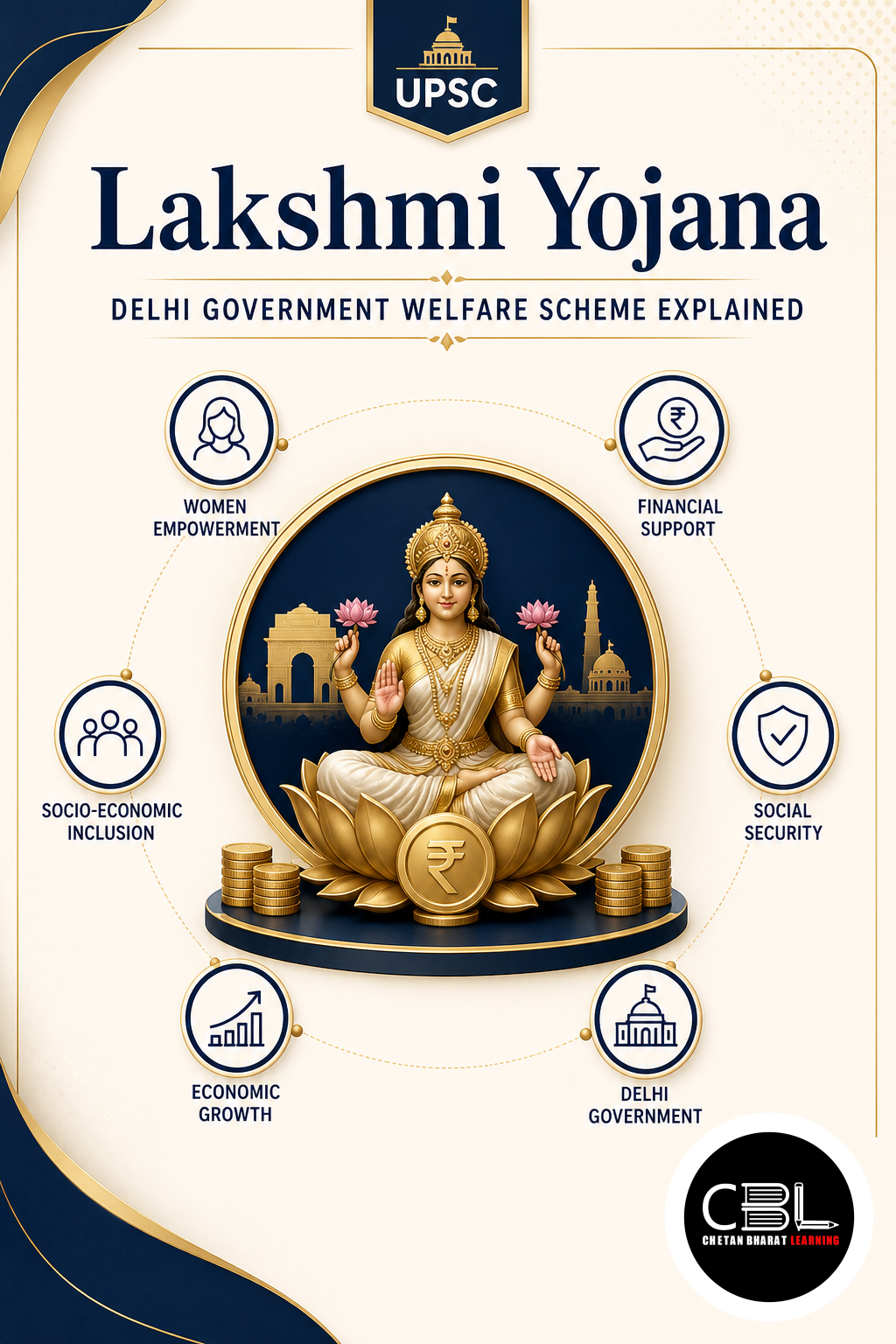
Lakshmi Yojana is a welfare initiative of the Delhi Government that provides ₹2,500 per month as financial assistance to economically weaker women. The scheme aims to promote financial inclusion and encourage savings among eligible beneficiaries. The initiative seeks to strengthen the economic security of women belonging to low-income households by providing regular financial support.
Why is Lakshmi Yojana in News?
The Delhi Government recently announced the implementation details and eligibility criteria for the scheme, making it an important welfare initiative for women.
Government welfare schemes remain important for UPSC examinations because they reflect the objectives of inclusive development and social protection.
Key Features
- Monthly assistance: Eligible women receive ₹2,500 every month.
- Objective: Promotes financial inclusion, household financial security and savings.
- Age criteria: Women aged 21 to 60 years are eligible.
- Income ceiling: Annual family income should not exceed ₹2.5 lakh.
- Residence requirement: Applicant must be a registered voter in Delhi and should have lived in Delhi for at least 10 years.
- Family condition: Only one eligible woman per family can avail the benefit.
Significance
- Women’s empowerment: Provides direct financial support to economically weaker women.
- Financial inclusion: Encourages regular savings and greater financial security.
- Social welfare: Strengthens the social safety net for vulnerable households.
- Direct benefit: Monthly assistance improves household income stability.
- Inclusive development: Supports equitable access to government welfare measures.
Way Forward
Effective implementation, transparent beneficiary identification and timely transfer of benefits will determine the long-term success of the scheme. Financial literacy and digital inclusion can further improve the impact of such welfare initiatives.
For UPSC, candidates should remember the implementing government, monthly assistance amount, eligibility criteria, income limit, age group and the objective of financial inclusion. Additional updates on welfare schemes can be accessed through the current affairs section.
Prelims Practice Corner
Q1. Lakshmi Yojana has been launched by which government?
- (a) Haryana
- (b) Delhi
- (c) Punjab
- (d) Rajasthan
Answer
(b) Delhi.
Q2. Under Lakshmi Yojana, eligible women receive:
- (a) ₹1,000
- (b) ₹2,000
- (c) ₹2,500
- (d) ₹3,000 per month
Answer
(c) ₹2,500.
Q3. The upper annual family income limit under Lakshmi Yojana is:
- (a) ₹1 lakh
- (b) ₹2 lakh
- (c) ₹2.5 lakh
- (d) ₹5 lakh
Answer
(c) ₹2.5 lakh.
Q4. Eligible beneficiaries must belong to which age group?
- (a) 18–60 years
- (b) 21–60 years
- (c) 25–65 years
- (d) 18–55 years
Answer
(b) 21–60 years.
Q5. One of the objectives of Lakshmi Yojana is to promote:
- (a) Export promotion
- (b) Financial inclusion
- (c) Skill certification
- (d) Agricultural mechanisation
Answer
(b) Financial inclusion.
Mains Practice Questions
Q1. Discuss the role of direct financial assistance schemes in promoting women’s empowerment and financial inclusion. (10 Marks)
Answer Structure:
- Intro: Explain the importance of women’s financial empowerment.
- Body: Discuss income security, financial inclusion, social welfare and implementation challenges.
- Conclusion: Highlight the need for effective delivery mechanisms.
Q2. Examine the significance of targeted welfare schemes in achieving inclusive development. (15 Marks)
Answer Structure:
- Intro: Introduce targeted welfare programmes.
- Body: Explain benefits, challenges, transparency, digital governance and social equity.
- Conclusion: Emphasise inclusive and accountable implementation.
FAQs on Lakshmi Yojana
What is Lakshmi Yojana?
Lakshmi Yojana is a Delhi Government welfare scheme that provides ₹2,500 per month to eligible economically weaker women to promote financial inclusion and savings.
Who is eligible under Lakshmi Yojana?
Women aged 21–60 years with an annual family income up to ₹2.5 lakh, who are registered voters in Delhi and have lived there for at least 10 years, are eligible. Only one woman per family can apply.
What is the main objective of Lakshmi Yojana?
The scheme aims to improve financial inclusion, encourage savings and provide economic support to women from economically weaker households.
Related Current Affairs
Preparing for UPSC, PCS or HCS?
Talk to a mentor at Chetan Bharat Learning, Chandigarh. Free guidance on choosing the right exam and building a study plan.
Chat on WhatsAppCall 97793 53345UPSC / IAS / PCS coaching in Chandigarh · Trusted by aspirants across Punjab & Haryana
Leave a Reply
You must be logged in to post a comment.