

UPSC Mapping
Exam Relevance
| Exam | Topics |
|---|---|
| Prelims | RBI, Currency Notes, Banking and Economy |
| Mains | GS Paper III – Indian Economy and Financial Sector |
Quick Facts
| Parameter | Details |
|---|---|
| Status | Field Trial Approved |
| Denominations | ₹10 and ₹20 |
| Material | Flexible Plastic Substrate |
| Conventional Notes | Cotton-based Paper |
Article
What are Polymer Currency Notes?
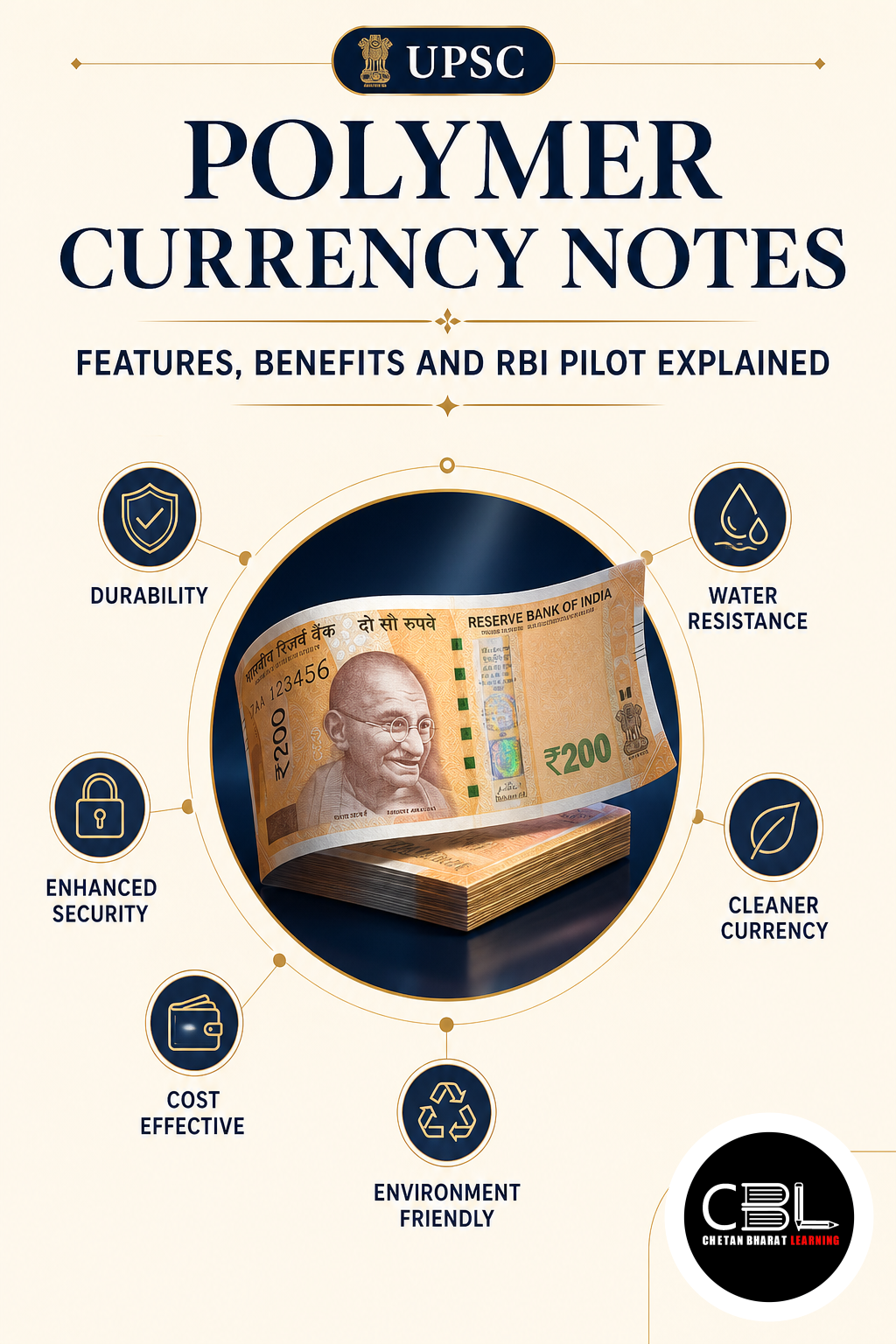
Polymer Currency Notes are banknotes printed on a thin, flexible plastic substrate instead of the conventional cotton-based paper used for existing currency notes. The change is intended to evaluate the suitability of polymer material for Indian circulation conditions.
The current proposal involves field-testing ₹10 and ₹20 denomination notes before any wider adoption is considered.
Why are Polymer Currency Notes in News?
The Centre has approved the Reserve Bank of India’s proposal to conduct field trials of polymer currency notes in ₹10 and ₹20 denominations. The move revives a proposal that remained pending for around fifteen years because of concerns related to printing infrastructure, costs and environmental evaluation.
More information on India’s currency management framework is available through the Reserve Bank of India.
Key Features
The source highlights the following important features of Polymer Currency Notes:
- Printing material: Manufactured using a flexible plastic substrate instead of cotton-based paper.
- Pilot implementation: Field testing has been approved for ₹10 and ₹20 denominations.
- Policy revival: The proposal revives a plan that remained pending for nearly fifteen years.
- Reason for delay: Earlier implementation was delayed because of printing machine requirements, higher costs and environmental scrutiny.
- UPSC relevance: The initiative is important under RBI, currency management and banking-related current affairs.
Challenges
The pilot project seeks to assess the feasibility of polymer banknotes under Indian conditions:
- Infrastructure requirements: Printing machinery may require modifications for polymer substrates.
- Cost considerations: Production costs remain an important policy consideration.
- Environmental assessment: Authorities have examined environmental implications before implementation.
- Operational testing: Field trials will evaluate performance during circulation.
- Policy evaluation: Aspirants should revise developments related to RBI through the Economy current affairs section.
Way Forward
The field trial will help policymakers assess the operational suitability of polymer banknotes before taking any decision on wider circulation. Evidence from the pilot will guide future policy on currency management.
For UPSC, candidates should remember that polymer currency notes are printed on a flexible plastic substrate, the current pilot covers ₹10 and ₹20 denominations, and the proposal revives an earlier plan delayed by technical, financial and environmental considerations. Additional information can be accessed through the Ministry of Finance.
Prelims Practice Corner
Q1. Polymer Currency Notes are printed on:
- a) Cotton paper
- b) Flexible plastic substrate
- c) Handmade paper
- d) Recycled cardboard
Answer: (b) Polymer currency notes use a flexible plastic substrate.
Q2. The recent RBI field trial involves which denominations?
- a) ₹50 and ₹100
- b) ₹100 and ₹200
- c) ₹10 and ₹20
- d) ₹500 and ₹2000
Answer: (c) ₹10 and ₹20.
Q3. Polymer Currency Notes differ from conventional notes because they are made from:
- a) Bamboo pulp
- b) Plastic substrate
- c) Silk fibre
- d) Wood pulp
Answer: (b) Plastic substrate.
Q4. Which institution proposed the field trial of polymer currency notes?
- a) SEBI
- b) RBI
- c) NABARD
- d) SIDBI
Answer: (b) The Reserve Bank of India.
Q5. The polymer currency proposal was earlier delayed mainly because of:
- a) Gold shortage
- b) Printing machines, costs and environmental scrutiny
- c) Lack of paper supply
- d) Currency demonetisation
Answer: (b) Printing machines, costs and environmental scrutiny.
Mains Practice Questions
Q1. Discuss the significance of technological innovations in currency management with reference to polymer currency notes. (10 Marks)
Answer Structure:
- Intro: Introduce polymer currency notes.
- Body: Explain the pilot initiative, implementation aspects, operational evaluation and policy significance.
- Conclusion: Highlight evidence-based decision-making in currency management.
Q2. Explain the role of the Reserve Bank of India in currency management and monetary stability. (15 Marks)
Answer Structure:
- Intro: Briefly explain RBI’s mandate.
- Body: Currency issuance, management, financial stability and technological initiatives.
- Conclusion: Emphasise efficient currency management for economic stability.
FAQs on Polymer Currency Notes
What are Polymer Currency Notes?
Polymer currency notes are banknotes printed on a thin, flexible plastic substrate instead of conventional cotton-based paper.
Which denominations will be field-tested?
The approved field trial covers ₹10 and ₹20 polymer currency notes.
Why was the polymer currency proposal delayed?
According to the source, the proposal was delayed because of issues relating to printing machines, costs and environmental scrutiny.
Related Current Affairs
Preparing for UPSC, PCS or HCS?
Talk to a mentor at Chetan Bharat Learning, Chandigarh. Free guidance on choosing the right exam and building a study plan.
Chat on WhatsAppCall 97793 53345UPSC / IAS / PCS coaching in Chandigarh · Trusted by aspirants across Punjab & Haryana
Leave a Reply
You must be logged in to post a comment.