
UPSC Syllabus Mapping
GS Paper: GS-III
Subject: Environment & Agriculture — Climate Change, Sustainable Agriculture, Food Security and Water Management
What are Paddy Methane Emissions?
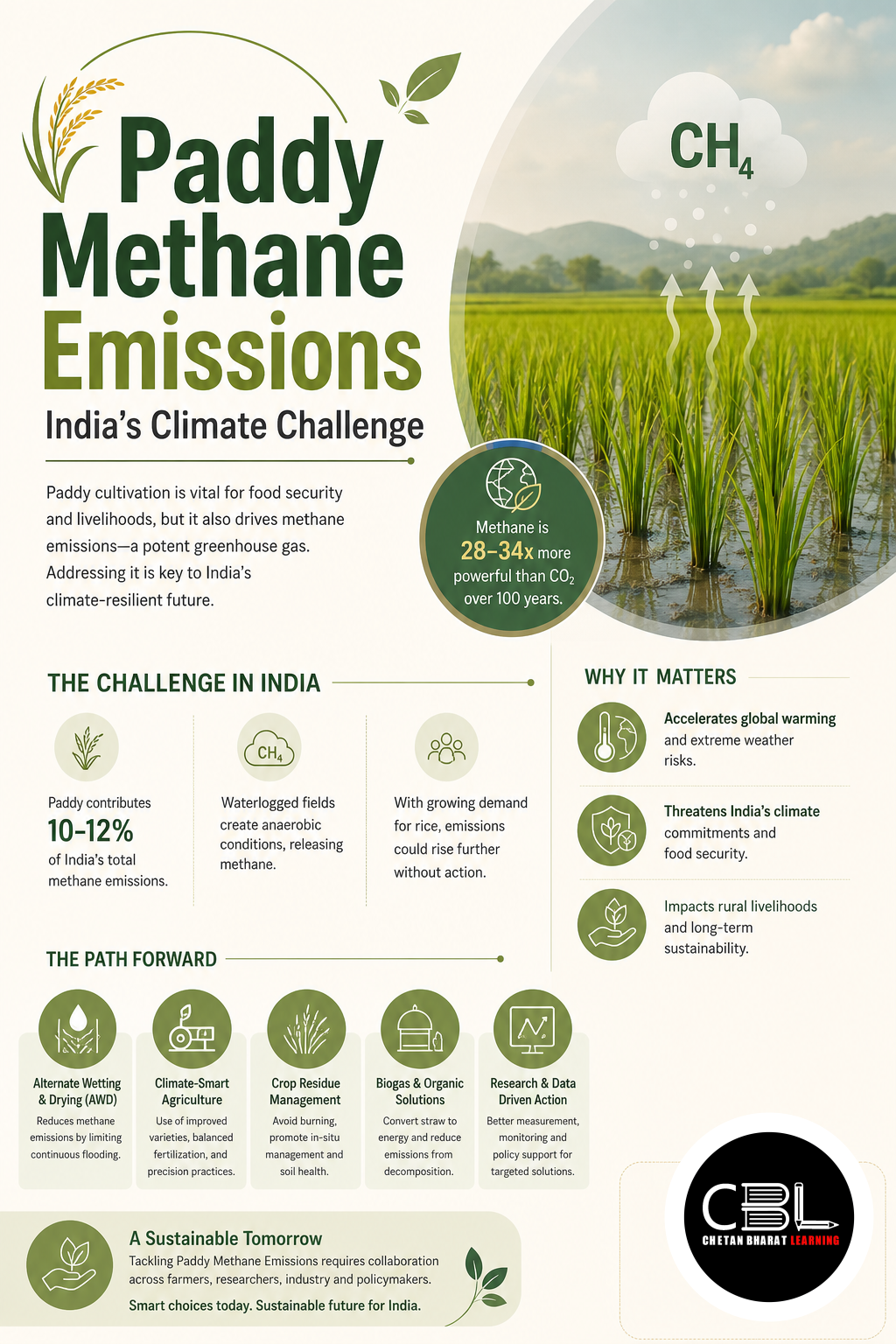
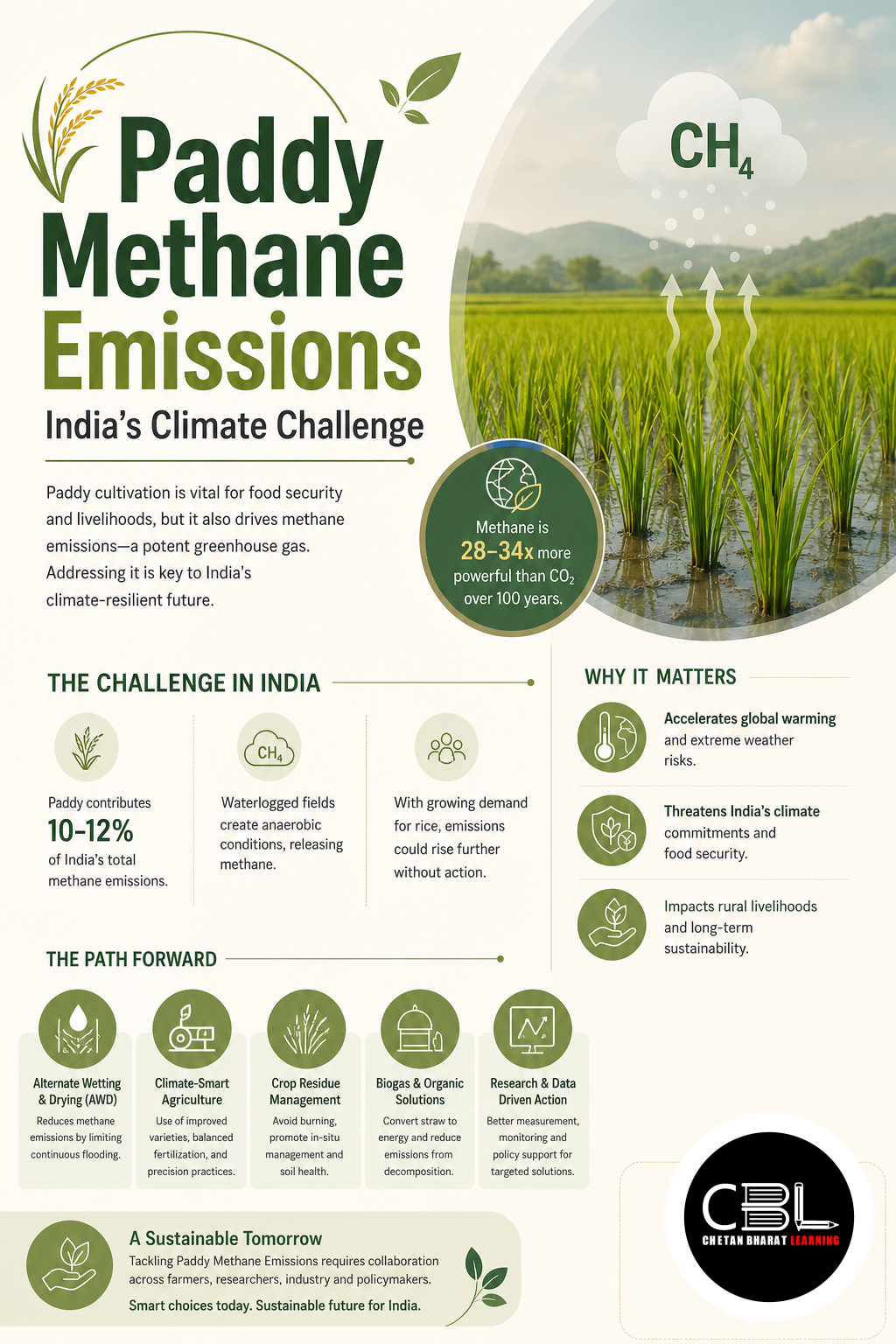
Methane is a potent greenhouse gas produced by both natural processes and human activities. In conventional irrigated rice cultivation, fields can remain flooded for extended periods. Standing water restricts the movement of atmospheric oxygen into the soil, creating anaerobic or oxygen-deficient conditions. Microorganisms known as methanogens can then break down organic material and generate methane as part of their metabolic activity.
Some of this methane reaches the atmosphere through bubbles, diffusion and the internal tissues of rice plants. Emissions vary considerably according to water regime, soil characteristics, temperature, organic inputs and cultivation practices. Rice itself is therefore not the fundamental cause; the interaction between flooded soil, organic matter and microbial processes creates favourable conditions for methane generation. This distinction is important because changing agricultural management can reduce emissions without necessarily abandoning rice production.
Why are Paddy Methane Emissions in News?
A global assessment published in Nature Food examined the greenhouse-gas balance of rice cultivation and identified irrigated paddy regions in India as major methane-emitting areas. According to the study figures, India’s irrigated paddy fields release about 3.9 million tonnes of methane annually. The assessment also highlighted a wider increase in greenhouse-gas emissions associated with global rice cultivation over recent decades.
The research is significant because it considers more than methane alone. Changes in soil organic carbon can alter the overall climate balance of cultivated land. Where soils lose stored organic carbon, they can weaken or reverse their role as carbon sinks. This means climate-smart rice policy must simultaneously consider methane, soil health, irrigation, productivity and food security. The Intergovernmental Panel on Climate Change provides authoritative scientific assessments of methane, agricultural emissions and climate mitigation.
Key Features of Paddy Methane Emissions
Methane deserves particular attention because it has a stronger warming effect per unit of mass than carbon dioxide over commonly assessed time horizons, although it remains in the atmosphere for a shorter period than carbon dioxide. Reducing anthropogenic methane can therefore complement long-term carbon dioxide mitigation. Agriculture is an important source through livestock, manure management and rice cultivation.
- Flooding and anaerobic conditions: Continuous standing water restricts oxygen availability and promotes methane-producing microorganisms.
- Organic matter: Crop residues and other organic material can provide substrates for microbial decomposition under anaerobic conditions.
- Temperature: Soil temperature influences microbial activity and can affect methane production.
- Water management: The duration and timing of flooding strongly influence the conditions under which methane is generated.
- Soil carbon: Changes in soil organic carbon must be considered alongside direct greenhouse-gas emissions when evaluating agricultural climate impacts.
- Regional variation: Emission intensity differs according to soil, climate, irrigation, crop management and local farming systems.
Several mitigation practices are relevant. Alternate Wetting and Drying periodically allows water levels to fall rather than maintaining continuous flooding. Direct Seeded Rice establishes rice without the conventional process of transplanting seedlings into puddled fields. The System of Rice Intensification uses changes in planting, water, soil and crop management. Crop diversification can reduce dependence on water-intensive paddy in suitable agro-climatic regions. Each approach, however, must be adapted to local conditions.
Challenges Related to Paddy Methane Emissions
India cannot approach agricultural methane as a simple choice between cultivation and climate mitigation. Rice is an important food crop, and millions of farmers operate under varying irrigation, soil, labour and market conditions. A practice that works effectively in one region may produce different agronomic outcomes elsewhere. Water-saving techniques can also require reliable irrigation control, suitable field conditions, extension support and farmer knowledge.
Measurement is another difficulty. Agricultural emissions are spatially heterogeneous, and estimates depend on data concerning water regimes, soils, crop duration, temperature and management. Policies based solely on broad national averages may overlook regional differences. There can also be trade-offs among methane reduction, nitrous oxide emissions, soil carbon and crop productivity, making whole-system assessment preferable to focusing on a single gas. For related climate and agriculture coverage, aspirants can use the UPSC current affairs library.
Way Forward for Climate-Smart Rice Farming
India can pursue region-specific mitigation rather than a uniform national prescription. Alternate Wetting and Drying can be promoted where farmers possess sufficient control over irrigation. Direct seeding can be encouraged where soil, weed-management and water conditions are appropriate. Crop diversification may be particularly useful in water-stressed areas where procurement incentives and irrigation patterns have encouraged paddy cultivation despite ecological constraints.
Agricultural research should evaluate emissions together with yield, farmer income, water use, labour requirements and soil health. Better field-level measurement can identify high-emission zones and determine which interventions deliver the greatest climate benefit without undermining productivity. Extension services, machinery access and economic incentives are necessary because farmers are unlikely to adopt unfamiliar practices merely because they reduce national greenhouse-gas inventories.
The larger objective should be low-emission, resource-efficient rice rather than reduced food security. Policies can integrate water conservation, improved residue management, soil-carbon restoration and suitable crop diversification while protecting farmer livelihoods. The Indian Council of Agricultural Research is an important institutional source for research on crop management and climate-resilient agriculture. Such an integrated approach can align agricultural adaptation and mitigation while strengthening the long-term sustainability of India’s food system.
Prelims Practice Corner
1. Why can continuously flooded paddy fields produce significant quantities of methane?
- (a) Flooding increases atmospheric oxygen in soil
- (b) Anaerobic conditions favour methane-producing microorganisms
- (c) Rice plants convert carbon dioxide directly into methane
- (d) Irrigation water always contains large quantities of methane
Answer: (b) Flooding restricts oxygen diffusion into soil and can create anaerobic conditions favourable for methanogens.
2. Consider the following practices:
- 1. Alternate Wetting and Drying
- 2. Direct Seeded Rice
- 3. System of Rice Intensification
Which of the above can be associated with climate-smart rice cultivation?
- (a) 1 only
- (b) 1 and 2 only
- (c) 2 and 3 only
- (d) 1, 2 and 3
Answer: (d) 1, 2 and 3.
3. Methanogens generally thrive under:
- (a) Anaerobic conditions
- (b) Highly oxygenated conditions only
- (c) Stratospheric conditions
- (d) Desert surfaces only
Answer: (a) Anaerobic conditions.
4. With reference to soil organic carbon, consider the following statements:
- 1. Soil can store carbon in organic matter.
- 2. Loss of soil organic carbon can affect the greenhouse-gas balance of agricultural land.
Which is/are correct?
- (a) 1 only
- (b) 2 only
- (c) Both 1 and 2
- (d) Neither 1 nor 2
Answer: (c) Both 1 and 2.
5. Which one of the following best describes Alternate Wetting and Drying in rice cultivation?
- (a) Maintaining permanent deep flooding
- (b) Periodically allowing field water levels to decline before re-irrigation
- (c) Growing rice exclusively through hydroponics
- (d) Replacing irrigation water with seawater
Answer: (b) AWD alternates flooded and non-flooded periods under managed irrigation conditions.
Mains Practice Questions
1. Methane mitigation in India’s rice sector requires balancing climate objectives with food security and farmer livelihoods. Discuss. (10 marks)
Outline:
- Methane formation in flooded fields
- Importance of rice
- Climate implications
- AWD, DSR and SRI
- Regional constraints
- Farmer incentives and extension
- Integrated approach protecting productivity and income
2. Climate-smart agriculture must address greenhouse-gas emissions, water use and soil health simultaneously rather than treating them as separate challenges. Examine with reference to rice cultivation in India. (15 marks)
Outline:
- Agriculture-climate relationship
- Methane from flooding
- Groundwater and irrigation concerns
- Soil organic carbon
- Mitigation trade-offs
- Crop diversification
- Research and measurement
- Region-specific policies
- Sustainable food systems
FAQs on Paddy Methane Emissions
Why do rice fields emit methane?
Prolonged flooding can create oxygen-deficient soil conditions in which methane-producing microorganisms decompose organic matter and release methane.
Can methane from rice cultivation be reduced without stopping rice production?
Yes. Suitable water and crop-management techniques such as Alternate Wetting and Drying, direct seeding and other locally adapted practices can reduce conditions favourable to methane formation while maintaining production objectives.
Why is soil organic carbon important in this debate?
Soils can store substantial carbon in organic matter. Loss of this stored carbon can worsen the overall climate balance of agricultural land, so mitigation strategies should consider both direct greenhouse-gas emissions and long-term soil health.
Related Current Affairs
Preparing for UPSC, PCS or HCS?
Talk to a mentor at Chetan Bharat Learning, Chandigarh. Free guidance on choosing the right exam and building a study plan.
Chat on WhatsAppCall 97793 53345UPSC / IAS / PCS coaching in Chandigarh · Trusted by aspirants across Punjab & Haryana
Leave a Reply
You must be logged in to post a comment.