
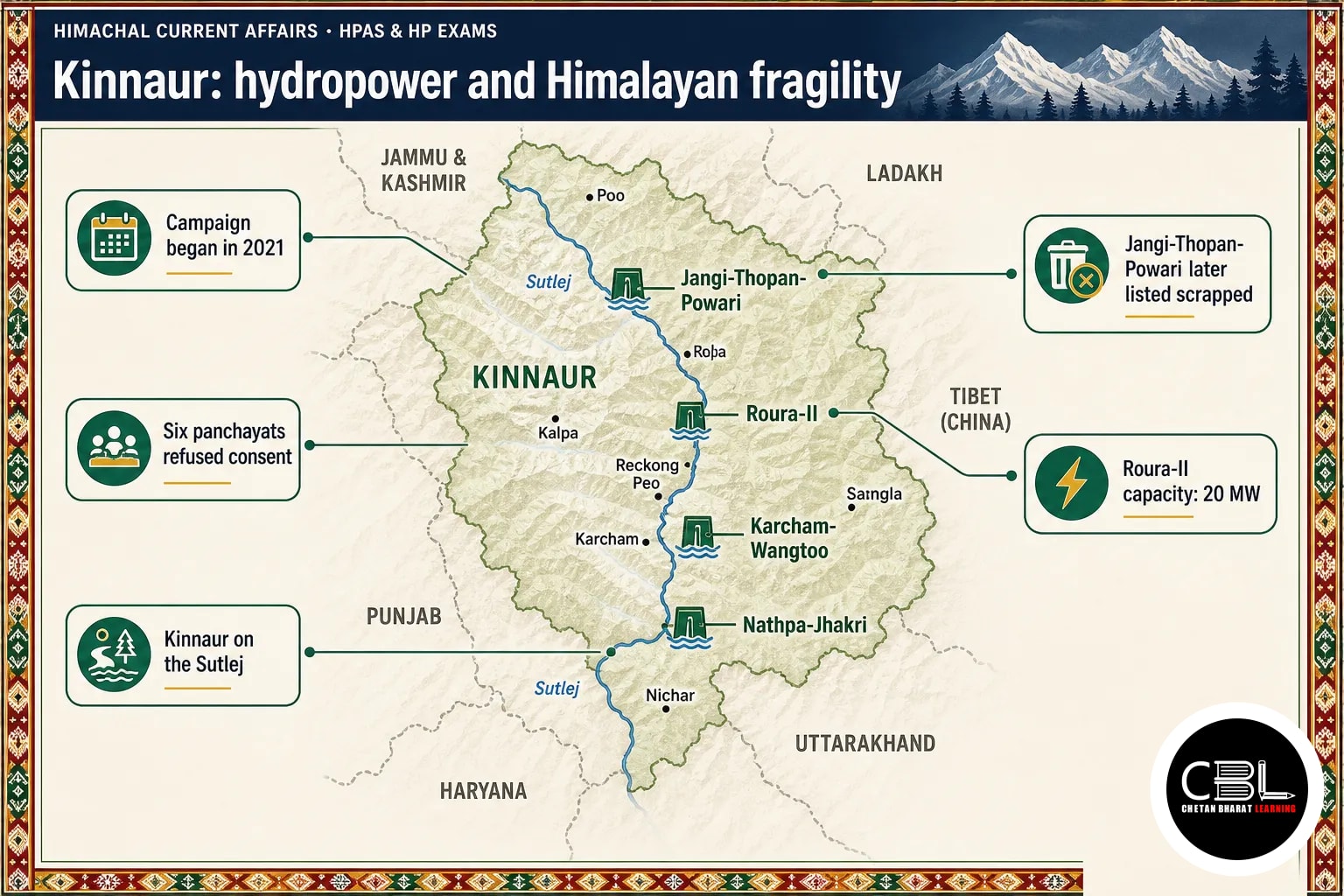
From 2021, Kinnaur residents campaigned against new hydropower projects after landslides. Six panchayats refused consent for the Jangi-Thopan-Powari project, later listed as scrapped. In July 2025, the Supreme Court cited hydropower among human causes of Himachal’s ecological crisis. Complaints about blasting and dumping followed in May 2026. In November 2026, Himachal cancelled 13 hydro allotments above 25 MW statewide, amid a push for higher royalty.
Timeline: from forest rights to allotment cancellations
- 2006forest rightsRights law
The Forest Rights Act, 2006 provided a framework for recognising forest rights.
- 2021campaign beginsLocal opposition
Kinnaur residents began the No Means No campaign after landslides.
- July2025Court warning
The Supreme Court cited hydropower projects among human causes of Himachal’s ecological crisis.
- May2026Complaints
Complaints alleged unscientific blasting and illegal muck dumping, including at the 20 MW Roura-II project.
- Nov2026Cancellations
Himachal cancelled 13 hydro allotments above 25 MW statewide.
- Kinnaur residents launched the No Means No campaign against new hydropower projects.
- Six panchayats refused consent for Jangi-Thopan-Powari.
- Jangi-Thopan-Powari was later listed as scrapped.
- Roura-II is a 20 MW project named in the 2026 complaints.
- 13 allotments above 25 MW were cancelled statewide in November 2026.
What is Kinnaur’s No Means No campaign?
The campaign began in 2021 after landslides, with residents demanding a halt to new hydroelectric projects. Six affected panchayats refused consent for Jangi-Thopan-Powari, a project valued at about Rs 5,700 crore.
Kinnaur is a tribal district on the Sutlej and has Fifth Schedule areas. The Forest Rights Act, 2006 provides for recognition of forest rights; forest diversion procedures also require gram sabha consent.
Why it matters
Project decisions can affect land, forest access and safety. The campaign brought local consent into the debate.
Blasting and muck disposal raise concerns in landslide-prone terrain. The 2026 complaints were allegations, not findings of guilt.
Hydropower offers electricity and potential state revenue, but decisions must also address ecological risks and rights.
- River: The Sutlej flows through Kinnaur.
- Projects: Karcham-Wangtoo and Nathpa-Jhakri are hydropower projects on the Sutlej.
- Seismic setting: Kinnaur lies in seismic zones IV–V.
Key data
| Point | Details |
|---|---|
| Campaign | No Means No, from 2021 |
| Local consent | Six affected panchayats refused consent for Jangi-Thopan-Powari |
| Project value | Jangi-Thopan-Powari: about Rs 5,700 crore |
| Roura-II | 20 MW; named in May 2026 complaints |
| Statewide decisions | 194 stalled hydro projects cancelled by the cabinet in 2025; 13 allotments above 25 MW cancelled in November 2026 |
| Rights framework | Forest Rights Act, 2006; Fifth Schedule areas in Kinnaur |
Way forward
- Respect rights: Complete forest rights recognition and obtain required gram sabha consent before diversion.
- Assess cumulative risk: Examine combined project impacts on slopes, rivers and settlements.
- Enforce safeguards: Inspect blasting and muck disposal and act on verified violations.
- Include communities: Share project information and provide accessible channels for public concerns.
- Balance energy choices: Weigh electricity and revenue benefits against Himalayan ecological risks.
HPAS Mains practice questions
Explain the concerns behind Kinnaur’s No Means No campaign. (150 words)
Answer pointers:
- Introduce the campaign after the 2021 landslides.
- Discuss local consent and the six panchayats.
- Identify slope safety and forest rights concerns.
- Conclude with participation and ecological safeguards.
Critically examine hydropower development in Himachal’s fragile mountain regions. (250 words)
Answer pointers:
- Introduce hydropower’s role in electricity and revenue.
- Discuss potential benefits alongside development needs.
- Examine cumulative ecological risks, rights and local concerns.
- Conclude with rigorous assessment and enforcement.
As Sub-Divisional Magistrate (SDM) in Kinnaur, how would you respond to complaints about project blasting and muck dumping? (150 words)
Answer pointers:
- Record complaints and prioritise immediate safety.
- Arrange joint inspections with competent technical authorities.
- Hear affected communities and check applicable permissions.
- Act on verified violations and monitor compliance.
Discuss how forest rights and Fifth Schedule protections relate to hydropower decisions in Kinnaur. (150 words)
Answer pointers:
- Introduce Kinnaur’s tribal and forest setting.
- Explain forest rights recognition and gram sabha consent.
- Link Fifth Schedule protections to local participation.
- Conclude with lawful, transparent decision-making.
For Himachal Pradesh Administrative Service (HPAS) prelims and Himachal Pradesh Rajya Chayan Aayog (HPRCA) papers, memorise the campaign, project and six panchayats. For mains, connect consent with ecological safeguards and energy needs.
MCQ Practice Corner
Q1. Consider the following statements:
1. Kinnaur’s No Means No campaign opposed new hydroelectric projects.
2. Six panchayats refused consent for Jangi-Thopan-Powari.
3. Roura-II has a capacity of 200 MW.
Which statements are correct?
(a) 1 and 2 only (b) 2 and 3 only (c) 1 and 3 only (d) 1, 2 and 3
Show answer
Answer: (a) because Roura-II is a 20 MW project, while statements 1 and 2 are correct.
Q2. Which law provides the framework for recognising forest rights relevant to forest diversion?
(a) Forest Rights Act, 2006 (b) Indian Contract Act, 1872 (c) Representation of the People Act, 1951 (d) Right to Information Act, 2005
Show answer
Answer: (a) because the Forest Rights Act, 2006 provides for recognition of forest rights.
Q3. Kinnaur’s No Means No campaign opposed which kind of new projects?
(a) Hydroelectric projects (b) Airports (c) Railway stations (d) Universities
Show answer
Answer: (a) because residents demanded a halt to new hydroelectric projects.
Q4. Which river flows through Kinnaur?
(a) Ravi (b) Sutlej (c) Yamuna (d) Ganga
Show answer
Answer: (b) because the Sutlej flows through Kinnaur.
Frequently Asked Questions
What is the No Means No campaign in Kinnaur?
It is a residents’ campaign opposing new hydroelectric projects. It began in 2021 after landslides.
What happened to the Jangi-Thopan-Powari project?
It was later listed as scrapped. Six affected panchayats had refused consent for the project.
Why is hydropower debated in Kinnaur?
The debate concerns energy and revenue alongside ecological risks and local rights. Complaints in 2026 alleged unscientific blasting and illegal muck dumping.
Sources: Outlook, The Wire Science, The Tribune, The Chenab Times
Related Current Affairs
More Himachal topics for HPAS & HP exams
Preparing for UPSC, PCS or HCS?
Talk to a mentor at Chetan Bharat Learning, Chandigarh. Free guidance on choosing the right exam and building a study plan.
Chat on WhatsAppCall 97793 53345UPSC / IAS / PCS coaching in Chandigarh · Trusted by aspirants across Punjab & Haryana



Leave a Reply
You must be logged in to post a comment.