

UPSC Mapping
| Prelims | IRDAI, Digital Public Infrastructure and Federated Data |
|---|---|
| Mains | GS Paper III — Digital Economy and Financial Inclusion |
Quick Facts
| Status | Proposed registry |
|---|---|
| Regulator | IRDAI |
| Model | Insurance DPI |
| Architecture | Federated |
| Data principle | Source-system primacy |
What is the Public Insurance Registry?
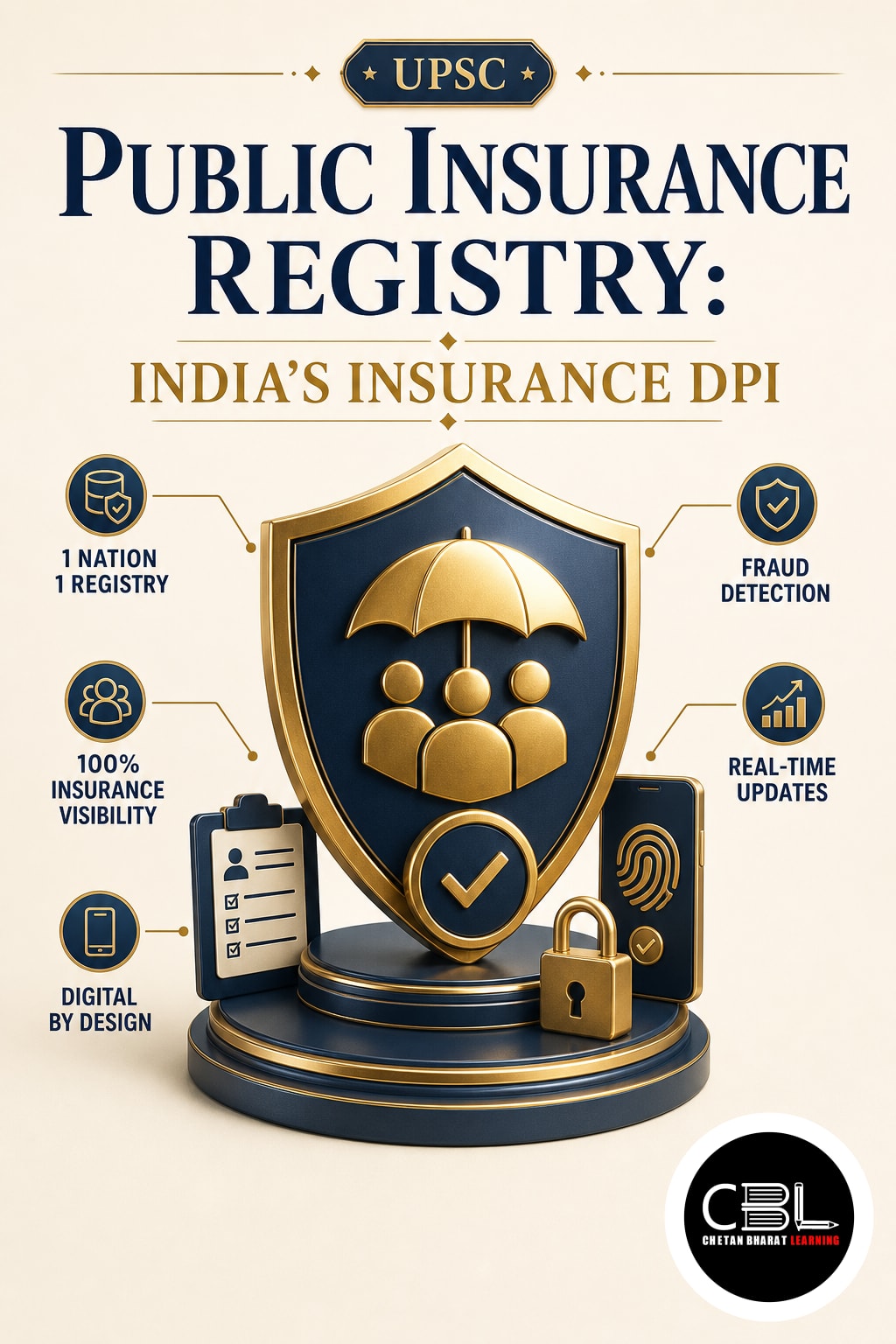
The Public Insurance Registry is a proposed population-scale Digital Public Infrastructure for discovering, verifying and exchanging insurance information. It would connect authorised participants across life, health and general insurance through common standards. The original institution would continue maintaining its records under the principle of source-system primacy.
The registry is intended as an information-exchange layer rather than a universal insurer or a product marketplace. A policyholder could obtain a consolidated view of policies, nominees, renewals, claims and unclaimed benefits through permitted services. Insurers and regulators could access verified information for legitimate purposes, subject to identity, consent, role and legal safeguards.
Why is the Public Insurance Registry in News?
The Public Insurance Registry entered the policy debate after IRDAI issued a consultation paper on September 1, 2026. The regulator proposed an interoperable and non-exclusionary information layer to reduce fragmented records and repeated verification. The proposal followed earlier stakeholder discussions on modernising insurance data infrastructure and coordinating it with Bima Sugam.
The IRDAI consultation process examines governance, access, privacy and implementation. The paper reportedly proposes restructuring the Insurance Information Bureau into a not-for-profit company wholly owned by IRDAI to develop the registry under a dedicated framework. These proposals remain subject to consultation and final regulatory decisions.
Key Features
The design adapts India’s DPI experience to insurance while recognising that sensitive financial and health information requires strict purpose limitation. Its success will depend on whether common services lower friction without converting valuable personal information into an unrestricted commercial asset.
- Federated architecture: Insurers and other originating institutions would retain primary records, while the common layer would enable authorised discovery and verification without routinely pooling every raw dataset into one central repository; this model can reduce duplication and concentration while preserving accountability because each source remains responsible for updating and correcting its records.
- Interoperable building blocks: Shared standards, identifiers and interfaces could help insurers, intermediaries, reinsurers, regulators and policyholders exchange reliable information while allowing participating systems to retain distinct products and operational models; common definitions for policy status, claims, nominees and coverage would still be needed so identical fields carry consistent meaning across organisations.
- Policyholder visibility: A consolidated interface could show active and lapsed policies, nominees, renewal dates, claim status and unclaimed benefits, reducing dependence on scattered documents or separate insurer portals; families could more easily locate cover after emergencies or death, while reminders may reduce accidental lapses caused by missed communications.
- Risk and fraud intelligence: Verified policy and claims histories could improve underwriting, identify duplicate or suspicious claims and support aggregate exposure assessment, provided decision-making remains lawful, explainable and subject to correction; the registry should support professional judgement rather than create an automatic score that unfairly excludes people because historical records are incomplete or disputed.
- Ecosystem linkages: Permitted connections with KYC, vehicle, disaster, health or other public systems could simplify servicing and claims, but each linkage would need a defined purpose, legal authority and proportionate data access; technical possibility alone cannot justify a connection, especially where information reveals medical conditions, household vulnerability, location or financial behaviour.
Challenges
A registry can reduce information gaps only when users trust its governance and remedies. Poorly designed access could magnify existing exclusions even while the technology appears efficient, comprehensive and inclusive nationwide. Related developments in finance and regulation are covered in CBL’s economy current affairs analysis.
- Privacy and cybersecurity: Federated storage reduces some concentration risks but does not eliminate unauthorised queries, identity theft, profiling or breaches across connected systems, making encryption, audit trails and rapid incident response essential; security requirements should cover application interfaces, service providers, employee access, authentication devices and the weakest connected participant, not merely the central coordinating layer.
- Consent quality: People may approve broad requests without understanding their consequences, so consent must remain informed, specific, purpose-bound and revocable rather than becoming a routine checkbox imposed during purchase or claims; refusal of an optional data use should not silently block essential servicing, and policyholders must be able to review earlier permissions.
- Data accuracy: Inconsistent names, nominee details, legacy records and claim classifications can produce misleading outputs, while policyholders need accessible mechanisms to inspect, correct and contest information before it affects underwriting or service; correction requests should propagate to authorised users so one obsolete error does not repeatedly travel between insurers and digital platforms.
- Uneven participation: A voluntary or phased rollout may initially leave significant gaps, yet premature mandatory use could burden smaller insurers and intermediaries that lack modern systems, trained staff or adequate cybersecurity capacity; phased onboarding should therefore combine minimum standards, technical assistance, realistic timelines and monitoring of whether excluded records disadvantage rural or low-income customers.
- Governance neutrality: The proposed operating body must balance regulator oversight with independent execution and stakeholder representation, while preventing industry capture, commercial discrimination and opaque algorithmic decision-making; transparent board processes, conflict-of-interest rules, public reporting and external review would help preserve legitimacy when commercial interests differ across participating insurers.
Way Forward
The Public Insurance Registry should begin with limited, high-value uses such as policy discovery, nominee verification and unclaimed-benefit tracing. IRDAI must publish clear rules for data purpose, retention, access, correction, grievance redressal and independent audits. Open technical standards and sandbox testing can improve interoperability before sensitive linkages expand across the ecosystem.
Implementation must align with the Digital Personal Data Protection Act and sector-specific duties strengthened through insurance-law reforms described by the Ministry of Finance. Policyholders should receive plain-language notices, usable consent controls and quick correction channels. Independent oversight, privacy-enhancing technology and phased inclusion of smaller participants can turn interoperability into genuine consumer empowerment.
Prelims Practice Corner
-
Which institution proposed the national insurance information registry?
- (a) RBI
- (b) SEBI
- (c) IRDAI
- (d) PFRDA
Answer: (c) IRDAI issued the consultation paper proposing the registry for the insurance sector.
-
What does source-system primacy mean in a federated data architecture?
- (a) Data is deleted after every query
- (b) The originating institution remains the primary record keeper
- (c) Every record moves to one central database
- (d) Only government departments may access data
Answer: (b) The institution that creates and maintains a record remains its primary source.
-
Consider the following statements: 1. Federated architecture necessarily transfers every raw record into one warehouse. 2. Interoperability can allow different systems to exchange verified information. Which statements are correct?
- (a) 1 only
- (b) 2 only
- (c) Both 1 and 2
- (d) Neither 1 nor 2
Answer: (b) Federated systems retain distributed source records while interoperability supports controlled exchange.
-
The Insurance Information Bureau of India primarily performs which function?
- (a) Monetary policy formulation
- (b) Insurance data and analytics
- (c) Securities listing
- (d) Pension-fund licensing
Answer: (b) IIB serves as a data and analytics body for the insurance ecosystem.
-
Which principle best protects policyholders when insurance data is shared?
- (a) Unlimited retention
- (b) Secret scoring
- (c) Purpose limitation and informed consent
- (d) Unrestricted commercial access
Answer: (c) Purpose limitation and informed consent restrict data use to legitimate, understood objectives.
Mains Practice Questions
-
Q1. Explain how federated Digital Public Infrastructure can reduce information asymmetry in India’s insurance sector. (10 marks)
Answer Structure
Intro: Define federated DPI as an interoperable layer connecting records retained by source institutions.
Body: Cover policy discovery, verified claims history, portability, underwriting, fraud control, regulatory oversight and source-system primacy.
Conclusion: Link trusted information exchange with competition, inclusion and improved consumer service.
-
Q2. Assess the privacy, governance and implementation safeguards required for a population-scale insurance data infrastructure. (15 marks)
Answer Structure
Intro: Frame insurance records as sensitive data requiring trust alongside interoperability.
Body: Discuss consent, purpose limitation, cybersecurity, correction rights, algorithmic accountability, institutional neutrality, phased adoption and independent audits.
Conclusion: Advocate rights-preserving digital infrastructure that makes policyholders active beneficiaries rather than passive data subjects.
FAQs on Public Insurance Registry
Is the Public Insurance Registry already operational?
No. IRDAI has placed the framework in consultation, and its final design may change. Implementation will require regulatory, technical and institutional decisions.
How is the registry different from Bima Sugam?
The registry is conceived mainly as a common insurance-information layer. Bima Sugam is designed as a digital platform supporting insurance purchase, servicing and related transactions.
Will federated architecture eliminate privacy risks?
No. Distributed storage can reduce central concentration, but connected systems still face unauthorised access and misuse. Strong consent, security, audit and grievance safeguards remain necessary.
Related Current Affairs
Preparing for UPSC, PCS or HCS?
Talk to a mentor at Chetan Bharat Learning, Chandigarh. Free guidance on choosing the right exam and building a study plan.
Chat on WhatsAppCall 97793 53345UPSC / IAS / PCS coaching in Chandigarh · Trusted by aspirants across Punjab & Haryana
Leave a Reply
You must be logged in to post a comment.