
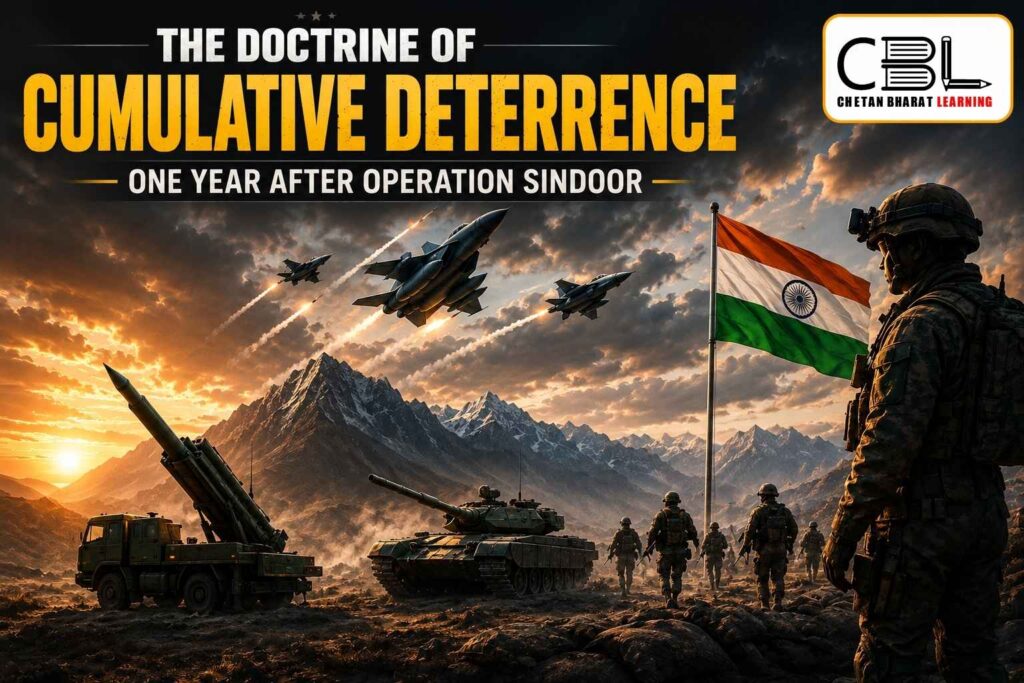
Exactly twelve months ago, the skies over the Indian subcontinent witnessed a dramatic tactical shift. Following the tragic Pahalgam terror attack of April 22, 2025, which claimed the lives of 26 innocent civilians, New Delhi completely altered its traditional defensive playbook.
On the intervening night of May 6–7, 2025, India launched Operation Sindoor — an unprecedented 88-hour tri-service offensive targeting nine major terror infrastructure hubs deep inside Pakistan and Pakistan-occupied Jammu & Kashmir (PoJK).
One year later, the tactical dust has settled, but the strategic landscape has permanently changed. Operation Sindoor was not merely a brief retaliatory strike like the 2016 Surgical Strikes or the 2019 Balakot air operations. Instead, it represented a calibrated deployment of India’s Comprehensive National Power. As military leadership later observed, it marked the practical application of “Smart Power” — combining precision military action with economic and information-based statecraft to establish a “new normal” in cross-border security.
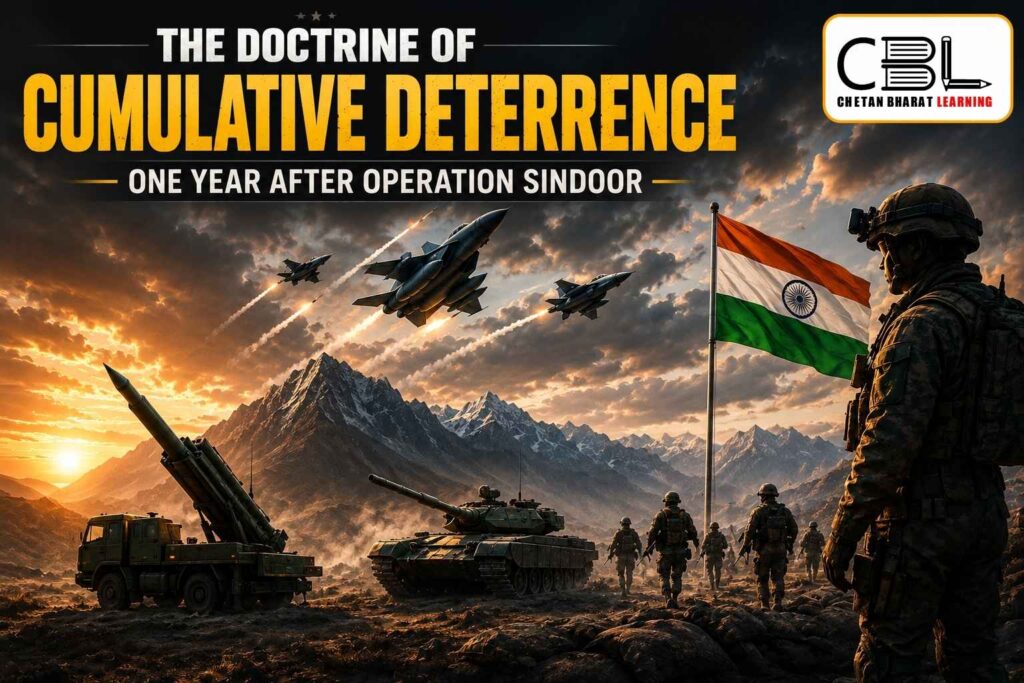
The Strategic Shift: From Punitive Retaliation to Cumulative Deterrence
The Historical Blueprint vs. The New Normal
Historically, India’s responses to cross-border provocations followed a predictable pattern:
- Diplomatic isolation
- International pressure campaigns
- Limited and localized military responses
Operation Sindoor fundamentally changed this approach.
EVOLUTION OF INDIA’S RESPONSE
| Year | Operation | Nature of Response |
|---|---|---|
| 2016 | Surgical Strikes | Localized ground-based cross-border raids |
| 2019 | Balakot Airstrike | Air power used beyond the LoC against a single target |
| 2025 | Operation Sindoor | Tri-service, 88-hour multi-domain stand-off campaign |
Understanding Cumulative Deterrence
Earlier defence doctrines focused on preventing conflict entirely through the threat of massive retaliation. However, proxy networks operating against India often do not function under conventional state logic. Because of this, Indian strategic thinking gradually evolved toward the doctrine of cumulative deterrence.
Under this framework:
- Precision strikes themselves become instruments of coercion.
- Repeated and calibrated actions continuously impose costs on hostile networks.
- Terror infrastructure becomes increasingly expensive and difficult to sustain.
Instead of depending on one massive retaliatory response, cumulative deterrence creates sustained pressure through continuous strategic signaling and multi-domain capability projection.
The Tri-Service Tactical Blueprint
Operation Sindoor stood out because of the extraordinary coordination among all branches of the Indian Armed Forces under an Integrated Command and Control Strategy (ICCS).
The Air Domain
The Indian Air Force (IAF) deployed:
- SCALP missiles
- HAMMER precision-guided weapons
- Loitering munitions
These systems targeted infrastructure linked to:
- Lashkar-e-Taiba (LeT)
- Jaish-e-Mohammed (JeM)
including facilities in Muridke and Bahawalpur — all without physically crossing the international border.
This demonstrated India’s growing stand-off strike capability.
The Maritime Domain
The Indian Navy deployed its Carrier Battle Group (CBG) in the northern Arabian Sea. The objective was to:
- Establish maritime dominance
- Create an air-defence shield
- Deter asymmetric naval or aerial retaliation
The deployment also strengthened India’s strategic posture near the Makran coast.
The Land and Border Domain
The Indian Army and Border Security Force (BSF) maintained a strict defensive posture along:
- The International Border (IB)
- The Line of Control (LoC)
During the period of heightened tension:
✔ Multiple infiltration attempts were neutralized
✔ Border stability was maintained successfully
Beyond the Kinetic: Fusing Water and Information Diplomacy
A major feature of Operation Sindoor was the integration of non-kinetic statecraft. The operation demonstrated how military action could be reinforced through wider policy instruments.
The Indus Waters Treaty (IWT) Mandate
In a major strategic shift, India placed the 1960 Indus Waters Treaty in abeyance, declaring that:
“Blood and water cannot flow together.”
This move targeted a key structural vulnerability because Pakistan heavily depends on the Indus river system for:
- Agriculture
- Irrigation
- Economic stability
For India, this policy change opened opportunities to accelerate:
- Run-of-the-river projects
- Water storage infrastructure
- Regional development projects in Jammu & Kashmir, Punjab, and Ladakh
This effectively transformed a long-standing diplomatic limitation into a developmental advantage.
The Intelligence Windfall: The PL-15E Breakthrough
During the aerial engagements of May 2025, the Indian Air Force recovered intact debris from a PL-15E Beyond-Visual-Range (BVR) missile near Kamahi Devi village in Hoshiarpur, Punjab.
INTACT PL-15E RECOVERY → DRDO/IAF LAB ANALYSIS → DECODED SIGNATURES → EW DATABASE INTEGRATION
Because modern long-range missiles function as highly sophisticated electronic systems, physical access to the missile allowed DRDO and IAF specialists to:
- Analyze internal systems
- Decode radar emissions
- Study frequency-hopping patterns
This data was directly integrated into India’s electronic warfare (EW) systems, providing frontline fighter squadrons with a long-term technological advantage.
Strategic Scorecard: One Year Later
| Domain of Impact | Strategic Outcome | UPSC Relevance |
|---|---|---|
| Tactical Deterrence | Elimination of 9 major launchpads and over 100 proxy assets | Counter-terror operations |
| Electronic Warfare | Profiling of Chinese-origin PL-15E missile systems | Technology capture in warfare |
| Hydrological Leverage | Accelerated western river infrastructure projects | Water diplomacy and resource management |
| Geopolitical Alignments | Stronger polarization in regional security architecture | International Relations |
Ongoing Challenges & Bottlenecks
1. Persistence of Proxy Networks
Although major infrastructure was damaged, proxy ecosystems often reorganize over time. Continuous surveillance and intelligence operations remain essential.
2. Escalation Risks
Multi-domain stand-off campaigns require extremely careful execution to avoid unintended escalation between two nuclear-armed neighbours.
3. The Technological Race
Asymmetric warfare is rapidly evolving through:
- Drones
- Cyber capabilities
- AI-enabled surveillance systems
India’s domestic defence ecosystem must innovate faster to maintain strategic superiority.
Masterclass Toolkit
Prelims Pointers
Integrated Command and Control Strategy (ICCS)
A system that integrates real-time surveillance and operational data across military branches for rapid threat assessment and coordinated response.
PL-15E Missile
A Chinese-designed export variant Beyond-Visual-Range (BVR) air-to-air missile with a reported range of nearly 145 km.
Indus Waters Treaty (1960)
Brokered by the World Bank, the treaty allocates:
- Eastern Rivers (Sutlej, Beas, Ravi) to India
- Western Rivers (Indus, Jhelum, Chenab) to Pakistan
while permitting India limited non-consumptive usage rights on western rivers.
Mains Analysis
Core Theme
“Operation Sindoor reflects India’s transition from isolated retaliatory actions toward an integrated doctrine of cumulative deterrence.”
Key Concept
The fusion of kinetic strikes with infrastructure development and water diplomacy demonstrates how national security can align directly with long-term developmental goals.
Essay Angle
Theme
“Smart power is not the celebration of force, but the precise calibration of comprehensive national capability.”
Approach
Operation Sindoor can be used to demonstrate how modern states protect national interests through:
- Strategic restraint
- Integrated warfare
- Economic signaling
- Resource diplomacy
- Technological superiority
Question Bank
Prelims MCQ
Q. With reference to the Indus Waters Treaty (1960), consider the following statements:
- The treaty gives India unrestricted use of all water from the Eastern rivers — Sutlej, Beas, and Ravi.
- India is completely prohibited from constructing run-of-the-river hydroelectric projects on the Western rivers.
- The treaty was signed under the aegis of the International Court of Justice (ICJ).
Which of the statements given above is/are correct?
A) 1 only
B) 1 and 2 only
C) 3 only
D) 1, 2, and 3
Answer: A) 1 only
Explanation
- Statement 2 is incorrect because India is permitted to construct run-of-the-river projects on western rivers under specific regulations.
- Statement 3 is incorrect because the treaty was mediated by the World Bank, not the ICJ.
Mains Question
Q. “One year after Operation Sindoor, India’s defence posture reflects a shift toward cumulative deterrence.” Analyze how this approach combines kinetic military operations with economic and diplomatic tools to strengthen national security. (15 Marks, 250 Words)
FAQ Section
What was Operation Sindoor?
Operation Sindoor was a major military operation launched by India in May 2025 targeting terror launchpads after the deadly Pahalgam terror attack.
Why was it different from earlier operations?
Unlike earlier short-duration operations, it was a coordinated 88-hour tri-service campaign involving the Army, Navy, and Air Force operating under an integrated command structure.
What was the major non-military step?
India temporarily suspended the Indus Waters Treaty, signaling that strategic resources could also become instruments of national security policy.
What technological advantage did India gain?
India recovered an advanced PL-15E missile, allowing scientists to study its electronic architecture and improve India’s electronic warfare capabilities.
What does stand-off warfare mean?
Stand-off warfare refers to striking targets from a safe distance using precision-guided systems without entering hostile territory directly.
How does missile recovery help electronic warfare teams?
Recovered missile systems help engineers analyze radar frequencies and tracking systems, allowing the development of stronger jamming and defensive technologies.
Conclusion
One year after Operation Sindoor, India’s evolving national-security doctrine has become increasingly clear. The country is steadily moving toward a framework that combines:
- Precision military operations
- Water diplomacy
- Technological intelligence
- Strategic signaling
- Economic leverage
This integrated approach reflects a broader doctrine of cumulative deterrence — where long-term national security is maintained through the coordinated application of comprehensive national power.
Related Current Affairs
Preparing for UPSC, PCS or HCS?
Talk to a mentor at Chetan Bharat Learning, Chandigarh. Free guidance on choosing the right exam and building a study plan.
Chat on WhatsAppCall 97793 53345UPSC / IAS / PCS coaching in Chandigarh · Trusted by aspirants across Punjab & Haryana
Leave a Reply
You must be logged in to post a comment.