
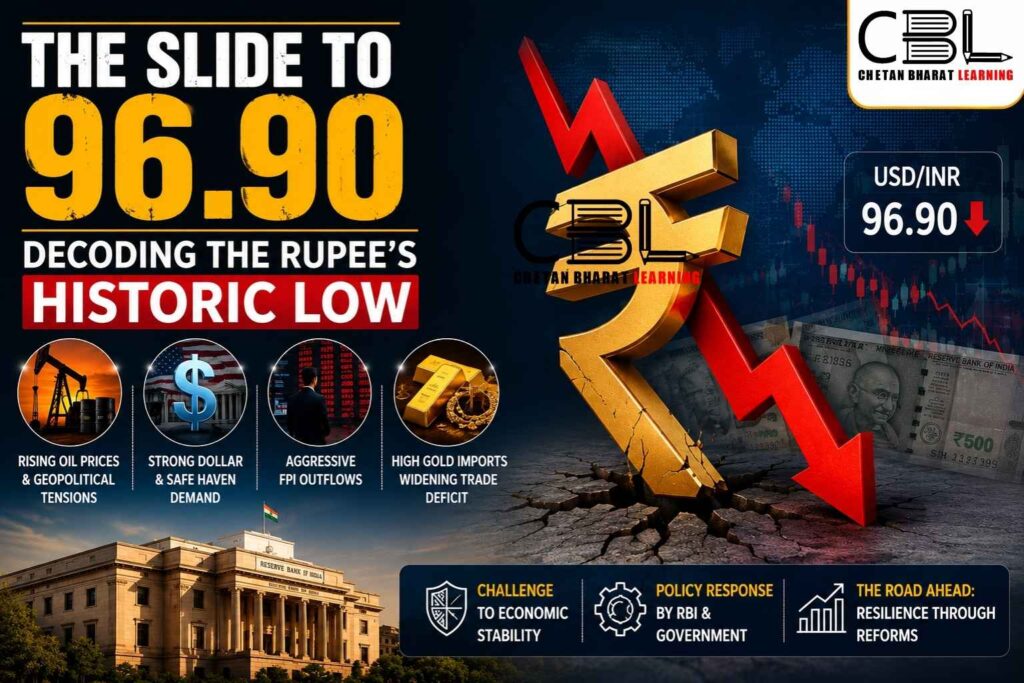
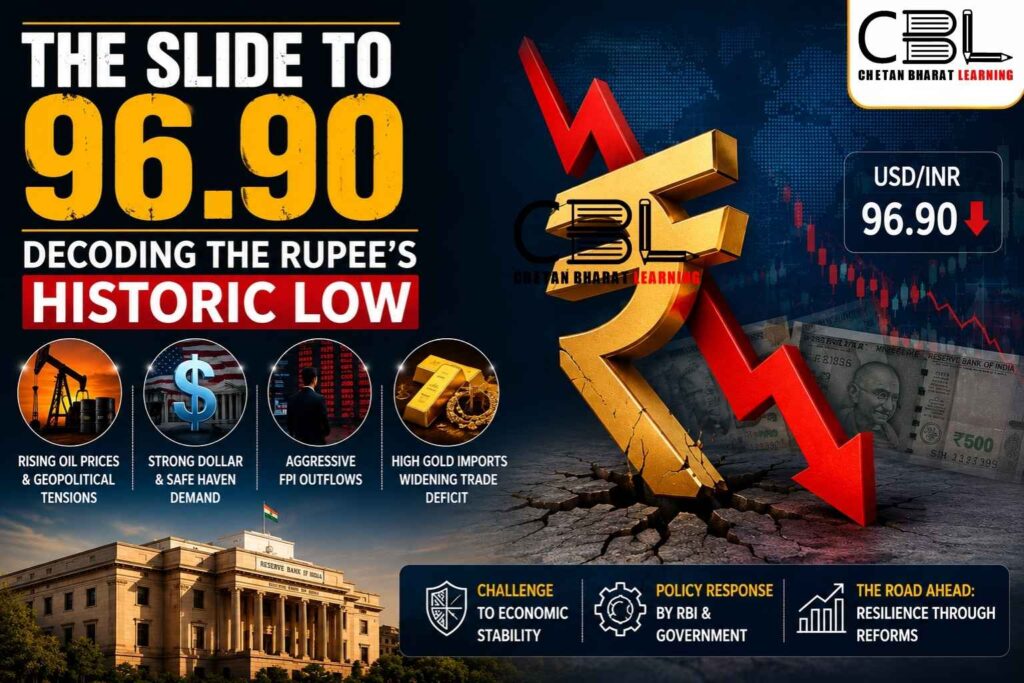
The Indian Rupee (INR) has hit a fresh lifetime low of 96.90 against the U.S. Dollar (USD), capping off a multi-session losing streak. This is not just a market volatility headline; it represents a major macro-economic shift affecting India’s external sector resilience, balance of payments, and domestic inflation.
1. The Core Triggers: Why is the Rupee Falling?
The current depreciation is a mix of global geopolitical shocks and structural external pressures:
- The Geopolitical Oil Shock: Following the escalation of conflicts in West Asia (specifically the US-Iran geopolitical tensions) and disruptions in the Strait of Hormuz, Brent crude has surged above $110 per barrel. Because India imports nearly 90% of its crude oil requirements, expensive oil massively swells India’s import bill, triggering a structural surge in dollar demand.
- The “Safe Haven” Flight & Strong Dollar: Heightened global risk has led international investors to pull capital out of emerging markets and park it in safer assets like U.S. Treasuries (with 10-year yields climbing sharply). This has pushed the Dollar Index (DXY) toward the 99.30 mark, systematically weakening emerging market currencies.
- Aggressive FPI Outflows: Foreign Portfolio Investors (FPIs) have turned into heavy net sellers in the domestic market, offloading billions in Indian equities and bonds in 2026 alone. This capital flight dries up dollar liquidity in the domestic market.
- The Gold Import Burden: Alongside oil, gold remains a major component of India’s import basket. High global gold prices combined with steady domestic demand have further widened the trade deficit.
2. Macro-Economic Implications for India
A falling rupee has a cascading effect across the Indian economy, presenting a classic policy dilemma for the Reserve Bank of India (RBI).
| Area of Impact | Economic Consequence |
| Imported Inflation | As the rupee weakens, importing essential commodities (crude oil, electronic components, edible oils) becomes costlier. This raw material spike passes directly into domestic consumer prices, causing cost-push inflation. |
| Current Account Deficit (CAD) | When the value of imports rises faster than the value of exports, the trade deficit widens. A persistently high CAD exerts structural downward pressure on the currency. |
| External Debt Servicing | Indian corporates with unhedged External Commercial Borrowings (ECBs) now face significantly higher repayment costs in rupee terms, straining corporate balance sheets. |
| Export Competitiveness | In theory, a weaker rupee makes Indian exports cheaper and more competitive globally. However, in an environment of global slowdown and high input costs (imported raw materials), this benefit is largely muted. |
3. Policy Interventions: How is India Responding?
The government and the RBI use a two-pronged approach—monetary intervention and trade adjustments—to stabilize the external sector.
A. RBI’s Monetary Measures
- Forex Intervention: The RBI actively intervenes in the Interbank Foreign Exchange market by selling dollars from its foreign exchange reserves to absorb excess rupee liquidity and smooth out extreme volatility.
- Defending the Yield Curve: The central bank monitors domestic bond yields to prevent sudden capital outflows, balancing growth with currency stability.
B. Government’s Fiscal and Trade Countermeasures
- Curbing Non-Essential Imports: To preserve foreign exchange for essential commodities like oil, the government has recently tightened import restrictions and raised import duties on gold and silver.
- Encouraging Import Substitution: Accelerating blending targets (like ethanol blending in petrol) and pushing for domestic manufacturing via Production Linked Incentive (PLI) schemes to reduce long-term external vulnerabilities.
4. Analytical Mains Focus: Is a Weak Rupee Always Bad?
UPSC Perspective: Aspirants should avoid a one-sided conclusion. A depreciating currency is a reflection of global economic realignments rather than domestic economic failure.
While it strains the fiscal deficit via oil bonds and subsidies, it also acts as an automatic stabilizer. By making imports expensive, it naturally discourages non-essential luxury consumption over time and incentivizes domestic manufacturing. The real test of economic resilience lies in the RBI’s ability to prevent a vicious cycle of depreciation and inflation, ensuring that the slide remains orderly rather than disruptive.
Key Terms for Revision: Imported Inflation, Current Account Deficit (CAD), External Commercial Borrowings (ECBs), Dollar Index (DXY), Foreign Portfolio Investors (FPIs), Real Effective Exchange Rate (REER).
Question Bank
Q1. With reference to the Indian economy, a persistent depreciation of the Indian Rupee (INR) against the U.S. Dollar is most likely to lead to which of the following outcomes?
1 An increase in the external debt burden of Indian corporates holding unhedged External Commercial Borrowings (ECBs).
2 A direct reduction in the country’s fiscal deficit due to increased export competitiveness.
3 An increase in “imported inflation,” particularly through commodities like crude oil and electronic components.
Select the correct answer using the code given below:
(a) 1 and 2 only
(b) 1 and 3 only
(c) 3 only
(d) 1, 2 and 3
Answer: (b) 1 and 3 only
Detailed Explanation:
Statement 1 is correct: External Commercial Borrowings (ECBs) are loans raised by Indian entities from foreign sources in foreign currencies (like USD). If a corporate has not “hedged” (protected against currency risk) its loan, a weaker Rupee means they must shell out more rupees to buy the same amount of dollars to service their debt, increasing their debt burden.
Statement 2 is incorrect: While depreciation theoretically boosts export competitiveness, it rarely reduces the fiscal deficit directly. In fact, because India imports massive amounts of crude oil and fertilizer, a falling rupee increases the government’s import bill and subsidy burden, which can actually widen the fiscal deficit.
Statement 3 is correct: India imports roughly 85–90% of its crude oil. When the rupee falls, buying oil costs more in domestic currency. This price hike transfers directly into the domestic economy (transportation, logistics, manufacturing costs), a phenomenon known as “imported inflation.”
Q2. Consider the following statements regarding the external sector of India in the context of a falling Rupee:
1 Aggressive selling by Foreign Portfolio Investors (FPIs) in the domestic equity market increases the demand for U.S. Dollars, exerting downward pressure on the Rupee.
2 An increase in the U.S. Federal Reserve’s interest rates generally leads to capital inflows into emerging markets like India.
3 The Dollar Index (DXY) measures the value of the U.S. Dollar relative to a basket of currencies belonging to India’s top ten trading partners.
Which of the statements given above is/are correct?
(a) 1 only
(b) 1 and 2 only
(c) 2 and 3 only
(d) 1, 2 and 3
Answer: (a) 1 only
Detailed Explanation:
Statement 1 is correct: When Foreign Portfolio Investors (FPIs) liquidate their Indian shares or bonds, they receive Indian Rupees. To repatriate their capital, they exchange these rupees for U.S. Dollars. This sudden, massive demand for dollars and oversupply of rupees causes the rupee to depreciate.
Statement 2 is incorrect: When the U.S. Federal Reserve hikes interest rates, U.S. Treasury bonds become more lucrative and safer. Investors pull capital out of riskier emerging markets (capital flight) and move it back to the U.S., causing emerging market currencies to weaken.
Statement 3 is incorrect: The Dollar Index (DXY) measures the value of the USD against a basket of six major global currencies: the Euro, Japanese Yen, British Pound, Canadian Dollar, Swedish Krona, and Swiss Franc. It does not include the Indian Rupee or currencies based on India’s specific trading partners.
Q3. To arrest the sharp depreciation of the Indian Rupee and stabilize the foreign exchange market, the Reserve Bank of India (RBI) is likely to resort to which of the following measures?
1 Selling U.S. Dollars from its Foreign Exchange Reserves in the spot market.
2 Significantly decreasing the domestic repo rate.
3 Conducting buy-sell swaps in the forward foreign exchange market.
Select the correct answer using the code given below:
(a) 1 only
(b) 1 and 3 only
(c) 2 and 3 only
(d) 1, 2 and 3
Answer: (b) 1 and 3 only
Detailed Explanation:
Statement 1 is correct: Selling U.S. Dollars from the forex reserves is the RBI’s primary tool to counter a falling rupee. By selling dollars and buying rupees in the interbank forex market, the RBI creates an artificial demand for the rupee and sucks out excess rupee liquidity, helping stabilize its value.
Statement 2 is incorrect: Decreasing the repo rate makes domestic credit cheaper, increasing rupee liquidity and potentially fueling inflation. Furthermore, lower domestic interest rates narrow the interest rate differential between India and developed nations, encouraging more foreign capital flight. To defend a currency, central banks typically hold or increase interest rates, not lower them.
Statement 3 is correct: The RBI frequently uses forward market interventions, such as buy-sell swaps, to manage dollar liquidity over a future timeline without instantly depleting its immediate spot foreign exchange reserves. This helps prevent speculative attacks on the currency.
FAQ Section
- What is the difference between Currency Depreciation and Currency Devaluation?
Currency Depreciation: This occurs under a Floating (Market-Determined) Exchange Rate System. The value of the rupee falls naturally due to market forces of demand and supply (e.g., higher demand for US Dollars due to rising crude oil prices or foreign capital flight). The slide to 96.90 is an example of depreciation.
Currency Devaluation: This is a deliberate, official downward adjustment of the domestic currency’s value by the Government or Central Bank under a Fixed Exchange Rate System (e.g., India devalued the rupee in 1991 to tackle the Balance of Payments crisis).
- How does a falling Rupee lead to “Imported Inflation”?
India imports nearly 90% of its crude oil and a vast majority of its electronic components and solar equipment. When the exchange rate moves to 96.90, Indian importers must shell out significantly more rupees to buy the exact same amount of dollar-denominated goods. This high input cost is passed down to the domestic consumer, directly pushing up the Consumer Price Index (CPI) and Wholesale Price Index (WPI).
- Why does the RBI conduct Dollar-Rupee “Buy/Sell” Swap Auctions?
When the rupee experiences extreme volatility, the RBI intervenes. For instance, the RBI announced a $5-billion dollar-rupee buy/sell swap auction to stabilize the ecosystem:
1 The Mechanism: Commercial banks sell dollars to the RBI now in exchange for immediate rupees, agreeing to reverse the transaction at a future date.
2 The Double Benefit: This does two things seamlessly without signaling a formal interest rate change—it immediately infuses durable rupee liquidity into a tightening domestic banking system and temporarily replenishes India’s foreign exchange reserves.
- What is the impact of a weak Rupee on India’s External Commercial Borrowings (ECBs)?
External Commercial Borrowings are loans raised by Indian corporate entities from foreign sources in foreign currencies. If an Indian company borrows $10 million when $1 = ₹83, and has to repay it when $1 = ₹96.90, its debt servicing burden in rupee terms skyrockets. If the corporate hasn’t “hedged” (bought financial contracts to lock in an exchange rate), this sudden depreciation can severely damage its corporate balance sheet and profitability.
- What indicator determines whether the Rupee is actually weak or just reacting to a strong Dollar?
Aspirants must look at the Real Effective Exchange Rate (REER) rather than just the nominal bilateral rate (96.90). The REER is a weighted average of the rupee relative to a basket of major currencies (typically 40 currencies), adjusted for inflation differentials. If the US Dollar is strengthening universally against all global currencies (indicated by a surging Dollar Index), the Rupee might look weak against the USD but remain fundamentally stable or even strong relative to other trading partners.
Related Current Affairs
Preparing for UPSC, PCS or HCS?
Talk to a mentor at Chetan Bharat Learning, Chandigarh. Free guidance on choosing the right exam and building a study plan.
Chat on WhatsAppCall 97793 53345UPSC / IAS / PCS coaching in Chandigarh · Trusted by aspirants across Punjab & Haryana
Leave a Reply
You must be logged in to post a comment.