
Important For:
UPSC / HCS / PCS Aspirants
GS Paper 2: Judiciary, Governance, E-Governance
GS Paper 3: Technology & AI Applications
Essay Topics: AI in Governance, Judicial Reforms, Digital India
Why in News?
The Supreme Court of India announced initiatives involving:
➤ Open Courts Data
➤ Artificial Intelligence (AI)
➤ Digital judicial records
to improve:
- Judicial transparency
- Court efficiency
- Access to justice
The discussion focused on how data and technology can modernise India’s judiciary.
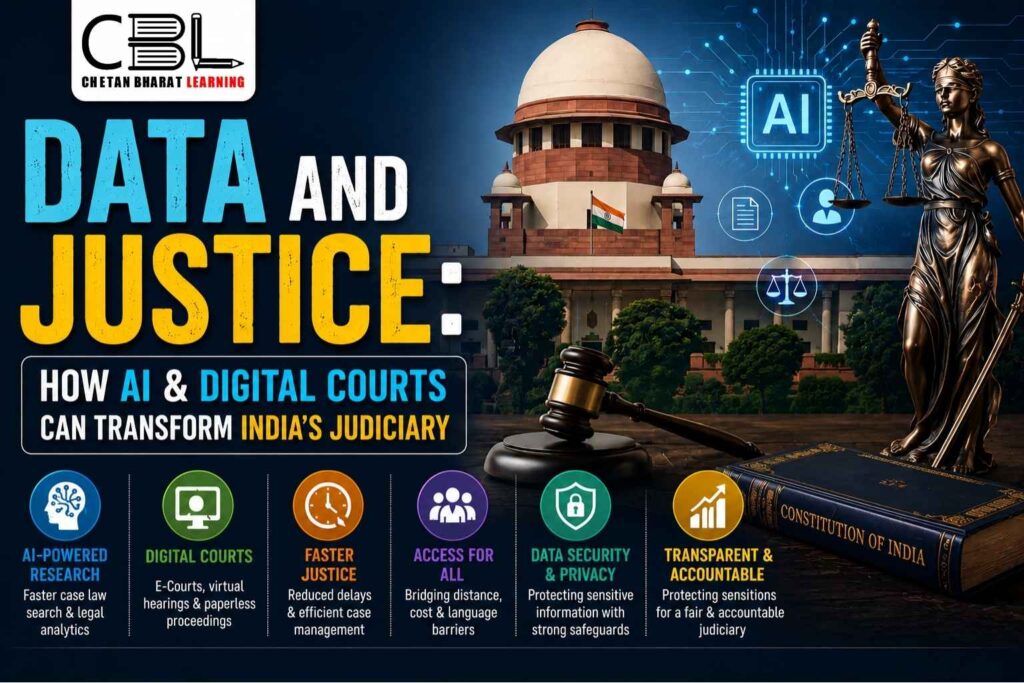
What is the Core Issue?
India’s judicial system faces challenges such as:
- Massive case backlog
- Delayed justice
- Limited transparency
- Unequal legal access
- Manual record management
Technology is now being explored as a solution.
How AI Can Help the Judiciary
1. Faster Case Management
AI can help:
✔ Organise case records
✔ Categorise cases
✔ Track pending matters
2. Predictive Analytics
AI tools may identify:
- Case trends
- Delay patterns
- Judicial workload distribution
3. Digital Access to Judgments
Online databases improve:
➤ Public access to legal information.
4. Improved Transparency
Open court data helps researchers and citizens understand:
✔ Court functioning
✔ Disposal rates
✔ Judicial efficiency
What is Open Courts Data?
It refers to:
➤ Publicly accessible judicial information
including:
- Case status
- Judgments
- Hearing schedules
- Court statistics
Importance of Judicial Data
Judicial data can help:
✔ Policy reforms
✔ Better resource allocation
✔ Transparency in governance
✔ Reduction in pendency
Key Concerns About AI in Judiciary
1. Bias in Algorithms
AI systems may reflect:
❌ Existing social or institutional biases.
2. Privacy Concerns
Judicial data involves sensitive personal information.
3. Risk of Over-Reliance
AI should assist judges:
➤ Not replace judicial reasoning.
4. Digital Divide
Many citizens still lack:
- Internet access
- Digital literacy
- Legal awareness
Why Judicial Reforms Matter
Delayed justice weakens:
- Rule of law
- Public trust
- Constitutional governance
The phrase:
➤ “Justice delayed is justice denied”
remains highly relevant.
Suggested Reforms
1. Digitisation of Courts
Expand:
✔ E-filing
✔ Virtual hearings
✔ Digital records
2. AI-Assisted Research Tools
Use AI for:
- Legal research
- Case sorting
- Data analysis
3. Strengthening Data Protection
Protect:
➤ Sensitive judicial information.
4. Capacity Building
Train:
- Judges
- Lawyers
- Court staff
in legal technology usage.
Global Trend
Countries worldwide are adopting:
✔ E-courts
✔ AI legal tools
✔ Online dispute resolution systems
India’s Digital Judiciary Push
India has introduced:
- E-Courts Mission Mode Project
- Virtual hearings
- Digital filing systems
to modernise judicial administration.
Special Note for Aspirants
Students preparing through UPSC Coaching Chandigarh and IAS Coaching Chandigarh should focus on:
- Judicial reforms
- AI governance
- Digital India initiatives
- E-governance models
These topics are highly important for:
✔ GS Paper 2
✔ Essay
✔ Ethics & Interview
Analytical Insight
Technology can improve judicial efficiency, but:
➤ Human judgment, constitutional morality, and fairness must remain central to justice delivery.
PRELIMS PRACTICE QUESTIONS
Q1. Open Courts Data primarily relates to:
A. Agricultural records
B. Judicial information accessibility
C. Defence intelligence
D. Banking regulation
✅ Answer: B
Q2. Which of the following is a concern regarding AI in judiciary?
A. Water scarcity
B. Inflation
C. Algorithmic bias
D. Forest fires
✅ Answer: C
Q3. E-Courts Project is associated with:
A. Agriculture reforms
B. Judicial digitisation
C. Railway modernisation
D. Mining reforms
✅ Answer: B
UPSC Mains Practice Question
“Artificial Intelligence can improve judicial efficiency, but it cannot replace constitutional morality and human judgment.” Discuss.
FAQs
1. What is Open Courts Data?
Public access to court-related records and judicial information.
2. How can AI help courts?
By improving case management, research, and efficiency.
3. What are the risks of AI in judiciary?
Bias, privacy concerns, and over-reliance on algorithms.
4. Why are judicial reforms important?
To reduce delays and improve access to justice.
Related Current Affairs
Preparing for UPSC, PCS or HCS?
Talk to a mentor at Chetan Bharat Learning, Chandigarh. Free guidance on choosing the right exam and building a study plan.
Chat on WhatsAppCall 97793 53345UPSC / IAS / PCS coaching in Chandigarh · Trusted by aspirants across Punjab & Haryana
Leave a Reply
You must be logged in to post a comment.