
UPSC Mapping
- Prelims: India & World
- Mains: GS Paper 2 (International Relations)
Quick Facts
| Summits | SCO (Aug 31–Sept 1) & BRICS (Sept 12–13) |
|---|---|
| Key Sectors | Energy, Fertilizers, Nuclear, High-Tech |
Article
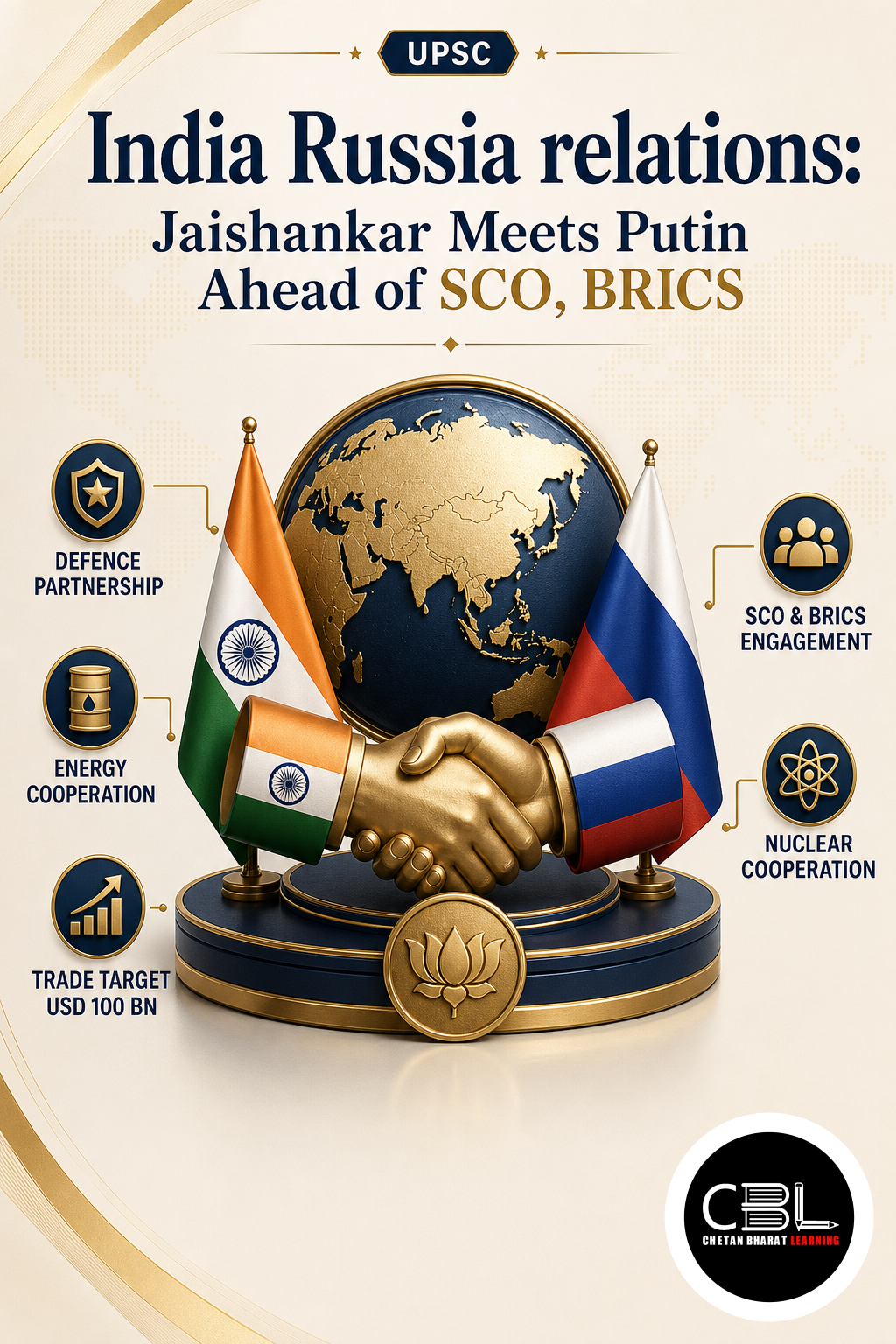
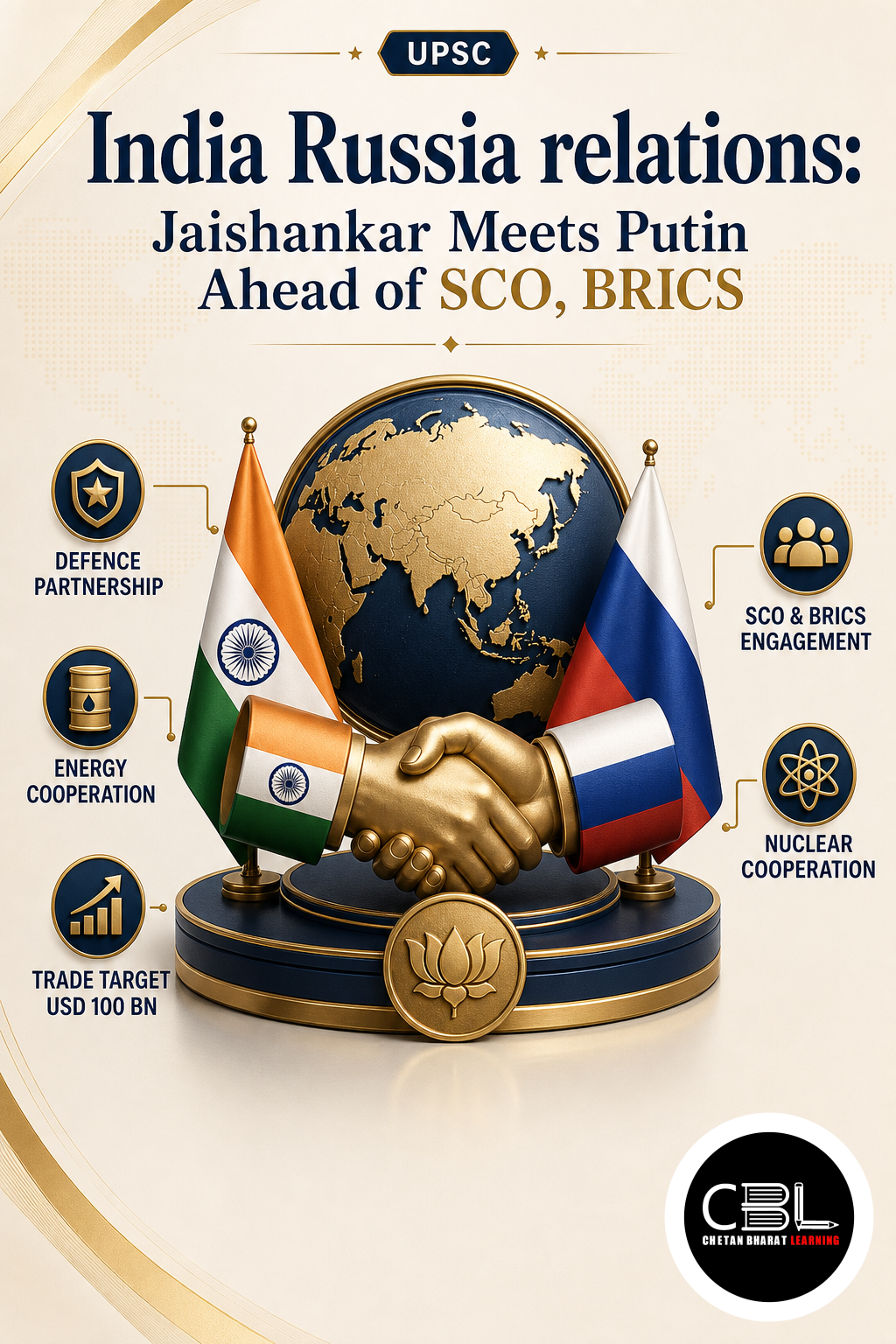
India Russia relations continue to be a cornerstone of India’s foreign policy, even as the global geopolitical landscape shifts. External Affairs Minister S Jaishankar’s recent meeting with President Vladimir Putin in Moscow highlights the enduring strategic partnership between the two nations, with a focus on trade, energy, fertilisers, and high-technology sectors. As Prime Minister Modi and Putin prepare to meet twice in the coming weeks—at the SCO summit in Kyrgyzstan and the BRICS summit in New Delhi—this bilateral relationship remains a key topic for international relations current affairs.
What are the Pillars of India Russia Relations?
The India Russia relations are built on a multi-dimensional strategic partnership that spans defence, energy, nuclear cooperation, space, and trade. Historically, the Soviet Union was India’s largest defence supplier, and this legacy continues with joint production of systems like the BrahMos missile and the S-400 air defence system. Russia remains a key partner in India’s nuclear energy programme, with the Kudankulam Nuclear Power Plant being a flagship project.
Beyond defence, the two countries collaborate in high-technology areas, including space exploration and rare earth minerals. The India-Russia Inter-Governmental Commission on Trade, Economic, Scientific, Technological and Cultural Cooperation (IRIGC) is the primary mechanism for regular dialogue. The relationship has weathered the Russia-Ukraine war, with India maintaining its strategic autonomy by continuing to engage with Russia while expanding ties with the West.
Why is India Russia Relations in News?
The India Russia relations are in the spotlight due to two upcoming high-level meetings between PM Modi and President Putin. The first at the SCO summit in Bishkek, Kyrgyzstan, and the second at the BRICS summit in New Delhi. These meetings come amid a visit by EAM Jaishankar to Moscow for the 27th session of the IRIGC, where both sides discussed trade, energy security, fertiliser supplies, and nuclear cooperation. Putin personally highlighted that Russia gives priority to energy, fertilisers, nuclear energy, and high-tech sectors in its partnership with India.
India’s stance on the Russia-Ukraine conflict—advocating dialogue and diplomacy—has been consistent, and the recent engagement signals that India’s multi-alignment policy remains intact. The deepening of ties between Russia and China, however, poses a strategic challenge for India, as excessive Russian dependence on Beijing could shrink India’s strategic room for manoeuvre. For official updates, refer to the PIB release on the meeting.
Key Aspects of the Bilateral Partnership
The India Russia relations encompass several critical dimensions:
- Defence & Security: Russia is India’s largest defence supplier, with joint ventures like BrahMos, S-400 systems, and licensed production of T-90 tanks and Sukhoi fighters.
- Energy Cooperation: Russia is a vital source of crude oil, fertilisers, and nuclear fuel. The Kudankulam plant is a key civil nuclear project.
- Trade & Investment: Bilateral trade has grown significantly, reaching over $45 billion in 2025, driven by Indian imports of Russian oil and coal.
- High-Technology & Space: Collaboration in space exploration, satellite navigation (GLONASS), and emerging technologies like AI and quantum computing.
- Multilateral Platforms: Both countries cooperate in SCO, BRICS, G20, and the UN, often supporting each other on issues like counter-terrorism and UNSC reform.
Challenges in India Russia Relations
Despite the long-standing friendship, India Russia relations face several challenges:
- Russia’s growing China tilt: The deepening Russia-China partnership may limit India’s strategic autonomy, especially in Asia.
- Western sanctions on Russia: India has to navigate secondary sanctions risks while continuing trade, especially in defence and oil.
- Payment and insurance hurdles: The disruption of SWIFT and insurance for shipping oil has created operational difficulties.
- Technology gaps: Russia’s defence technology is ageing compared to Western alternatives, making India diversify to France, US, and Israel.
- Geopolitical realignment: India’s growing ties with the US and the Quad have created a delicate balancing act for New Delhi.
Way Forward for India Russia Relations
To sustain the India Russia relations in a multipolar world, both nations need to modernise their partnership. India should push for joint development of next-generation military platforms and explore co-production of civilian nuclear reactors. Expanding trade in non-sanctioned sectors like pharmaceuticals, IT, and agro-processing can reduce vulnerability to external pressures. At the same time, India must continue its strategic outreach to the US and other partners, ensuring that its ties with Russia do not come at the cost of its broader global ambitions.
As Russia faces increasing isolation from the West, India’s role as a bridge could become more valuable. The upcoming summits provide an opportunity to reaffirm mutual trust and update the strategic framework. A Ministry of External Affairs analysis suggests that the relationship will remain resilient if both sides invest in diversifying their engagements and respecting each other’s core interests.
Prelims Practice Corner
Q1. Which flagship nuclear power plant in India is being built with Russian collaboration?
(a) Kaiga (b) Kudankulam (c) Tarapur (d) Narora
Show answer
Answer: (b) Kudankulam. It is a major civil nuclear project with Russian assistance.
Q2. The India-Russia Inter-Governmental Commission (IRIGC) focuses on which areas?
(a) Defence only (b) Trade, Economic, Scientific, Technological & Cultural (c) Space only (d) Nuclear energy only
Show answer
Answer: (b) It covers multiple sectors including trade, economy, science, technology, and culture.
Q3. Which of the following is a joint defence project between India and Russia?
(a) Rafale (b) BrahMos (c) Tejas (d) Apache
Show answer
Answer: (b) BrahMos is a supersonic cruise missile jointly developed by India and Russia.
Mains Practice Questions
Q1. “India’s relationship with Russia remains a vital pillar of its foreign policy, but it is increasingly challenged by the shifting geopolitical landscape.” Examine this statement with reference to recent developments. (250 words, 15 marks)
Answer Structure:
- Intro: Historical significance and the recent Jaishankar-Putin meeting.
- Body: Pillars (defence, energy, nuclear, high-tech), challenges (Russia-China axis, sanctions, technology gap), and balancing act with the West. Mention SCO and BRICS summits.
- Conclusion: Need for a modernised, diversified partnership respecting India’s strategic autonomy.
FAQs on India Russia Relations
Why does Russia remain important for India despite India’s growing ties with the US?
Russia is a critical defence supplier, a reliable partner in nuclear energy, and a source of affordable energy. The relationship is multi-dimensional and not easily replaced, and India maintains strategic autonomy by engaging both Russia and the US.
What are the major summits where Modi and Putin will meet in 2026?
They are expected to meet at the SCO summit in Kyrgyzstan (August 31–September 1) and the BRICS summit in New Delhi (September 12–13).
How does the Russia-Ukraine war affect India-Russia ties?
India has maintained a neutral stance, calling for dialogue and diplomacy. While trade has increased, India faces challenges from Western sanctions and has diversified its defence procurement to reduce dependency.
Related Current Affairs
Preparing for UPSC, PCS or HCS?
Talk to a mentor at Chetan Bharat Learning, Chandigarh. Free guidance on choosing the right exam and building a study plan.
Chat on WhatsAppCall 97793 53345UPSC / IAS / PCS coaching in Chandigarh · Trusted by aspirants across Punjab & Haryana
Leave a Reply
You must be logged in to post a comment.