
Why IMEC Matters for India and the Global Economy
The India-Middle East-Europe Economic Corridor (IMEC), unveiled during the 2023 G20 Summit in New Delhi, has rapidly evolved from a diplomatic vision into one of the most important geopolitical and economic initiatives of the decade.
By 2026, IMEC is no longer viewed merely as a transport corridor. It has become a central pillar of India’s:
- Foreign policy
- Supply-chain strategy
- Global economic positioning
At its core, IMEC represents a new model of connectivity based on:
- Transparency
- Trusted partnerships
- Sustainable infrastructure
- Diversified supply chains
- Democratic economic cooperation
In an increasingly fragmented global order, IMEC is emerging as India’s strategic response to changing trade dynamics and geopolitical competition.
Students preparing through UPSC Coaching Chandigarh and IAS Coaching Chandigarh should closely follow topics like strategic connectivity, global trade routes, supply-chain resilience, and India-Europe relations because these themes are highly important for GS Paper 2, GS Paper 3, Essay, and UPSC Interview preparation.
What Is the India-Middle East-Europe Economic Corridor (IMEC)?
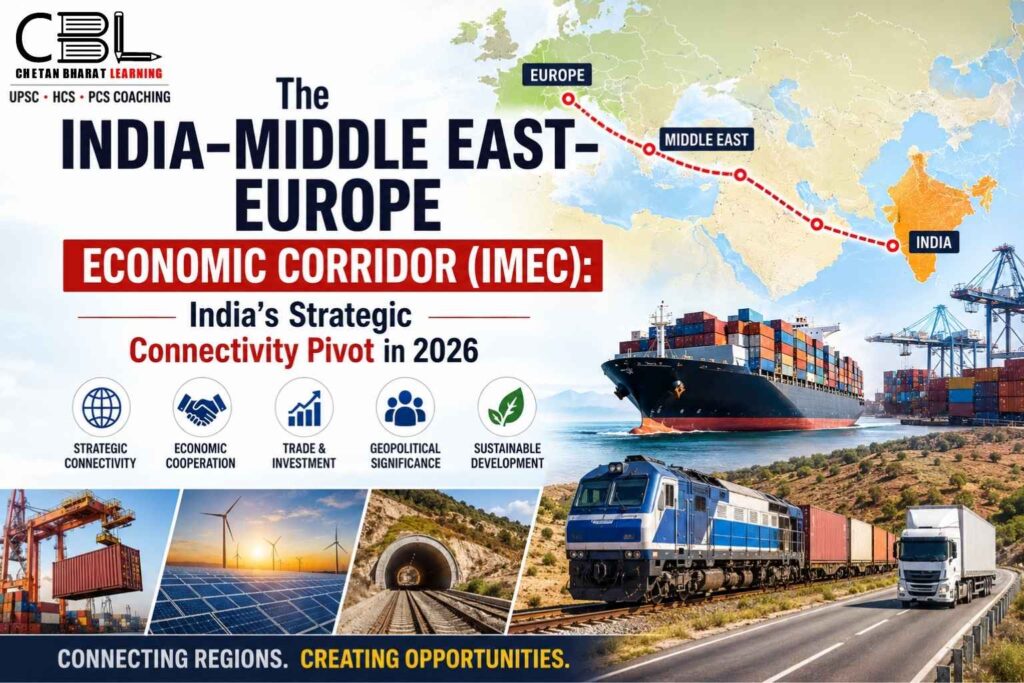
The India-Middle East-Europe Economic Corridor (IMEC) is a multi-modal connectivity project linking India, the Gulf region, and Europe through:
- Rail networks
- Maritime routes
- Digital infrastructure
- Energy corridors
The initiative aims to:
✔ Improve trade efficiency
✔ Reduce logistics costs
✔ Strengthen energy connectivity
✔ Create resilient supply chains
Unlike traditional infrastructure projects focused only on transport, IMEC integrates:
- Physical connectivity
- Digital interoperability
- Green energy infrastructure
- Strategic economic partnerships
This makes IMEC a comprehensive economic architecture rather than just another trade route.
Why IMEC Is More Than Just a Trade Corridor
The “Triangular Architecture” of IMEC
IMEC is built around a powerful strategic partnership connecting three major economic regions.
1. India: Manufacturing and Digital Powerhouse
India serves as:
- A manufacturing hub
- A global services center
- A digital innovation ecosystem
- A rapidly growing export economy
Under initiatives such as:
- Make in India
- Production-Linked Incentive (PLI) schemes
India aims to deepen integration into global value chains.
2. The Gulf: Logistics, Energy, and Investment Hub
Countries like:
- United Arab Emirates (UAE)
- Saudi Arabia
provide:
✔ Strategic geographic access
✔ World-class port infrastructure
✔ Energy resources
✔ Sovereign wealth investments
The Gulf region acts as the logistical bridge connecting Asia and Europe.
3. Europe: Technology and Consumption Center
Europe contributes:
- Advanced industrial technology
- Green energy expertise
- High-value consumer markets
- Financial and regulatory standards
This creates an integrated trade ecosystem stretching from South Asia to Europe.
IMEC vs China’s Belt and Road Initiative (BRI)
One of the most significant dimensions of IMEC is its strategic contrast with China’s Belt and Road Initiative (BRI).
While the BRI is largely:
- State-driven
- Centrally financed
IMEC is structured around:
✔ Market-led growth
✔ Multilateral cooperation
✔ Transparent financing
✔ Shared infrastructure governance
1. A Geopolitical Counterbalance to China
IMEC strengthens India’s:
- “Act West” policy
- Strategic engagement with Europe
- Partnerships with the United States and Gulf countries
By positioning India as a central connectivity node, IMEC provides a democratic and rules-based alternative to China’s infrastructure expansion across Eurasia.
This also enhances India’s role in shaping the future global order.
2. Supply-Chain Resilience and Trade Security
Recent disruptions — including:
- The Red Sea crisis
- Suez Canal blockages
highlighted the vulnerability of global supply chains.
IMEC aims to:
✔ Reduce dependence on single maritime chokepoints
✔ Diversify trade routes
✔ Improve logistics resilience
✔ Reduce transit time by nearly 40%
This makes IMEC not only a trade initiative, but also a long-term economic risk-management strategy.
3. A Sustainable and Diversified Financing Model
Unlike several BRI projects criticized for debt dependency, IMEC promotes a diversified funding structure involving:
- European Union grants
- Indian infrastructure financing
- UAE sovereign wealth funds
- Private-sector participation
This reduces fears of “debt-trap diplomacy” while improving project transparency and sustainability.
IMEC’s Multi-Layered Infrastructure Vision
Beyond Roads and Ports
IMEC is designed as a next-generation connectivity framework integrating multiple dimensions of infrastructure.
Physical Infrastructure
- Railways
- Ports
- Shipping corridors
- Industrial logistics networks
Digital Connectivity
- Undersea fiber-optic cables
- Secure data infrastructure
- Cross-border digital interoperability
Energy Connectivity
- Green hydrogen pipelines
- Renewable energy trade
- Clean energy cooperation
This multi-dimensional approach reflects the future direction of global infrastructure development.
IMEC Progress in 2026: From Vision to Execution
By May 2026, IMEC has moved from diplomatic vision toward operational execution.
High-Level Diplomatic Momentum
During Prime Minister Narendra Modi’s visit to Rome in May 2026, India and Italy reaffirmed their commitment to advancing IMEC.
Both countries emphasized the corridor’s role in:
- Global trade expansion
- Strategic connectivity
- Economic prosperity
- Supply-chain resilience
This reflects growing international support for the initiative.
Push for the First IMEC Ministerial Meeting
Participating countries are now working toward organizing the first formal IMEC Ministerial Meeting in 2026.
The objective is to:
✔ Finalize implementation roadmaps
✔ Coordinate financing mechanisms
✔ Harmonize customs systems
✔ Improve logistics integration
This indicates a transition from political declarations to practical infrastructure execution.
Strategic Partnerships and Railway Connectivity
Increasing focus is now being placed on:
- Cross-border railway integration
- Standardized logistics procedures
- Customs harmonization
- Faster cargo movement
These measures are essential for reducing trade delays and improving corridor efficiency.
Why IMEC Matters for India’s Strategic Future
Economic Advantages for India
IMEC can help India:
- Expand exports to Europe
- Reduce logistics costs
- Integrate into global value chains
- Attract foreign investment
- Strengthen manufacturing competitiveness
The corridor closely aligns with India’s ambition of becoming a major global economic power by 2047.
Energy and Green Transition Benefits
IMEC also supports India’s clean energy goals through:
- Green hydrogen trade
- Renewable energy partnerships
- Sustainable transport systems
This aligns with:
✔ Global climate goals
✔ India’s long-term energy security strategy
Strategic Influence in Eurasia
Geopolitically, IMEC strengthens India’s influence across:
- West Asia
- The Indian Ocean Region
- Europe
- Eurasian trade networks
It reinforces India’s image as a reliable and responsible global partner.
Prelims Pointers
Structure of IMEC
IMEC consists of:
- Eastern Corridor → India to the Gulf
- Northern Corridor → Gulf to Europe
Core Participating Members
- India
- USA
- European Union
- Saudi Arabia
- UAE
- France
- Germany
- Italy
Important Linkages
IMEC complements India’s:
- Connectivity diplomacy
- Green energy ambitions
- “One Sun, One World, One Grid” initiative
Mains Perspective
Possible Question
“How does IMEC reflect a shift from geopolitical competition to economic risk management in India’s foreign policy?”
Key Dimensions to Discuss
- Supply-chain diversification
- Trade resilience
- Strategic connectivity
- Digital interoperability
- Energy security
- Democratic infrastructure governance
- Sustainable financing mechanisms
Frequently Asked Questions (FAQ)
Why is IMEC called an alternative to the Suez route?
IMEC creates a faster trade corridor linking India to Europe through the Middle East, reducing dependence on congested maritime chokepoints like the Suez Canal.
How is IMEC different from China’s BRI?
Unlike the BRI’s centralized state-driven model, IMEC emphasizes:
- Transparency
- Shared ownership
- Sustainable financing
- Market-oriented infrastructure
Why is green hydrogen important in IMEC?
Green hydrogen infrastructure allows IMEC to support clean energy transport, making the corridor compatible with future global climate goals.
What is the biggest strategic advantage of IMEC for India?
IMEC strengthens India’s position as a global connectivity hub while improving:
✔ Trade resilience
✔ Geopolitical influence
✔ Economic integration with Europe and the Gulf
Conclusion: IMEC and the Future of Democratic Connectivity
The India-Middle East-Europe Economic Corridor is far more than an infrastructure project.
It represents a strategic reimagining of global connectivity in an era marked by:
- Geopolitical fragmentation
- Supply-chain disruptions
- Economic uncertainty
IMEC demonstrates that transparent, sustainable, and rules-based infrastructure can effectively compete with centralized state-driven models.
For India, IMEC is:
- A trade corridor
- A geopolitical strategy
- An energy partnership
- A supply-chain resilience framework
- A long-term economic vision
As global power balances continue to shift, IMEC may emerge as one of the defining infrastructure partnerships of the 21st century.
“IMEC is not just a path for goods; it is a blueprint for the future of democratic infrastructure in an age of geopolitical fragmentation.”
Related Current Affairs
Preparing for UPSC, PCS or HCS?
Talk to a mentor at Chetan Bharat Learning, Chandigarh. Free guidance on choosing the right exam and building a study plan.
Chat on WhatsAppCall 97793 53345UPSC / IAS / PCS coaching in Chandigarh · Trusted by aspirants across Punjab & Haryana
Leave a Reply
You must be logged in to post a comment.