
Important for:
UPSC, Haryana HCS, Punjab PCS
Prelims: Official language policy, linguistic diversity, federalism
Mains: GS Paper 2 — Federalism, Language Politics, Governance
Why in News?
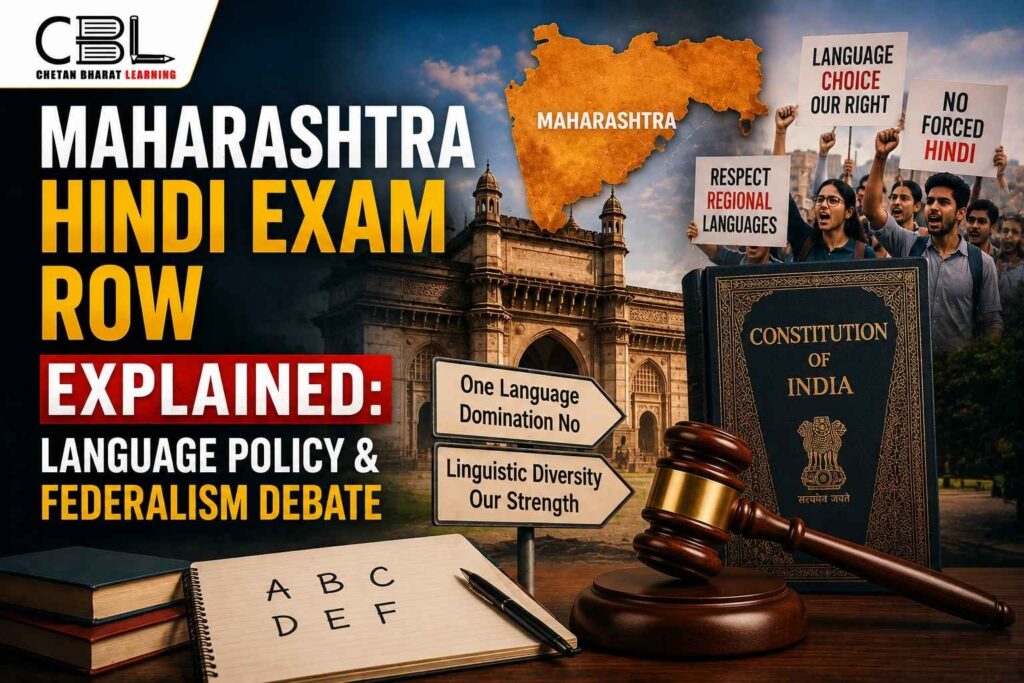
The Maharashtra government put on hold its decision to conduct a mandatory Hindi examination for certain government employees after protests by linguistic and regional groups.
The protests continue with demands to:
→ Completely scrap the rule.
What Was the Rule?
The proposed rule required:
✔ Government employees
✔ Gazette and non-gazette staff
to pass:
→ A Hindi language examination.
Employees failing the exam could reportedly face:
✔ Withholding of salary increments.
Why Are Groups Opposing It?
Critics argue:
✔ Maharashtra primarily functions in Marathi
✔ Hindi imposition threatens linguistic identity
✔ Regional languages should remain central in administration
The issue has triggered debates around:
→ Language imposition and cultural autonomy.
Constitutional Context
Article 343
Declares:
→ Hindi in Devanagari script as the Official Language of the Union.
Eighth Schedule
Recognises:
→ 22 official languages of India.
Federal Structure
States have powers regarding:
✔ Regional administration
✔ Official state language use
Why Language Issues Are Sensitive in India
India is:
✔ Linguistically diverse
✔ Culturally pluralistic
Language debates often involve:
→ Identity
→ Culture
→ Regional pride
→ Political mobilisation
Major Themes in the Debate
1. Linguistic Federalism
States seek autonomy over:
✔ Administrative language policies.
2. National Integration vs Regional Identity
Balancing:
✔ National communication
✔ Regional linguistic rights
remains a challenge.
3. Employment Concerns
Mandatory language requirements may affect:
→ Recruitment and promotions.
Historical Background
India has witnessed several:
✔ Anti-Hindi agitations
✔ Regional language movements
especially in:
→ Southern and western states.
Special Note for Aspirants
Students preparing through:
UPSC coaching Chandigarh
or
IAS coaching Chandigarh
should prepare:
✔ Official language provisions
✔ Federalism
✔ Regionalism
✔ Constitutional debates on language
These are highly important for:
⇢ GS2 + Essay + Interview.
Key Insight for UPSC
➤ India’s unity is based on:
✔ Cooperative federalism
✔ Cultural diversity
✔ Linguistic accommodation
not forced uniformity.
PRELIMS PRACTICE QUESTIONS
Q1. Article 343 relates to:
A. Fundamental Duties
B. Official Language of the Union
C. Emergency provisions
D. Finance Commission
⇢ Answer: B
Q2. The Eighth Schedule of the Constitution deals with:
A. Union Territories
B. Fundamental Rights
C. Officially recognised languages
D. Judiciary
⇢ Answer: C
Q3. Language-related issues are mainly linked with:
A. Cultural identity
B. Foreign trade
C. Defence policy
D. Space technology
⇢ Answer: A
Q4. Federalism means:
A. Centralised governance
B. Division of powers between Centre and States
C. Military rule
D. Judicial supremacy
⇢ Answer: B
Q5. Which GS paper covers federalism and language policy?
A. GS1
B. GS2
C. GS3
D. GS4
⇢ Answer: B
CBL Mains Practice Question
“Language policy in India requires balancing national integration with regional linguistic identities.”
Discuss in the context of recent debates over Hindi language requirements.
FAQs
1. What is the Maharashtra Hindi exam controversy?
The state paused a mandatory Hindi exam rule after protests.
2. Why are linguistic groups opposing it?
They see it as linguistic imposition affecting regional identity
3. Which Article deals with official language?
Article 343
4. Why is language policy sensitive in India?
India is linguistically and culturally diverse.
5. Which GS paper covers this topic?
GS Paper 2.
Related Current Affairs
Preparing for UPSC, PCS or HCS?
Talk to a mentor at Chetan Bharat Learning, Chandigarh. Free guidance on choosing the right exam and building a study plan.
Chat on WhatsAppCall 97793 53345UPSC / IAS / PCS coaching in Chandigarh · Trusted by aspirants across Punjab & Haryana
Leave a Reply
You must be logged in to post a comment.