
India-Europe Relations in 2026: From Trade Partnership to Strategic Necessity
The rapid rise of the India-Europe partnership in 2026 is not accidental — it is a carefully calculated response to a changing global order.
As globalization becomes increasingly fragmented and the world gradually shifts toward a multipolar system, India and Europe are beginning to view each other as trusted and reliable partners capable of balancing:
- Geopolitical uncertainty
- Supply-chain vulnerabilities
- Technological competition
For India, Europe is no longer just a destination for exports. It has emerged as:
- A technology partner
- A green energy collaborator
- A trusted investment source
- A strategic geopolitical ally
For Europe, India represents:
- A massive consumer market
- A digital innovation ecosystem
- A democratic alternative in Asia
- A key pillar in global supply-chain diversification
The India-Europe relationship in 2026 is therefore evolving from one of convenience into one of strategic necessity.
Students preparing through UPSC Coaching Chandigarh and IAS Coaching Chandigarh should closely follow topics like India-Europe relations, supply-chain resilience, strategic autonomy, green energy cooperation, and geopolitical alignment because these themes are highly important for GS Paper 2, GS Paper 3, Essay, and UPSC Interview preparation.
Why Europe Matters to India’s Rise as a Global Power
India’s ambition to become a $30 trillion economy requires:
- Advanced technology
- Long-term capital investment
- Supply-chain resilience
- Energy transition support
- High-value industrial partnerships
Europe is uniquely positioned to support all these objectives simultaneously.
1. The “Scale-Innovation” Multiplier: Europe’s Technology Meets India’s Scale
At the center of the new India-Europe partnership lies a powerful economic synergy.
Europe: The Global R&D and Innovation Hub
Europe continues to dominate several high-value sectors, including:
- Deep technology
- Industrial engineering
- Precision manufacturing
- Semiconductors
- Green technologies
- Intellectual property-driven industries
European economies possess world-class research ecosystems and technological expertise.
India: The World’s Largest Digital Sandbox
India contributes something equally valuable — scale.
With:
- A massive consumer base
- Rapid digital adoption
- Expanding Digital Public Infrastructure (DPI)
- A young workforce
- Fast-growing markets
India provides the ideal environment for testing and scaling innovation.
European companies can now deploy technological solutions across India’s population-scale digital ecosystem, reducing years of experimentation into months of practical adaptation.
This creates a powerful “Scale + Innovation” multiplier effect:
- Europe develops advanced technologies
- India scales them rapidly and affordably
2. The “China+1” Strategy and Supply-Chain De-Risking
One of the biggest drivers of India-Europe cooperation is the global shift toward supply-chain diversification.
Why the World Is Moving Away from Single-Country Dependence
Recent geopolitical tensions exposed the risks of excessive dependence on a single manufacturing center.
Europe remains heavily dependent on China for:
- Rare earth materials
- Industrial inputs
- Critical minerals
- Manufacturing supply chains
India also faces vulnerabilities in:
- Lithium imports
- Cobalt dependency
- Semiconductor supply chains
As a result, both India and Europe are increasingly adopting a “de-risking” strategy instead of complete economic decoupling.
India-EU Trade and Technology Council (TTC)
The India-EU Trade and Technology Council (TTC) has become the central mechanism driving this transition.
Key Focus Areas of the TTC
- Strategic technologies
- Semiconductor cooperation
- Digital governance
- Artificial intelligence
- Green and clean energy
- Secure supply chains
The TTC reflects a shift from traditional trade diplomacy toward industrial and technological security cooperation.
EV Battery Recycling and Industrial Security
A major example of this collaboration is the €15.2 million India-EU initiative focused on EV battery recycling.
This project demonstrates how India and Europe are moving beyond conventional trade toward:
- Critical mineral security
- Green industrial cooperation
- Circular economy systems
- Strategic manufacturing resilience
3. The Green Energy Partnership: Europe and India’s Climate Alignment
Energy security has become one of the strongest pillars of India-Europe relations.
Europe’s “Energy Trilemma”
Europe currently faces three simultaneous challenges:
- Energy security
- Affordable energy access
- Climate sustainability
The Russia-Ukraine conflict and related energy disruptions accelerated Europe’s search for stable and clean energy partners.
India’s Renewable Energy Potential
India’s massive investments in:
- Solar energy
- Wind power
- Green hydrogen
- Renewable infrastructure
make it an ideal long-term energy partner for Europe.
India is increasingly being viewed as a future global hub for green hydrogen production.
Europe’s Capital Fuels India’s Green Transition
European financial institutions, including the European Investment Bank, are helping finance India’s renewable energy expansion.
This creates a mutually beneficial arrangement:
- India receives large-scale green investment
- Europe secures sustainable energy partnerships
- Both sides advance decarbonization goals
4. The Geopolitical Turning Point of 2026
The India-Europe partnership reached a major diplomatic milestone during the 16th India-EU Summit in January 2026.
This summit marked a strategic deepening of:
- Economic cooperation
- Technological collaboration
- Security coordination
India-EU Free Trade Agreement (FTA): A Historic Breakthrough
One of the biggest outcomes was the successful conclusion of negotiations on the India-EU Free Trade Agreement (FTA).
Why the FTA Matters
The agreement is expected to:
✔ Reduce or eliminate tariffs on over 96% of EU goods exports
✔ Increase bilateral trade
✔ Improve market access
✔ Expand industrial cooperation
✔ Strengthen manufacturing integration
For India, the FTA improves access to:
- Advanced machinery
- Industrial chemicals
- Precision technologies
- High-value manufacturing inputs
For Europe, India becomes one of the world’s largest future growth markets.
Republic Day Diplomacy and Security Cooperation
The 2026 partnership also carried symbolic geopolitical significance.
For the first time:
- European Union leaders attended India’s Republic Day celebrations as Guests of Honour
- Representatives from EU military staffs participated in the parade
This signaled the expansion of India-Europe ties beyond economics into:
- Defense cooperation
- Maritime security
- Strategic coordination
- Indo-Pacific stability
Why India and Europe Are Becoming Natural Strategic Partners
Shared Commitment to a Rules-Based Order
Both India and Europe strongly support:
- International law
- Open trade systems
- Transparent governance
- Democratic institutions
- Multilateral cooperation
In an increasingly unstable geopolitical environment, this shared preference for a rules-based order has brought both sides closer together.
India-Europe Connectivity and IMEC
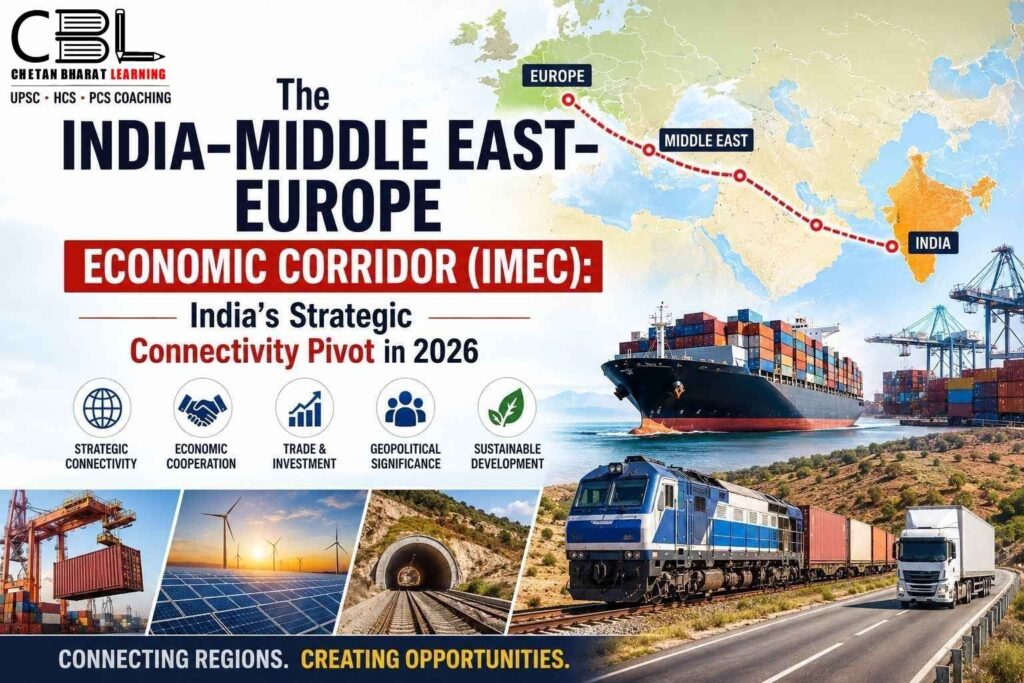
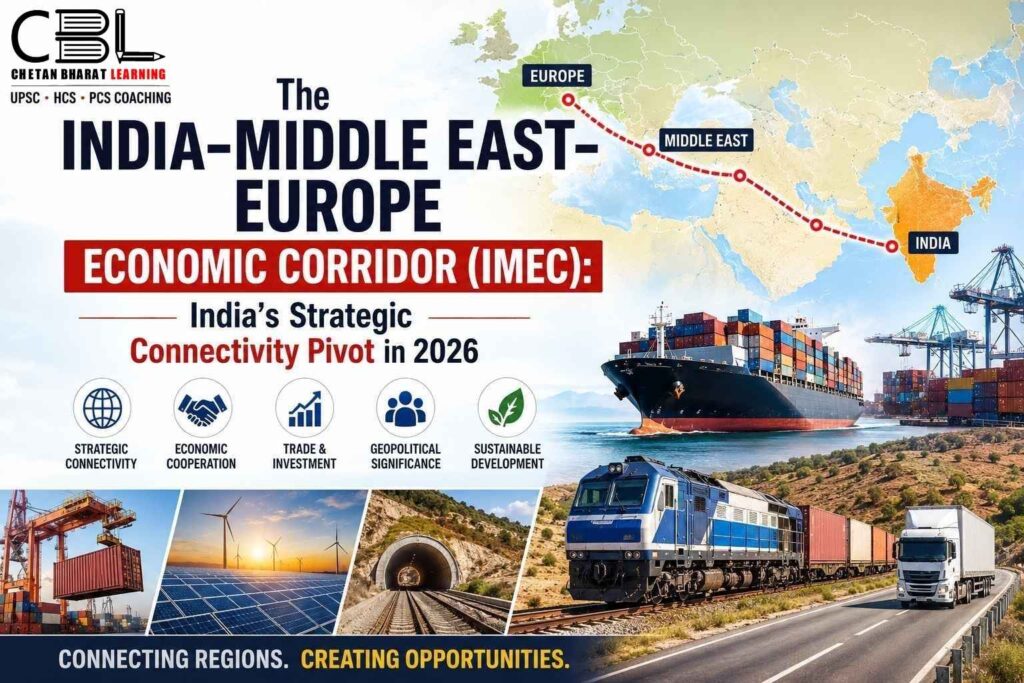
Projects like the India-Middle East-Europe Economic Corridor (IMEC) further strengthen this strategic alignment.
IMEC aims to:
- Improve trade connectivity
- Reduce logistics costs
- Enhance energy cooperation
- Build resilient supply chains
It also aligns closely with Europe’s “Global Gateway” infrastructure strategy.
Prelims Pointers
India-EU Trade and Technology Council (TTC)
The TTC has three major working groups:
- Strategic technologies
- Digital governance
- Green and clean energy
India-EU FTA
The India-EU FTA aims to reduce duties worth nearly €4 billion annually.
Connectivity Projects
- IMEC
- Global Gateway initiative
- Green hydrogen partnerships
Mains Perspective
Possible Question
“The India-EU Strategic Partnership is a response to the erosion of the rules-based global order.” Discuss.
Key Dimensions to Cover
- Supply-chain resilience
- Trusted technology ecosystems
- Strategic autonomy
- Green transition cooperation
- Rules-based connectivity
- Economic de-risking
- Democratic partnerships
Frequently Asked Questions (FAQ)
How has the India-Europe relationship changed?
Earlier, India-Europe trade focused mainly on textiles and basic goods.
Today, cooperation includes:
- Semiconductors
- EV batteries
- Artificial intelligence
- Green hydrogen
- Critical technologies
Why does Europe need India?
Europe possesses advanced technology but lacks:
- India’s market scale
- Large digital infrastructure
- Rapid innovation deployment capacity
India provides one of the world’s largest real-world testing grounds for scalable technologies.
Why does India need Europe?
India requires:
- High-end industrial technology
- Green investments
- Semiconductor expertise
- Long-term infrastructure capital
Europe provides both advanced innovation and financial capacity.
What is the biggest strategic benefit of the partnership?
The partnership creates a trusted economic and technological ecosystem capable of reducing geopolitical vulnerabilities while supporting long-term growth.
Conclusion: From Convenience to Strategic Necessity
India and Europe are entering a new era of strategic cooperation shaped by:
- Technology
- Green energy
- Supply-chain security
- Geopolitical alignment
The partnership is no longer limited to trade alone. It is evolving into a comprehensive framework for:
- Trusted innovation
- Sustainable growth
- Industrial resilience
- Democratic connectivity
- Strategic stability
As the global order becomes increasingly fragmented, India and Europe now see each other not merely as economic partners, but as essential pillars of a stable multipolar world.
“Europe is the world’s R&D lab; India is the world’s sandbox. Together, they are building a bridge of trusted innovation in a fractured global economy.”
Related Current Affairs
Preparing for UPSC, PCS or HCS?
Talk to a mentor at Chetan Bharat Learning, Chandigarh. Free guidance on choosing the right exam and building a study plan.
Chat on WhatsAppCall 97793 53345UPSC / IAS / PCS coaching in Chandigarh · Trusted by aspirants across Punjab & Haryana
Leave a Reply
You must be logged in to post a comment.