
UPSC Mapping
| Level | Topics |
|---|---|
| Prelims | Houthis, Yemen, Bab-el-Mandeb, Red Sea |
| Mains | GS Paper II – International Relations & GS Paper III – Internal Security |
| Aspect | Details |
|---|---|
| Location | Jazan Refinery, Saudi Arabia |
| Strategic Route | Bab-el-Mandeb Strait |
| Core Theme | Maritime and Energy Security |
What are Houthi Attacks?
The Houthis are a Yemeni political-military movement controlling significant territory in Yemen, operating autonomously while receiving support through Iran’s regional network. In the context of recent developments, Houthi attacks refer to missile and drone strikes on strategic infrastructure—particularly energy installations and maritime routes associated with Saudi Arabia and the Red Sea region. This illustrates how non-state actors can influence regional geopolitics and international trade.
Why are Houthi Attacks in News?
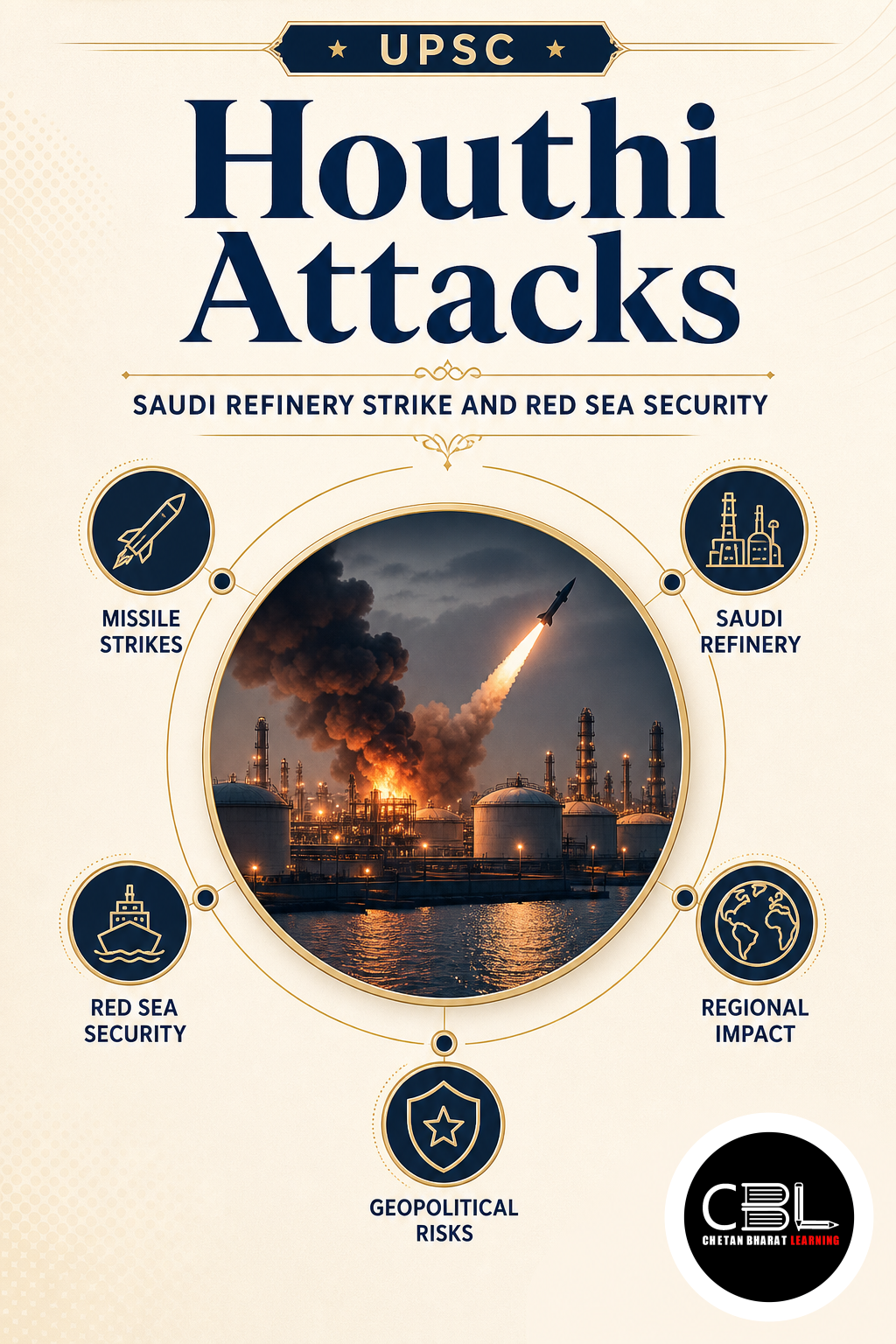
Houthi forces launched an attack on Saudi Arabia’s Jazan refinery shortly after the kingdom signed a defence pact. Although the resulting fire was extinguished without casualties, the incident underscores the link between the Yemen conflict, Saudi-Iran rivalry and the security of energy infrastructure and shipping lanes that form part of the regional economic system.
Key Features
- Strategic energy target: The Jazan refinery is a major Saudi energy facility, making any attack there a threat to energy security.
- Regional conflict: The incident is tied to the Yemen conflict and the broader Saudi-Iran strategic rivalry.
- Maritime importance: The Bab-el-Mandeb Strait links the Red Sea with the Gulf of Aden, serving as a chokepoint for global shipping.
- Critical infrastructure: Refineries convert crude oil into petroleum products and are vital in the energy supply chain.
- Red Sea security: Disruptions at Bab-el-Mandeb can impact trade between Asia and Europe via the Red Sea route.
Challenges
- Energy security: Attacks on refineries disrupt petroleum supply chains.
- Maritime trade: Threats around Bab-el-Mandeb create uncertainty for commercial shipping.
- Regional instability: The Yemen conflict is linked to wider Saudi-Iran rivalries.
- Infrastructure vulnerability: Critical energy installations become strategic targets.
- Escalation risks: Military actions can heighten tensions across West Asia.
Way Forward
Safeguarding maritime routes, protecting critical energy infrastructure and pursuing diplomatic engagement are key to regional stability. For India, this means linking West Asian developments with energy security, maritime security and trade interests through diversified partnerships, resilient logistics and sustained diplomacy.
Prelims Practice Corner
-
Q1. The Bab-el-Mandeb Strait connects:
- (a) Persian Gulf and Gulf of Oman
- (b) Red Sea and Gulf of Aden
- (c) Arabian Sea and Bay of Bengal
- (d) Mediterranean Sea and Black Sea
Answer: (b) Red Sea and Gulf of Aden
-
Q2. The Houthis are primarily associated with which country?
- (a) Oman
- (b) Yemen
- (c) Saudi Arabia
- (d) Jordan
Answer: (b) Yemen
-
Q3. The Jazan refinery mentioned in the report is located in:
- (a) Saudi Arabia
- (b) Yemen
- (c) Iran
- (d) Oman
Answer: (a) Saudi Arabia
-
Q4. Why are refineries considered strategic infrastructure?
- (a) They store only natural gas
- (b) They process crude oil into usable petroleum products
- (c) They manufacture ships
- (d) They regulate maritime boundaries
Answer: (b) They process crude oil into usable petroleum products
-
Q5. The Bab-el-Mandeb route is particularly important for trade between:
- (a) Asia and Europe
- (b) North America and Australia
- (c) South America and Africa
- (d) Antarctica and Europe
Answer: (a) Asia and Europe
Mains Practice Questions
-
Q1. Examine the strategic importance of the Bab-el-Mandeb Strait in global maritime trade and energy security. (10 Marks)
Answer Structure:
- Intro: Introduce Bab-el-Mandeb as a strategic maritime chokepoint linking the Red Sea and Gulf of Aden.
- Body: Cover geography, Asia-Europe trade, energy shipments, Yemen-related security risks, regional stability and India’s interests.
- Conclusion: Maritime stability around critical sea lanes is essential for predictable global commerce.
-
Q2. Discuss how the Yemen conflict influences regional geopolitics and maritime security in West Asia. (15 Marks)
Answer Structure:
- Intro: Place the Yemen conflict within the wider security environment of West Asia.
- Body: Discuss the Houthi movement, Saudi-Iran rivalry, attacks on energy infrastructure, Bab-el-Mandeb, Red Sea trade and implications for India.
- Conclusion: Diplomatic engagement, infrastructure protection and secure shipping lanes are important for durable regional stability.
FAQs on Houthi Attacks
Who are the Houthis?
According to the passage, the Houthis are a Yemeni political-military movement controlling significant territory in Yemen. The source describes the movement as autonomous while receiving support through Iran’s regional network.
Why is the Jazan refinery important?
The passage identifies the Jazan refinery as important energy infrastructure. Refineries process crude oil into usable petroleum products, making their security relevant to energy resilience.
What is the Bab-el-Mandeb Strait?
Bab-el-Mandeb is a strategic maritime passage connecting the Red Sea with the Gulf of Aden. It is a major international shipping route.
Why does the Red Sea matter for global trade?
The Red Sea route links Asia and Europe. Disruptions around key passages can affect international shipping and regional economic stability.
How are Houthi Attacks linked to energy security?
The report discusses attacks on energy infrastructure such as the Jazan refinery and highlights risks to maritime routes through which energy and other goods move.
How does the Yemen conflict affect regional geopolitics?
The conflict is connected with wider Saudi-Iran rivalry, creating consequences for energy infrastructure, maritime security and regional stability.
Why is maritime security important for India?
India depends on secure sea routes for external trade and energy supplies. Instability around major maritime corridors can affect India’s economic and strategic interests.
Why is this topic important for UPSC?
This issue connects international relations, West Asian geopolitics, maritime security, critical infrastructure and energy security. It is relevant to GS Paper II and the security dimensions of GS Paper III.
Related Current Affairs
Preparing for UPSC, PCS or HCS?
Talk to a mentor at Chetan Bharat Learning, Chandigarh. Free guidance on choosing the right exam and building a study plan.
Chat on WhatsAppCall 97793 53345UPSC / IAS / PCS coaching in Chandigarh · Trusted by aspirants across Punjab & Haryana
Leave a Reply
You must be logged in to post a comment.