
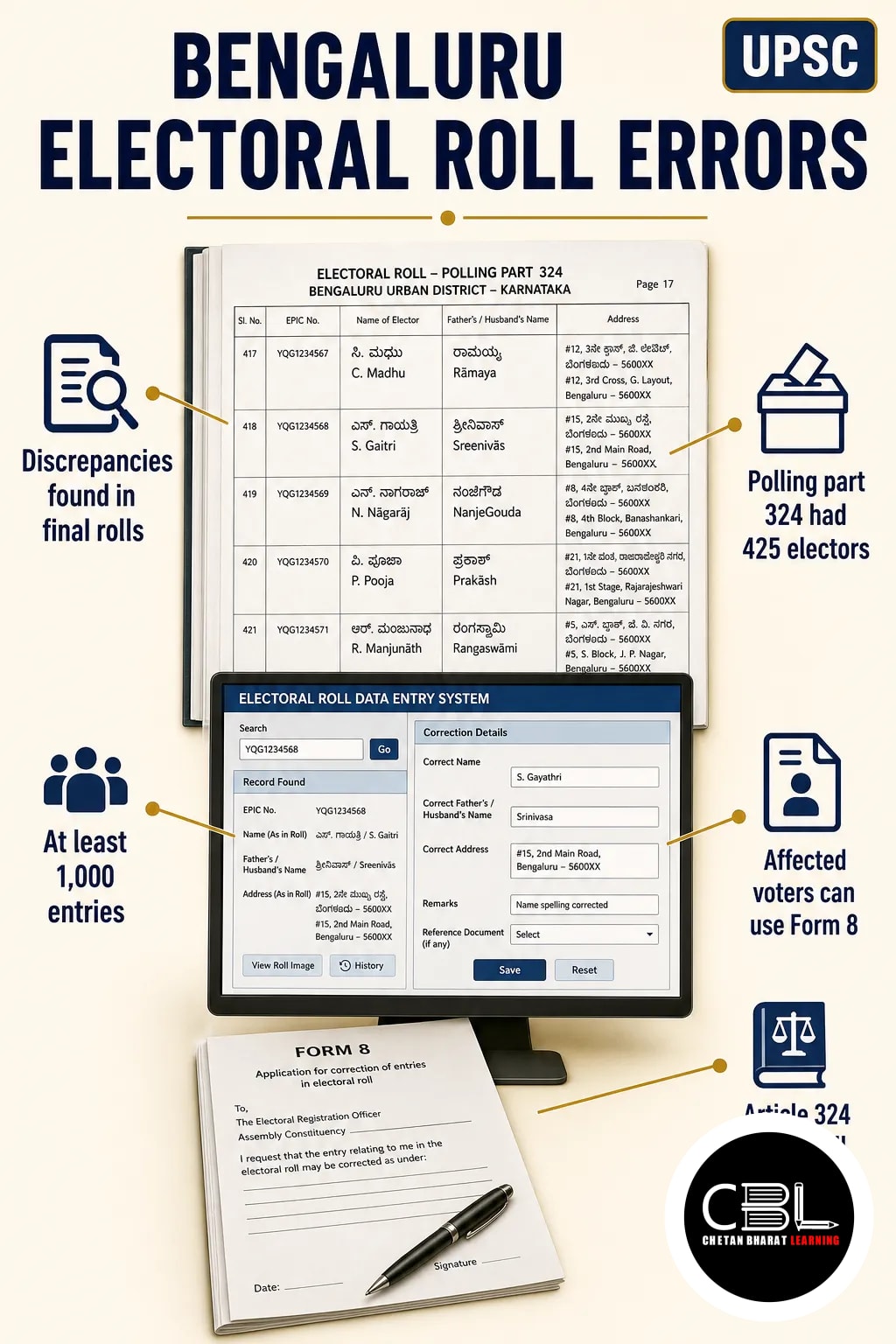
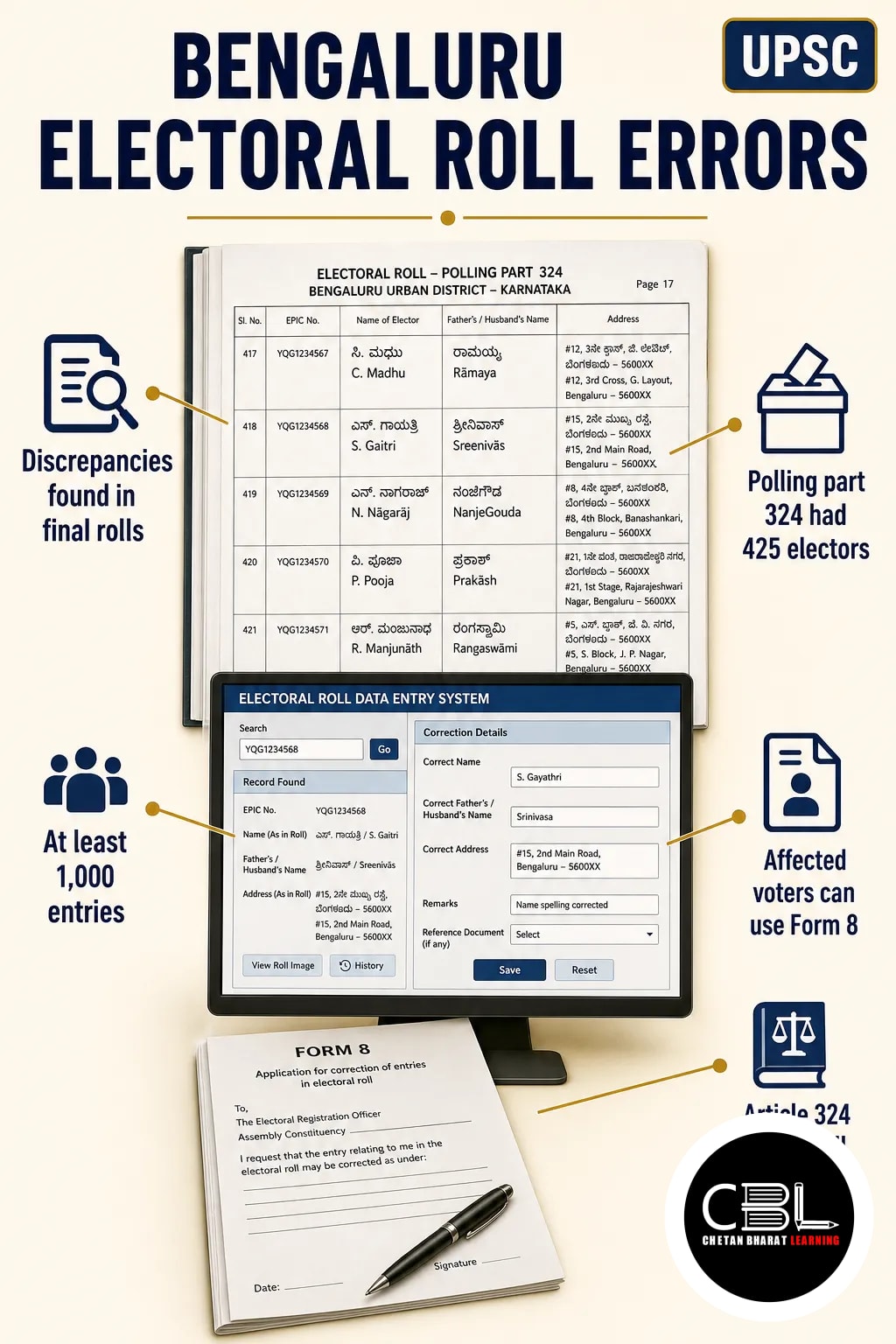
Bengaluru electoral roll errors have raised questions about data quality after the Special Intensive Revision (SIR). The issue connects electoral administration with constitutional safeguards covered in polity current affairs.
Quick answer: Bengaluru electoral roll errors surfaced in final rolls after SIR, with The Hindu finding discrepancies in at least 1,000 entries. Names and relatives’ details included symbols and unrelated text. Officials cited possible transliteration and software problems; booth-level officers advised affected voters to seek corrections through Form 8.
What are the Bengaluru electoral roll errors?
The errors include illegible names, incorrect relatives’ details and unrelated text in final electoral rolls. The Hindu identified discrepancies in at least 1,000 entries in Bengaluru; this is a finding from its examination, not an official citywide error count.
In several polling parts, consecutive entries contained jumbled characters in both name fields. Moreover, some entries contained single letters, symbols, email addresses or dates where names should have appeared.
| Location | Reported discrepancy |
|---|---|
| Dasarahalli, part 324 | Several consecutive names and relatives’ names appeared as unfamiliar characters; the part had 425 electors. |
| Dasarahalli, part 7 | One relative’s name appeared as ‘Husband Husband’; the elector’s name mixed English and Kannada in the English roll. |
| Chamarajpet and Mahadevapura | A relative’s name appeared as ‘Wife’ in one entry; elsewhere, some contained only a single letter. |
| Yelahanka, part 332 | One relative’s name field contained an email address combined with a name. |
In Dasarahalli part 324, the affected serial-number ranges included 4–7, 143–150 and 306–313. Thus, the pattern warrants checking groups of entries, not only individual complaints.
What explains the discrepancies?
Officials suggested transliteration and software problems, but the report does not establish a definitive cause for every error. One polling official said font codes used for Kannada could produce unrelated symbols when conversion software failed to recognise them.
At least three booth-level officers (BLOs) said they had encountered similar software glitches and informed supervisors. Meanwhile, assistant electoral registration officers (AEROs) and BLO supervisors contacted by The Hindu said they were unaware of these cases and would examine them.
Most electors interviewed said they had supplied correct details. Some identified their records through house numbers only later; therefore, inaccurate output should not automatically be treated as incorrect information supplied by voters.
Which constitutional and legal provisions matter?
The Constitution and the Representation of the People Act, 1950 establish the framework for electoral rolls and registration. Together, they connect electoral administration with equal access to registration.
| Provision | Relevance |
|---|---|
| Article 324 | Vests superintendence, direction and control of electoral roll preparation and specified elections in the Election Commission of India. |
| Article 325 | Provides for one general electoral roll for each territorial constituency and bars exclusion solely on specified grounds, including religion, race, caste or sex. |
| Article 326 | Bases House of the People and State Legislative Assembly elections on adult suffrage, subject to constitutional and legal qualifications. |
| 1950 Act, Section 22 | Provides for correction of entries by the electoral registration officer in specified circumstances. |
| 1950 Act, Section 23 | Provides for inclusion of names in electoral rolls, subject to statutory conditions. |
The Election Commission’s roll-related mandate is distinct from the rules governing the Chief Election Commissioner’s removal. For institutional context, see the analysis of the removal process.
Why do roll errors matter for electoral governance?
Accurate, readable rolls help voters locate their entries and enable officials to identify electors. However, an erroneous entry does not by itself establish that a voter was denied a vote.
- Access and inclusion: Illegible names can make an entry difficult to find or verify; consequently, affected electors may face uncertainty.
- Administrative accountability: Conflicting accounts about glitches and awareness make it important to trace when errors entered the publication process.
- Language and technology: The suggested font-conversion problem shows why multilingual records need checks across versions, not just data entry checks.
- Unequal correction burden: Individual applications may leave errors unnoticed when electors cannot recognise their own entries; therefore, group-level checks matter.
Correction and inclusion are distinct from challenging a registration decision. For that related process, read the explainer on SIR voter roll appeals.
How can electoral roll accuracy improve?
Election authorities can combine individual correction requests with systematic checks of published records. The following measures address the reported failure points without assuming a single confirmed cause.
- Test conversions: Check Kannada and English output against source records before publication; also test fonts and character encoding.
- Inspect clusters: Review consecutive garbled entries together, because repeated patterns may indicate a shared processing problem.
- Make corrections accessible: Inform electors about Form 8 and help them identify entries through available roll details.
- Track resolution: Record complaints, assign responsibility and verify corrected output; moreover, protect personal information during review.
Overall, reliable electoral administration requires both inclusion on the roll and usable records. Therefore, technology checks and local verification should reinforce, rather than replace, one another.
Source: The Hindu, 2 November 2026
- CEC Impeachment Process: Rules and UPSC Analysis (31 Oct 2026)
Asked in UPSC: Previous Year Questions
- UPSC CSE Mains 2026 (GS Paper II): Discuss the Election Commission of India’s position during electoral roll revision. Can it also examine voters’ citizenship?
UPSC connects roll revision with the Election Commission’s powers; therefore, revise the constitutional and statutory framework.
Punjab PCS and Haryana HCS can test Articles 324–326 and electoral roll correction in General Studies. In addition, multilingual data accuracy offers a useful state-governance case study.
Prelims Practice Corner
Mains Practice Questions
Frequently Asked Questions
What errors were found in Bengaluru’s electoral rolls?
Names and relatives’ details contained garbled characters, symbols and unrelated text. In addition, some entries used relationship labels or single letters instead of relatives’ names.
How can a voter seek correction of electoral details?
A voter can seek correction using Form 8. The BLOs interviewed by The Hindu advised affected voters to use this form.
Did transliteration cause all the Bengaluru roll errors?
No definitive cause for all errors has been established in the report. However, one polling official suggested font conversion as a possible explanation, while BLOs cited software glitches.
Which constitutional article covers electoral roll preparation?
Article 324 gives the Election Commission superintendence, direction and control over electoral roll preparation. In addition, Articles 325 and 326 address the general roll and adult suffrage.
Related Current Affairs
Preparing for UPSC, PCS or HCS?
Talk to a mentor at Chetan Bharat Learning, Chandigarh. Free guidance on choosing the right exam and building a study plan.
Chat on WhatsAppCall 97793 53345UPSC / IAS / PCS coaching in Chandigarh · Trusted by aspirants across Punjab & Haryana

 Ananya RanaIAS · AIR 60
 Aditya SharmaIAS · AIR 70
 Ria Kaur SethiIPS · AIR 89
 Aman AloonIRS · AIR 295
 Sumer Singh VirkIRS · AIR 335
 Shivani PanchalIAS

Leave a Reply
You must be logged in to post a comment.