
UPSC Mapping
Prelims
Indian Economy, Customs Duties and External Sector
Mains
GS Paper III – Indian Economy
Article
Quick Facts
| Effective from | May 13, 2026 |
|---|---|
| Gold BCD | 10% |
| AIDC | 5% |
| Gold effective import duty | 15.4% |
What is gold import duty?
Gold import duty is the customs burden imposed on gold entering India from abroad. It forms part of the landed cost of imported gold and can influence domestic prices, import demand, government revenue and the incentives faced by consumers, traders and businesses.
The supplied material distinguishes different components of the import-duty structure. It identifies Basic Customs Duty (BCD), the Agriculture Infrastructure and Development Cess (AIDC), and IGST as separate elements that can contribute to the overall tax incidence on imported precious metals. For exam preparation, students should not treat these terms as interchangeable.
Why is gold import duty in news?
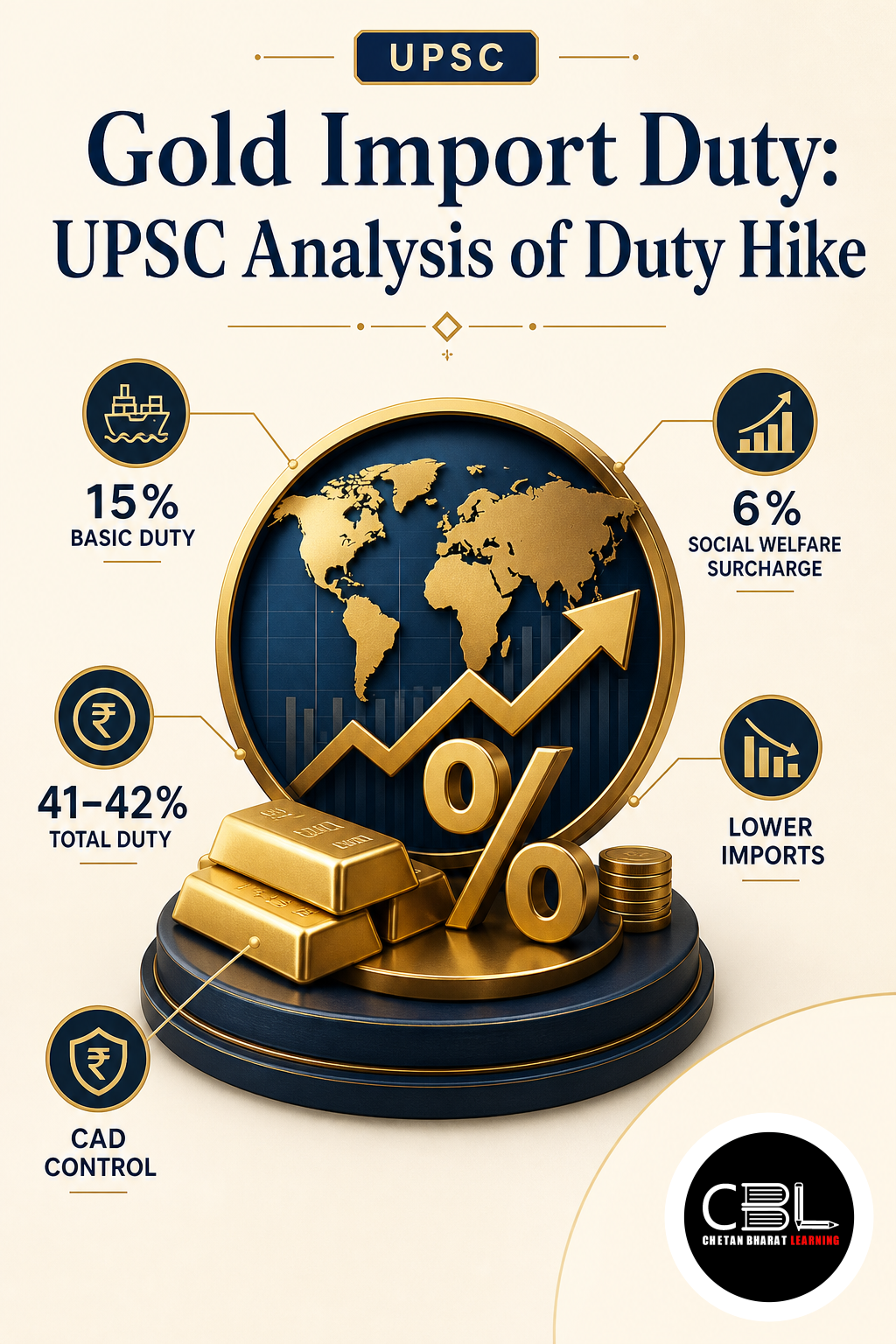
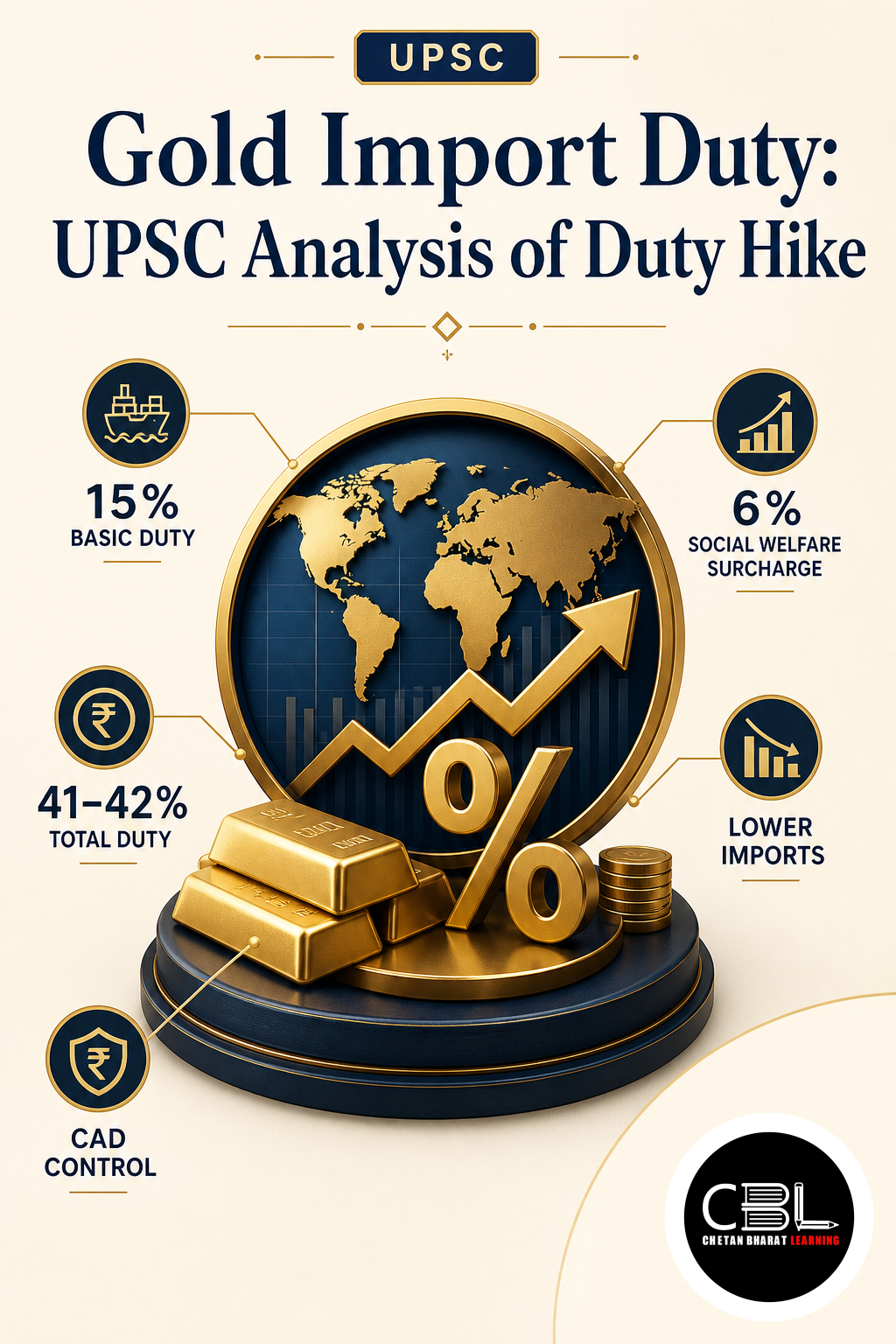
The government increased the applicable import-duty burden on gold and silver from May 13, 2026. The change raised the gold effective import duty from 6.4% to 15.4%, with BCD at 10% and AIDC at 5% in the revised structure.
Between May 13 and August 2, the government collected about ₹10,040 crore from gold, ₹328 crore from silver and ₹95 crore from platinum under the relevant precious-metal duties. This reflects revenue generated after the duty increase rather than as the sole policy objective.
India’s large dependence on imported gold means aspirants should follow official customs and finance-policy updates through the Press Information Bureau while analysing the measure within the external-sector framework.
Key Features
- Higher import burden: The revised structure increases the effective duty applicable to imported gold, raising its landed cost.
- Revenue generation: The supplied material reports substantial customs revenue from gold after the May 13 change.
- Import-demand channel: A higher domestic price can moderate import demand if buyers become more price-sensitive.
- External-sector relevance: Lower gold imports can reduce foreign-exchange outflows and potentially ease pressure on the current account.
- Precious-metal coverage: The reported collections also include silver and platinum, showing that the policy change extends beyond gold alone.
The source also emphasises the importance of understanding the difference between revenue objectives and macroeconomic objectives. Customs revenue is an immediate fiscal outcome, whereas managing import demand and external-sector pressures represents a wider economic-policy consideration.
Challenges
- Domestic price impact: Higher import costs can raise the domestic cost of gold, affecting consumers and jewellery demand.
- Demand substitution: Consumers may alter purchasing patterns when imported gold becomes more expensive, with consequences for the jewellery market.
- Trade-off with revenue: If higher duties significantly reduce imports, the tax base can eventually respond to lower import volumes.
- External-sector complexity: Gold is only one component of India’s external accounts, so duty policy cannot by itself determine the current account outcome.
- Market adjustment: Businesses dealing with imported precious metals may need to adapt to changes in costs, demand and working-capital requirements.
The policy therefore needs to be assessed through both short-run and long-run effects. A rise in customs revenue can coexist with changes in consumer demand, import volumes and external-sector conditions.
Way Forward
The government should evaluate the duty structure through a balanced framework covering revenue, import demand and external-sector stability. Monitoring actual import volumes is essential because the fiscal effect of a duty depends not only on the rate but also on the taxable base.
Policy assessment should also consider the domestic jewellery industry, consumer demand and the potential effect on the formal trade ecosystem. The larger objective should be to manage non-essential import pressures without creating avoidable distortions in legitimate economic activity.
For UPSC, the key analytical chain is simple: higher import duty → higher landed cost → possible moderation in import demand → lower foreign-exchange outflow → potential external-sector benefit.
Prelims Practice Corner
Q1. With reference to gold import duty, consider the following statements:
- (a) It is imposed only on domestically produced gold
- (b) It forms part of the cost of imported gold
- (c) It is identical to the current account deficit
- (d) It has no effect on import demand
Answer: (b) Import duty adds to the cost of imported gold and can influence demand and prices.
Q2. According to the supplied material, the revised gold effective import duty became:
- (a) 6.4%
- (b) 10%
- (c) 15.4%
- (d) 20%
Answer: (c) 15.4%. The supplied material shows the effective import duty rising from 6.4% to 15.4% from May 13, 2026.
Q3. Which of the following is an objective associated with higher gold import duty in the supplied analysis?
- (a) Encouraging unlimited gold imports
- (b) Managing external-sector pressures
- (c) Eliminating customs revenue
- (d) Increasing foreign-exchange outflows
Answer: (b) The source links the measure with import management, foreign-exchange pressures and external-sector stability.
Q4. Which of the following correctly describes the current account?
- (a) It records only gold imports
- (b) It is broader than the trade balance and includes other current transactions
- (c) It records only government revenue
- (d) It measures only foreign-exchange reserves
Answer: (b) The current account covers goods, services, income and transfers, so it is broader than merchandise trade alone.
Q5. According to the supplied report, approximately how much revenue was collected from gold between May 13 and August 2?
- (a) ₹1,040 crore
- (b) ₹5,040 crore
- (c) ₹10,040 crore
- (d) ₹20,040 crore
Answer: (c) ₹10,040 crore. This figure is reported in the supplied current-affairs material.
Mains Practice Questions
Q1. How can an increase in gold import duty influence India’s external sector? Explain. (10 marks)
Answer Structure:
- Intro: Define import duty and establish gold as an important imported commodity for India.
- Body: Explain the effects on landed cost, import demand, foreign-exchange outflow, trade balance, current account and the rupee, while noting possible domestic-price and demand effects.
- Conclusion: Emphasise calibrated customs policy alongside broader external-sector management.
Q2. Higher customs duties can generate revenue but may also alter import behaviour. Discuss this trade-off with reference to gold imports. (15 marks)
Answer Structure:
- Intro: Introduce customs duty as both a fiscal instrument and a tool that can influence relative prices.
- Body: Cover revenue mobilisation, import compression, foreign-exchange management, current account implications, consumer demand, jewellery-sector effects and the limits of relying on one tariff measure.
- Conclusion: Recommend evidence-based calibration that balances fiscal needs, external stability and domestic economic activity.
FAQs on gold import duty
What is gold import duty?
Gold import duty is the customs burden applied to gold brought into India from abroad. It increases the landed cost of imported gold and can influence domestic prices, import demand and government revenue.
Why does India impose a duty on imported gold?
The measure acts as a policy instrument for revenue generation and external-sector management. By raising the cost of imports, it can moderate import demand and foreign-exchange outflows.
How can gold imports affect the current account?
Gold imports add to merchandise imports and therefore can affect the trade balance, which forms part of the current account. Higher gold imports can increase foreign-exchange outflows, while moderation in imports can ease that pressure.
Related Current Affairs
Preparing for UPSC, PCS or HCS?
Talk to a mentor at Chetan Bharat Learning, Chandigarh. Free guidance on choosing the right exam and building a study plan.
Chat on WhatsAppCall 97793 53345UPSC / IAS / PCS coaching in Chandigarh · Trusted by aspirants across Punjab & Haryana
Leave a Reply
You must be logged in to post a comment.