

UPSC Syllabus Mapping
GS Paper: GS-II and GS-III
Subject: Health, Antimicrobial Resistance, Public Health Governance and Science & Technology
Article
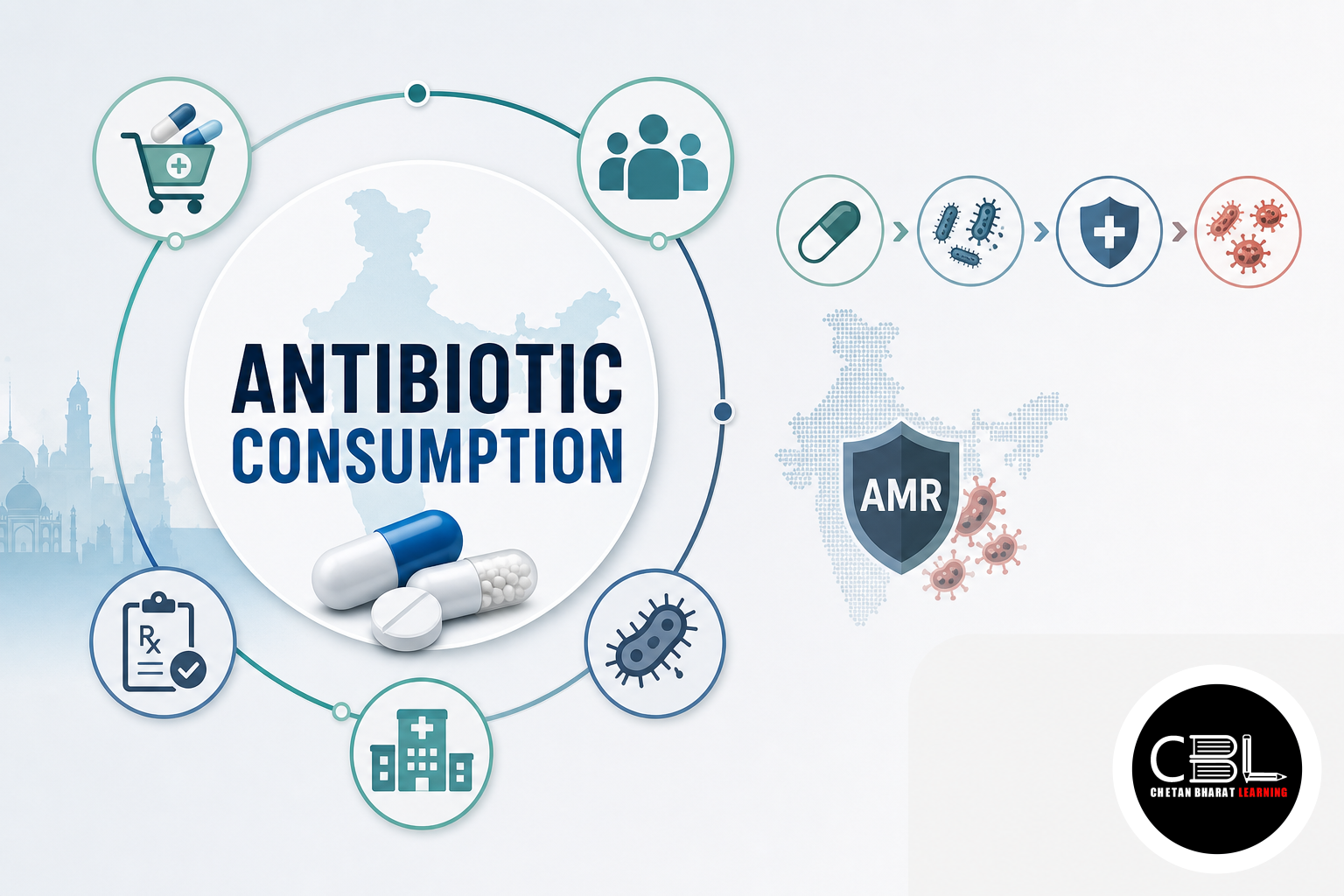
Antibiotic Consumption in India shows a troubling mismatch between how many antibiotics people use and which medicines they receive. A recent international study assessed antibiotic requirements against local disease burdens using the World Health Organization’s AWaRe framework. India consumes more antibiotics overall than its estimated optimal requirement. However, it simultaneously underuses safer first-line medicines and some last-resort drugs needed for severe resistant infections. Moreover, excessive reliance on broad-spectrum antibiotics can accelerate antimicrobial resistance. For structured preparation, explore our daily current affairs archive. The findings therefore reveal that India’s challenge involves inappropriate composition and unequal access, not merely excessive medicine use.
What is Antibiotic Consumption?
Antibiotics are medicines that treat bacterial infections, but their public health value depends on appropriate use. Taking an antibiotic when it is unnecessary exposes bacteria to selective pressure without providing a corresponding clinical benefit. Consequently, susceptible bacteria may die while resistant variants survive and multiply. Repeated inappropriate use can therefore accelerate the emergence and spread of antimicrobial resistance.
Antimicrobial resistance occurs when microorganisms evolve mechanisms that reduce the effectiveness of medicines used against them. Antibiotic resistance refers specifically to this process among bacteria. As resistance grows, common infections can become harder and more expensive to treat. Moreover, modern medicine depends on effective antibiotics for surgery, cancer treatment, intensive care and many other procedures.
Researchers often compare antibiotic use through Defined Daily Doses. Population-level consumption can be expressed as Defined Daily Doses per 1,000 inhabitants per day, commonly abbreviated as DID. This standardised measure allows comparisons across populations and time. However, it represents aggregate consumption rather than the exact dose prescribed to every individual patient.
The WHO AWaRe framework provides another important analytical tool. It classifies antibiotics into Access, Watch and Reserve categories according to their role in treatment and stewardship. Access medicines generally include preferred first- or second-choice treatments for many common infections. In contrast, Watch antibiotics have greater resistance potential and require more careful stewardship.
Reserve antibiotics constitute last-resort options for selected infections involving multidrug-resistant organisms. Clinicians must protect these medicines from unnecessary use so that they remain effective. However, excessive restriction can also harm critically ill patients who genuinely need them. Good stewardship therefore seeks the right antibiotic, for the right patient, at the right dose and duration.
Why is Antibiotic Consumption in News?
A study reported in The Indian Express examined antibiotic requirements across 186 countries using local disease burdens and the WHO classification. The findings suggest a global mismatch between medically appropriate need and actual use. Many countries consume more antibiotics than their estimated requirement. Meanwhile, inappropriate choices within total consumption create an additional stewardship problem.
For India, the study estimated actual use at 18.3 DID compared with an optimal requirement of 14.7 DID. This suggests overall consumption exceeds the modelled need. However, the aggregate figure hides a more important structural imbalance. India uses too many higher-risk broad-spectrum medicines while consuming fewer safer first-line drugs than the estimated requirement.
The reported Watch-group consumption stands at 9.3 DID against an estimated optimal requirement of 6.0 DID. In contrast, Access-group use stands at 4.5 DID against an estimated requirement of 7.8 DID. Therefore, India’s prescribing pattern appears skewed towards medicines that require greater stewardship. This can increase selective pressure for resistance when clinicians use such drugs unnecessarily.
The study also highlights inadequate use of Reserve medicines relative to estimated need. India reportedly consumes 0.19 DID in this category against an optimal requirement of 0.99 DID. This does not imply that doctors should routinely prescribe last-resort drugs. Rather, it may indicate that some patients with serious resistant infections face barriers to appropriate diagnostics or access.
The WHO AWaRe framework promotes more responsible antibiotic selection and stewardship. The findings are therefore significant because they shift attention from total volumes towards the composition of antibiotic use. For India, reducing inappropriate use must occur alongside improving access to the medicines patients actually require.
Key Features
Access antibiotics form the foundation of responsible treatment for many common bacterial infections. They generally have a favourable resistance profile compared with broader-spectrum alternatives and should remain widely available at appropriate quality and price. Increasing their appropriate share can therefore improve both access and stewardship. However, doctors must still prescribe them according to clinical need rather than automatically.
Watch antibiotics include agents that carry greater potential to select for resistance. Clinicians need them for specific infections, so stewardship does not seek to eliminate their use. Instead, healthcare systems should prevent routine empirical use when a narrower appropriate option exists. Better diagnostics can help doctors make this distinction with greater confidence.
Reserve medicines act as protected last-line options for selected multidrug-resistant infections. Hospitals need microbiology laboratories and susceptibility testing to determine when such drugs are necessary. Moreover, infectious-disease expertise and stewardship teams can improve their use. Restricted access without diagnostic capacity can otherwise leave critically ill patients without appropriate treatment.
The Indian pattern therefore presents an apparent paradox. Excessive overall antibiotic use can coexist with inadequate access to specific appropriate medicines. Similarly, patients may receive a broad-spectrum drug when a first-line treatment would work, while another patient cannot obtain a last-resort medicine for a resistant infection. Antimicrobial policy must address both misuse and access failures simultaneously.
This issue also demonstrates the One Health nature of resistance. Antibiotic use in humans interacts with antimicrobial practices in animals, food systems and the wider environment. Resistant organisms and resistance genes can move across these domains. Consequently, stewardship requires coordinated action involving healthcare, veterinary practice, sanitation, pharmaceutical waste and surveillance.
Challenges
Unregulated or inappropriate over-the-counter access remains an important challenge. Patients may purchase antibiotics without adequate diagnosis or may stop treatment when symptoms improve. Moreover, self-medication can result in incorrect drug selection, dose or duration. Effective regulation therefore requires both pharmacy enforcement and affordable access to qualified healthcare.
Diagnostic uncertainty can also push clinicians towards broad-spectrum treatment. Many rural and smaller health facilities lack rapid tests that can distinguish bacterial infections or identify likely pathogens quickly. Consequently, doctors may prescribe empirically to avoid delaying treatment. Affordable point-of-care diagnostics could reduce this uncertainty and improve antibiotic selection.
Hospitals also need local antibiograms, which summarise patterns of antimicrobial susceptibility among organisms isolated in a facility or region. National resistance data remain essential, but local patterns can differ significantly. Therefore, clinicians need timely local information when selecting empirical therapy. Weak microbiology networks limit the quality of such evidence.
Public expectations can create another pressure. Some patients may expect antibiotics for viral respiratory infections even though antibiotics do not treat viruses. Meanwhile, time-constrained consultations can make detailed counselling difficult. Public awareness and better clinical communication can therefore reduce unnecessary demand without restricting legitimate access.
India must also prevent stewardship from becoming a simple policy of using fewer antibiotics everywhere. Underserved populations may already struggle to obtain appropriate medicines and diagnostics. A successful strategy must reduce unnecessary Watch use while expanding suitable Access medicines and ensuring Reserve drugs reach patients with genuine need. Aspirants can connect this issue with wider public health governance through our UPSC current affairs library.
Way Forward
India should embed AWaRe principles more deeply within prescribing guidelines, procurement systems and hospital stewardship programmes. Public facilities can prioritise appropriate Access medicines while closely monitoring Watch and Reserve use. Moreover, prescription audits can identify facilities where broad-spectrum use appears unusually high. Feedback to clinicians can then support evidence-based correction.
Diagnostic capacity needs parallel expansion. District hospitals and medical colleges require stronger microbiology laboratories, while primary facilities need affordable rapid diagnostics where validated tests exist. Furthermore, digital reporting can connect laboratory findings with regional resistance surveillance. Clinicians could then choose empirical treatment using current local evidence rather than outdated assumptions.
Pharmacy regulation should curb non-prescription sales without creating barriers for patients who legitimately require treatment. Enforcement therefore needs stronger primary healthcare and affordable consultations. Similarly, public campaigns should explain that antibiotics do not treat viral infections. Better health literacy can reduce demand-driven misuse.
Hospitals should establish multidisciplinary antimicrobial stewardship programmes involving clinicians, microbiologists, pharmacists and infection-control teams. These teams can review high-risk prescriptions and promote appropriate de-escalation after laboratory results become available. In addition, strong infection prevention reduces the need for antibiotics in the first place. Clean water, sanitation, vaccination and hospital hygiene therefore remain central AMR interventions.
Finally, India should treat resistance as a One Health governance challenge rather than a problem of human prescriptions alone. The National Centre for Disease Control provides an important institutional platform for public health surveillance and antimicrobial-resistance action. Antibiotic Consumption patterns show why stewardship must combine appropriate access with restraint. Therefore, India’s objective should be optimal antibiotic use rather than simply maximum access or minimum consumption.
Prelims Practice Corner
-
Under the WHO AWaRe framework, which category generally contains preferred first-line antibiotics for many common infections?
- (a) Access
- (b) Watch
- (c) Reserve
- (d) Critical
Answer: Access antibiotics include many preferred treatments with comparatively lower resistance potential.
-
Reserve antibiotics are primarily intended for:
- (a) Routine treatment of viral infections
- (b) Selected multidrug-resistant bacterial infections
- (c) Nutritional deficiencies
- (d) Routine preventive use by healthy people
Answer: Reserve medicines are protected last-resort options for selected resistant bacterial infections.
-
DID in antibiotic-consumption studies refers to:
- (a) Defined Daily Doses per 1,000 inhabitants per day
- (b) Disease Incidence Density
- (c) Drug Import Duty
- (d) Diagnostic Infection Database
Answer: DID is a standardised population-level measure of medicine consumption.
-
Consider the following statements:
1. Antibiotics are effective against all viral infections.
2. Inappropriate antibiotic use can accelerate resistance.
3. Local antibiograms can guide empirical antibiotic selection.Which statements are correct?
- (a) 1 only
- (b) 2 only
- (c) 2 and 3 only
- (d) 1, 2 and 3
Answer: Statements 2 and 3 are correct. Antibiotics target bacteria rather than viral infections.
-
Antimicrobial resistance is considered a One Health issue because:
- (a) Resistance concerns hospitals alone
- (b) Humans, animals and environmental systems can exchange resistant organisms and resistance determinants
- (c) Antibiotics are used only in agriculture
- (d) Resistance occurs only outside India
Answer: Human, animal and environmental health are interconnected in the emergence and spread of resistance.
Mains Practice Questions
-
India’s antimicrobial challenge is not merely one of excessive antibiotic use but also inappropriate composition and unequal access. Examine. (10 marks)
- Explain AWaRe framework
- Discuss overall overconsumption, excessive Watch use, inadequate Access share and barriers to Reserve medicines
- Conclude with balanced stewardship and access
-
Antimicrobial stewardship requires health-system strengthening rather than prescription restrictions alone. Discuss in the Indian context. (15 marks)
- Discuss diagnostics, microbiology laboratories, antibiograms
- Cover pharmacy regulation, public awareness and hospital stewardship
- Add sanitation, vaccination and One Health surveillance
- Conclude with equitable access to appropriate treatment
FAQs on Antimicrobial Stewardship
What is the WHO AWaRe classification?
It groups antibiotics into Access, Watch and Reserve categories. The framework helps health systems improve antibiotic selection, preserve critical medicines and monitor stewardship.
Why is excessive use of broad-spectrum antibiotics problematic?
Broad-spectrum drugs affect a wider range of bacteria and can exert substantial selective pressure. Unnecessary use can therefore encourage resistance and reduce future treatment options.
Does fighting antimicrobial resistance mean reducing every antibiotic prescription?
No. Stewardship seeks appropriate treatment rather than indiscriminate reduction. Patients with bacterial infections must receive effective medicines, while health systems should minimise unnecessary use and ensure access to suitable first-line and last-resort treatments.
Related Current Affairs
Preparing for UPSC, PCS or HCS?
Talk to a mentor at Chetan Bharat Learning, Chandigarh. Free guidance on choosing the right exam and building a study plan.
Chat on WhatsAppCall 97793 53345UPSC / IAS / PCS coaching in Chandigarh · Trusted by aspirants across Punjab & Haryana
Leave a Reply
You must be logged in to post a comment.