

UPSC Mapping
| Prelims | Mains |
|---|---|
| Indian Society | GS Paper 1 (Social Issues) & GS Paper 3 (Economy) |
Article
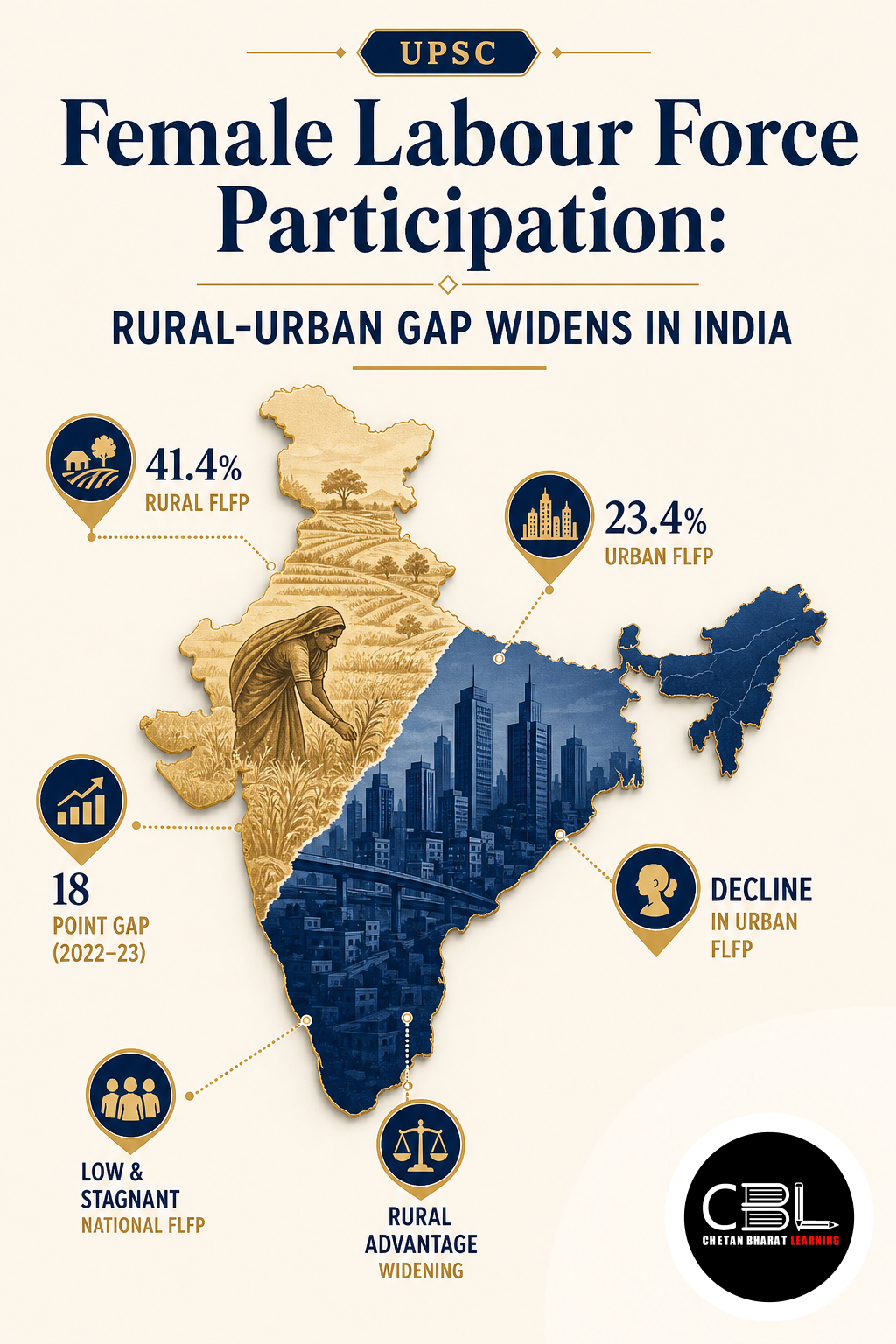
The female labour force participation (FLFPR) in India presents a complex picture, with rural participation rates rising significantly while urban rates remain stagnant, according to the July 2026 Periodic Labour Force Survey (PLFS). Overall FLFPR for women aged 15+ increased from 30% in 2019-20 to 40% in 2025, but the rural-urban gap has widened: rural FLFPR expanded from 33.0% to 45.9%, while urban FLFPR grew slowly from 23.3% to 27.7% during the same period. This divergence is a critical issue for social sector current affairs.
| Rural FLFPR | Urban FLFPR |
|---|---|
| 45.9% (2025) | 27.7% (2025) |
What is Female Labour Force Participation?
Female labour force participation refers to the proportion of women aged 15 and above who are either employed or actively seeking work. It is a key indicator of women’s economic empowerment and overall economic development. In India, FLFPR has historically been low compared to global averages, and the recent rise in rural participation is notable. However, the stagnation in urban FLFPR poses a significant challenge to inclusive growth.
Rural women accounted for 80% of the rise in female workers from 2017-18 to 2023-24, with leading states like West Bengal, UP, and Bihar driving these gains. In contrast, urban FLFPR has remained low due to factors such as industrial saturation, patriarchal norms, care burdens, and mobility barriers.
Why is Female Labour Force Participation in News?
The female labour force participation data has come under the spotlight following the release of the July 2026 PLFS report, which highlights the widening rural-urban gap. The report shows that while rural FLFPR has expanded significantly, urban FLFPR has barely increased, reflecting deep-rooted structural barriers. This divergence has implications for policy, as the nature of work differs between rural and urban areas—rural women are often engaged in subsistence agriculture and unpaid family work, while urban women face a lack of formal job opportunities.
The government’s initiatives, such as the Deendayal Antyodaya Yojana-National Rural Livelihoods Mission (DAY-NRLM), have contributed to rural participation by expanding credit and skilling for self-employment. However, urban women continue to face challenges like unsafe transport, care burden, and the income effect, where rising household incomes lead to women exiting the workforce. For official data, refer to the PIB release on PLFS findings.
Drivers of the Rural-Urban Gap
- Agricultural Absorption: Concentration in subsistence farming and unpaid family work sustains high rural female participation compared to lower urban levels.
- Distress Employment: Vulnerable household income compels rural women into low-productivity work as an economic necessity to cushion family finances.
- Methodological Effect: Broadened survey codes count unpaid domestic tasks as active employment, inflating rural female workforce beyond formal job gains.
- Enterprise Support: DAY-NRLM credit and skilling expand self-employment opportunities for rural women.
- Barriers to Urban Participation: Industrial saturation, income effect, care burden, and mobility barriers limit urban FLFPR. For more on women’s issues, explore the women’s issues archive.
Challenges to Urban Female Participation
- Industrial Saturation: Manufacturing employs only about 11.4% of workers, limiting expansion of formal jobs suitable for educated urban women.
- Income Effect: Patriarchal norms prompt women to leave the workforce as household incomes rise, reinforcing domesticity as a status symbol.
- Care Burden: Eldercare and childcare responsibilities during peak working years limit female participation to 48% (ages 25-35), compared to 98% for males.
- Mobility Barrier: Limited last-mile transit options and unsafe routes discourage women in cities, with 31% citing transit safety as a barrier to employment.
Way Forward for Female Labour Force Participation
To boost female labour force participation, especially in urban areas, the government and private sector must address structural barriers. Key measures include enforcing Section 11A crèche mandates under the Maternity Benefit Amendment Act through PPP daycare facilities in industrial corridors. Expanding subsidized, safe public transport like pink buses and women-only coaches can reduce urban commuting barriers.
Reskilling urban women for gig work, formal care services, and emerging digital sectors can reduce educated female unemployment. In rural areas, scaling agro-processing MSMEs and targeted credit can move women from subsistence self-employment into higher-margin value chains. According to a World Bank report, investing in women’s economic empowerment is crucial for sustainable development.
Prelims Practice Corner
Q1. According to the July 2026 PLFS, what is the overall FLFPR for women aged 15+ in India?
- a) 30%
- b) 35%
- c) 40%
- d) 45%
Answer: (c) 40%. FLFPR increased from 30% in 2019-20 to 40% in 2025.
Q2. Which states led rural female participation gains?
- a) Gujarat, Maharashtra
- b) West Bengal, UP, Bihar
- c) Tamil Nadu, Kerala
- d) Punjab, Haryana
Answer: (b) West Bengal, UP, and Bihar.
Q3. What percentage of urban women cite transit safety as a barrier to employment?
- a) 21%
- b) 31%
- c) 41%
- d) 51%
Answer: (b) 31%.
Q4. What is the income effect in the context of FLFPR?
- a) Women work more when incomes rise
- b) Women leave work as household income rises
- c) Women prefer informal jobs
- d) Income does not affect participation
Answer: (b) Women leave work as household income rises, due to patriarchal norms.
Q5. Which scheme supports rural women’s self-employment through credit and skilling?
- a) PMJDY
- b) DAY-NRLM
- c) NRLM
- d) PM-KISAN
Answer: (b) DAY-NRLM (Deendayal Antyodaya Yojana-National Rural Livelihoods Mission).
Mains Practice Questions
Q1. “The rural-urban gap in female labour force participation reflects deeper structural inequalities in India’s economy and society.” Examine the drivers and suggest policy measures. (250 words, 15 marks)
Answer Structure:
- Intro: Define FLFPR and highlight recent trends from PLFS data.
- Body: Discuss drivers of rural participation (agriculture, distress, enterprise support) and barriers to urban participation (industrial saturation, care burden, mobility). Analyse policy implications.
- Conclusion: Suggest measures like crèche expansion, gender-responsive transport, and skill alignment.
Q2. “Women’s economic empowerment is central to achieving inclusive growth.” Discuss the challenges and opportunities for increasing female labour force participation in India. (250 words, 15 marks)
Answer Structure:
- Intro: Emphasize the importance of FLFPR for economic growth and gender equality.
- Body: Discuss challenges (patriarchal norms, care burden, mobility, industrial stagnation) and opportunities (gig economy, digital skills, policy initiatives like DAY-NRLM).
- Conclusion: Highlight the need for a comprehensive approach involving infrastructure, legal reforms, and social awareness.
FAQs on Female Labour Force Participation
What is the income effect in the context of female labour force participation?
The income effect refers to the phenomenon where women exit the workforce as household incomes rise, often due to patriarchal norms that associate domesticity with higher social status.
How does DAY-NRLM contribute to rural female participation?
The Deendayal Antyodaya Yojana-National Rural Livelihoods Mission provides credit, skilling, and self-employment opportunities, enabling rural women to engage in income-generating activities.
What are the major barriers to urban female employment?
Major barriers include limited formal jobs, caregiving responsibilities, unsafe transport, and the income effect, where rising household income leads to women leaving the workforce.
Related Current Affairs
Preparing for UPSC, PCS or HCS?
Talk to a mentor at Chetan Bharat Learning, Chandigarh. Free guidance on choosing the right exam and building a study plan.
Chat on WhatsAppCall 97793 53345UPSC / IAS / PCS coaching in Chandigarh · Trusted by aspirants across Punjab & Haryana
Leave a Reply
You must be logged in to post a comment.