
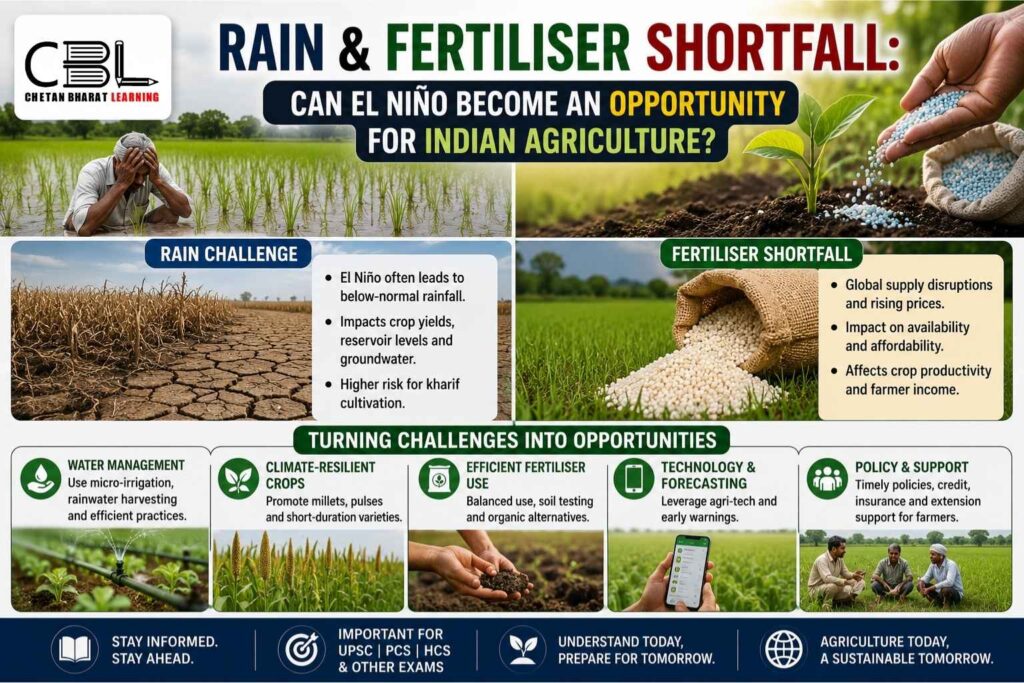
India’s agriculture sector has remained one of the strongest pillars of the economy in recent years. Good monsoon rainfall and record crop production helped the sector achieve steady growth and supported rural incomes. However, concerns are emerging again as forecasts indicate the possible return of El Niño conditions, which could weaken monsoon rainfall and affect agricultural output.
At the same time, global supply chain disruptions and geopolitical tensions are creating uncertainty in fertiliser availability. While these developments may seem challenging, experts believe they could also become an opportunity for India to improve agricultural efficiency and strengthen climate resilience.
For UPSC aspirants, this topic is important from the perspective of Agriculture, Climate Change, Food Security, and the Indian Economy.
Why Is This Issue in the News?
Recent weather forecasts suggest that El Niño conditions may develop during the current monsoon season. The India Meteorological Department (IMD) has also indicated the possibility of below-normal rainfall in some regions.
Alongside weather concerns, fertiliser supplies remain under pressure due to global geopolitical tensions and disruptions in international trade routes. Experts believe that the combined impact of lower rainfall and fertiliser shortages could influence agricultural production, especially during the Rabi season.
Understanding El Niño
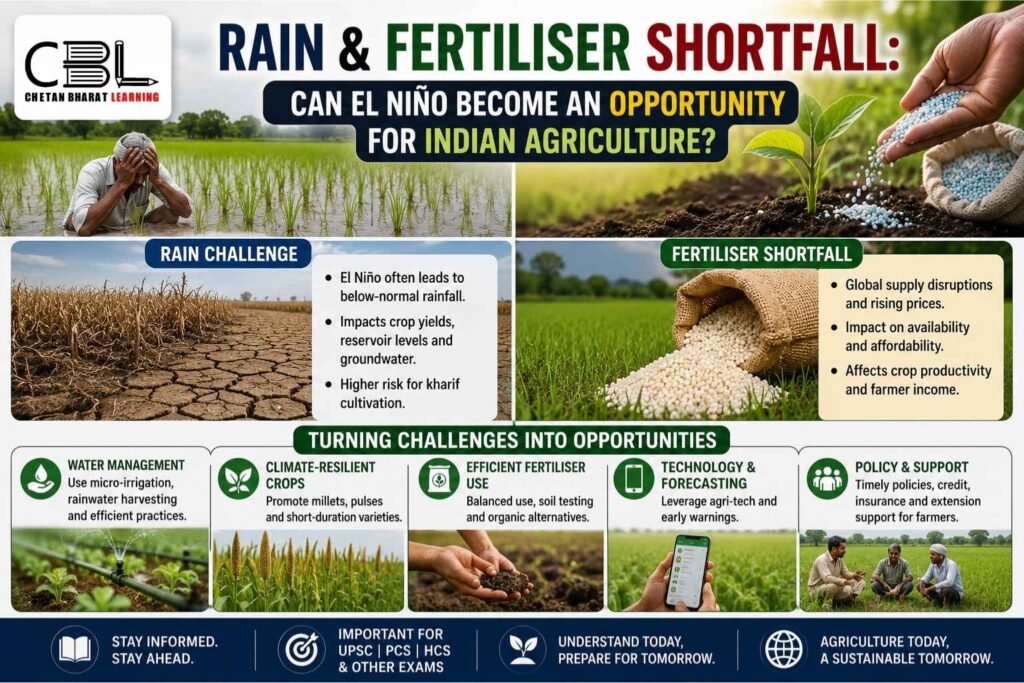
El Niño is a climate phenomenon caused by the warming of sea surface temperatures in the central and eastern Pacific Ocean.
This phenomenon affects weather patterns across the world and often leads to reduced monsoon rainfall in India. Since a large part of Indian agriculture depends on rainfall, El Niño can significantly influence crop production and rural livelihoods.
Some common impacts of El Niño include:
- Reduced monsoon rainfall
- Higher temperatures
- Increased risk of drought
- Lower soil moisture
- Stress on agricultural production
How Has Indian Agriculture Performed Recently?
Indian agriculture has performed remarkably well over the last two years due to favourable monsoon conditions.
Agricultural growth remained strong as rainfall exceeded the Long Period Average (LPA) during previous monsoon seasons. This helped increase crop production and supported food security across the country.
Strong agricultural performance also played an important role in controlling food inflation and improving rural economic conditions.
The success of recent crop seasons has created a strong foundation that may help India manage future climatic challenges more effectively.
Why Are Fertiliser Supplies a Concern?
India relies on imports for a significant portion of its fertiliser requirements and raw materials.
Recent geopolitical tensions, especially in West Asia, have increased concerns regarding supply disruptions and transportation costs. Rising energy prices have also contributed to higher fertiliser production and import costs globally.
Although current stocks appear sufficient for the Kharif season, experts warn that prolonged disruptions could affect fertiliser availability during the Rabi season.
This highlights the need for better supply chain management and increased domestic production capacity.
How Could This Become an Opportunity?
While lower rainfall and fertiliser shortages present risks, they also provide an opportunity to improve agricultural practices.
The situation encourages farmers and policymakers to focus on efficient resource utilisation rather than excessive dependence on rainfall and fertilisers.
Greater emphasis on scientific farming methods can help improve productivity while reducing environmental stress.
Promoting Efficient Fertiliser Use
One of the biggest opportunities lies in improving fertiliser efficiency.
Farmers are increasingly being encouraged to adopt:
- Soil testing
- Balanced nutrient management
- Precision farming techniques
- Organic and natural farming practices
These methods help reduce unnecessary fertiliser consumption while maintaining crop productivity.
Improved fertiliser management can also lower production costs and improve soil health over the long term.
Strengthening Water Management
Water conservation becomes even more important when rainfall is uncertain.
A weaker monsoon can encourage faster adoption of:
- Drip irrigation
- Sprinkler irrigation
- Rainwater harvesting
- Watershed management
- Efficient groundwater use
Such measures improve water-use efficiency and help farmers cope with rainfall variability.
Climate-Resilient Agriculture
Climate change has made weather patterns increasingly unpredictable.
To address these challenges, India is promoting climate-resilient agricultural practices such as:
- Drought-resistant crop varieties
- Crop diversification
- Improved seed technology
- Climate-smart farming
These initiatives can help reduce the vulnerability of farmers to changing climatic conditions.
Impact on Kharif and Rabi Crops
Experts believe that the impact of El Niño may vary across agricultural seasons.
The Kharif season may not experience severe disruptions if rainfall remains reasonably adequate during the early monsoon months. Crops such as rice, maize, cotton, and soybean could continue to perform relatively well.
However, greater concerns exist for the Rabi season. If El Niño strengthens later in the year, warmer winters and lower soil moisture could affect wheat and other winter crops.
Fertiliser shortages may also become more visible during this period.
Impact on Food Inflation
Food inflation has remained under control due to strong agricultural production in recent years.
However, prolonged rainfall deficits or supply-side disruptions could increase food prices in the future. Reduced crop output may affect the availability of cereals, vegetables, and other essential food items.
The government may need to rely on buffer stocks and timely policy interventions to ensure food security and price stability.
Government Measures Supporting Agriculture
The Government of India has launched several programmes to improve agricultural resilience and sustainability.
Important initiatives include:
- Pradhan Mantri Krishi Sinchai Yojana (PMKSY)
- PM Fasal Bima Yojana
- Soil Health Card Scheme
- National Mission for Sustainable Agriculture
- Promotion of Natural Farming
These schemes help farmers manage climate risks and improve productivity.
Significance for UPSC Aspirants
This topic is highly relevant for UPSC preparation because it combines agriculture, climate change, food security, and economic development.
GS Paper III
- Agriculture
- Food Security
- Climate Change
- Disaster Management
- Indian Economy
Essay Topics
- Climate Change and Agriculture
- Sustainable Farming in India
- Food Security Challenges
- Building Climate Resilience
Students preparing through UPSC Coaching in Chandigarh and IAS Coaching in Chandigarh should understand the relationship between climate events, agricultural productivity, and economic stability.
FAQs
What is El Niño?
El Niño is a climate phenomenon caused by warming sea surface temperatures in the Pacific Ocean that affects global weather patterns.
How does El Niño affect India?
It can weaken the monsoon, reduce rainfall, increase temperatures, and impact agricultural production.
Why are fertiliser supplies under pressure?
Global supply chain disruptions, geopolitical tensions, and rising energy prices have affected fertiliser availability and costs.
Which crop season may face greater risks?
The Rabi season could face greater risks if El Niño conditions strengthen later in the year.
Why is this topic important for UPSC?
It is relevant for Agriculture, Climate Change, Food Security, Disaster Management, and the Indian Economy.
Conclusion
The possibility of weaker monsoons and fertiliser shortages presents challenges for Indian agriculture. However, these developments also provide an opportunity to promote efficient resource use, strengthen climate resilience, and modernise farming practices.
With proper planning, improved irrigation systems, climate-smart agriculture, and better fertiliser management, India can transform these challenges into long-term opportunities for sustainable agricultural growth and food security.
Related Current Affairs
Preparing for UPSC, PCS or HCS?
Talk to a mentor at Chetan Bharat Learning, Chandigarh. Free guidance on choosing the right exam and building a study plan.
Chat on WhatsAppCall 97793 53345UPSC / IAS / PCS coaching in Chandigarh · Trusted by aspirants across Punjab & Haryana
Leave a Reply
You must be logged in to post a comment.