
UPSC Mapping
| Prelims | Social Sector & Education |
|---|---|
| Mains | GS Paper 1 (Social Issues) & GS Paper 2 (Governance) |
Quick Facts
| NEET Youth | 8.7 crore (15-29 age) |
|---|---|
| Skilling Spend | ₹34,000 crore (2025-26) |
What is the Education-Employment Gap?
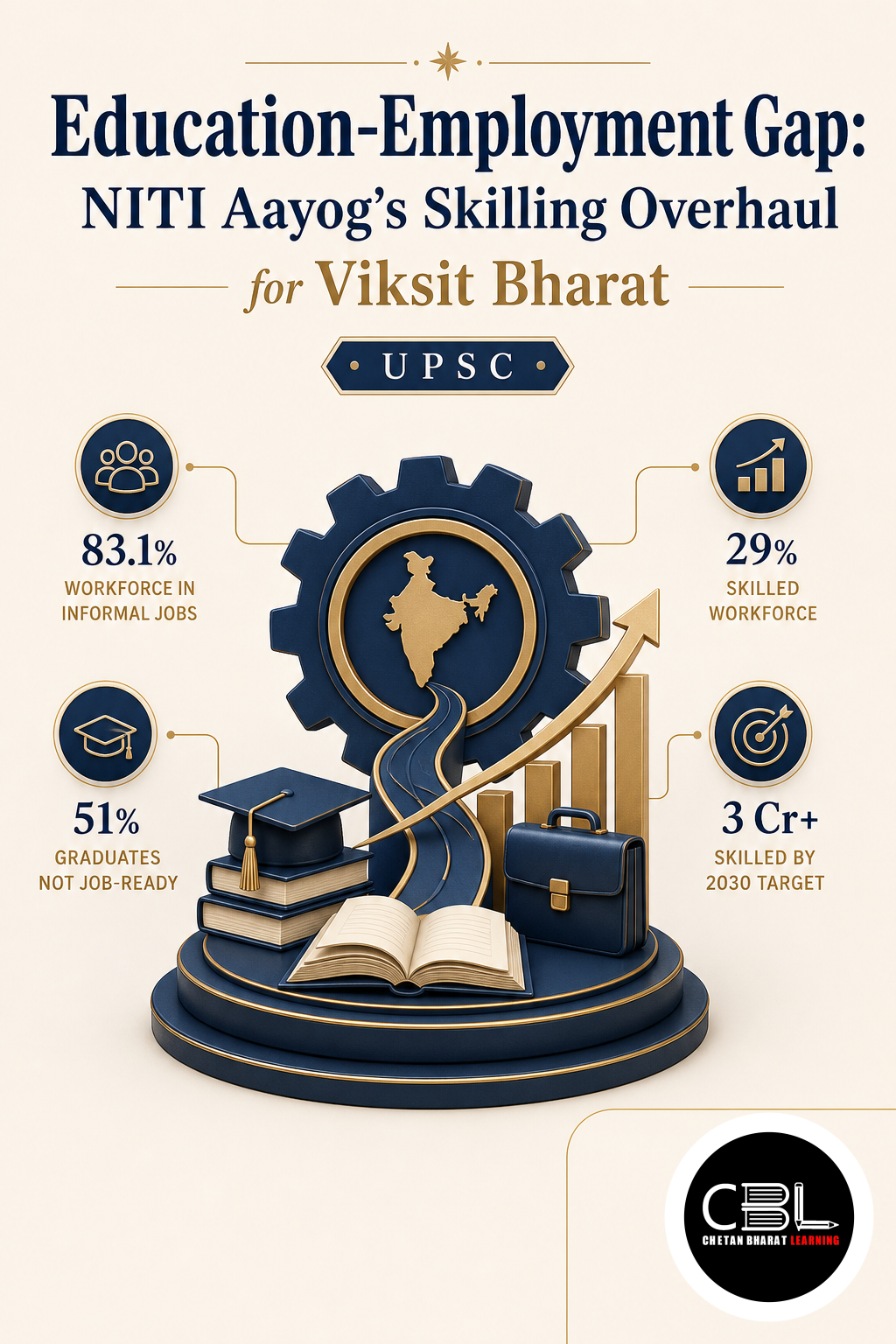
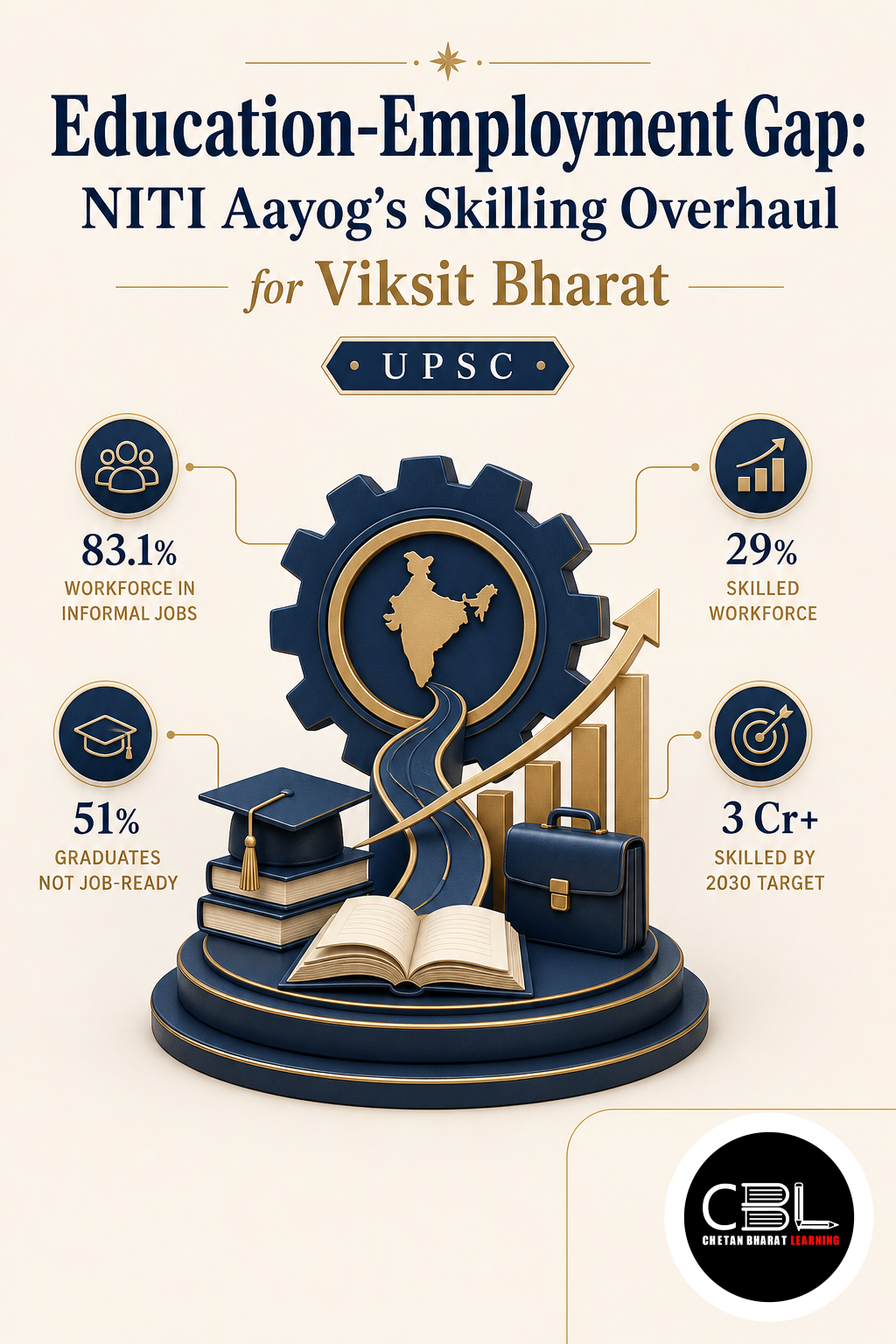
The education-employment gap refers to the disconnect between the skills acquired through formal education and the competencies required by the labour market. In India, this manifests in high graduate unemployment, qualification mismatches and a large share of youth who are neither employed nor in education or training. Only 8.25% of graduates secure roles matching their qualifications, while 34% of higher-education students are structurally unprepared for industry demands.
Why is the Education-Employment Gap in News?
NITI Aayog’s ‘Reimagining Skilling for Viksit Bharat@2047’ report has renewed focus on this gap by identifying key bottlenecks and outlining a roadmap for skilling reforms. Despite a ₹34,000 crore skilling spend in 2025–26, outcomes remain uneven. The report also highlights gender disparities—only 3% of women hold formal jobs, with 71% working informally or being NEET—spurring calls for targeted interventions for women, rural youth and marginalised communities.
Key Gaps Identified
- NEET Burden: 8.7 crore youth aged 15–29 are not in education, employment or training.
- Female Informality: Only 3% of women have formal jobs; 71% are informal or NEET.
- Qualification Mismatch: 8.25% of graduates find jobs aligned with their qualifications.
- Skill Deficit: 36% of workers face digital skill gaps; 18% lack adequate communication skills.
- Entrepreneurial Disconnect: 61% of higher-education students interested in entrepreneurship are unaware of available pathways.
Systemic and Structural Bottlenecks
- Affordability Barrier: NEET youth lack income; low-income students struggle with paid skilling amid college expenses.
- Mobility Lock: Caregiving duties and household expectations limit women’s access to training centres.
- Degree-Skill Mismatch: Outdated curricula leave 34% of students unprepared for industry.
- School Deficiency: Fewer than 1 in 12 secondary schools offer vocational subjects despite NEP 2020 guidance.
- Outcome Disconnect: Weak outcome orientation hinders impact despite ₹34,000 crore in skilling expenditure.
Way Forward for Bridging the Gap
NITI Aayog recommends a multi-pronged approach: universal General Employability and Entrepreneurship Skills (GEES) from Class 6; structured ‘Kaushal Tracks’ from Class 9 based on local demand; targeted skill vouchers and local training spaces for women; Apprenticeship-Embedded Degree and Diploma programmes; micro-credentials aligned with the National Credit Framework; and a centralised apprenticeship platform linking students and MSMEs.
Prelims Practice Corner
Q1. What is the estimated number of Indian youth in the NEET category according to the NITI Aayog report?
- (a) 5.5 crore
- (b) 8.7 crore
- (c) 10.2 crore
- (d) 12.5 crore
Answer
(b) 8.7 crore.
Q2. What percentage of graduates in India secure roles that match their qualifications?
- (a) 5.2%
- (b) 8.25%
- (c) 12.5%
- (d) 15.3%
Answer
(b) 8.25%.
Q3. What is the proposed ‘Kaushal Track’ in the NITI Aayog report?
- (a) A new college degree
- (b) A vocational pathway from Class 9
- (c) A skill voucher scheme
- (d) A centralized apprenticeship platform
Answer
(b) A vocational pathway from Class 9 based on local industrial demand.
Q4. Which scheme provides credit and skilling for rural women’s self-employment?
- (a) PM-KISAN
- (b) DAY-NRLM
- (c) NREGA
- (d) PM-AASHA
Answer
(b) DAY-NRLM (Deendayal Antyodaya Yojana–National Rural Livelihoods Mission).
Q5. What is the government’s expenditure on skilling in 2025-26?
- (a) ₹20,000 crore
- (b) ₹34,000 crore
- (c) ₹50,000 crore
- (d) ₹70,000 crore
Answer
(b) ₹34,000 crore.
Mains Practice Questions
Q1. “The education-employment gap in India is a major impediment to reaping the demographic dividend.” Discuss the key challenges and suggest measures based on NITI Aayog’s recommendations. (250 words, 15 marks)
Answer Structure:
- Intro: Define the education-employment gap and its significance for India’s growth.
- Body: Cover key gaps (NEET burden, female informality, skill deficits), structural bottlenecks (affordability, mobility, curriculum mismatch), and NITI Aayog’s recommendations (GEES, Kaushal Tracks, apprenticeship integration).
- Conclusion: Emphasise the need for outcome-oriented skilling and gender-responsive interventions.
Q2. “Skilling and vocational education are critical for India’s transition to a knowledge economy.” Analyse the systemic barriers and suggest a roadmap for effective implementation. (250 words, 15 marks)
Answer Structure:
- Intro: Highlight the importance of skilling for Viksit Bharat@2047.
- Body: Discuss barriers (school deficiency, affordability, mobility, degree-skill mismatch) and recommendations (GEES, Kaushal Tracks, apprenticeship programmes, credit framework).
- Conclusion: Stress on outcome orientation and stakeholder collaboration.
FAQs on Education-Employment Gap
What is the NEET category?
NEET stands for
Related Current Affairs
Preparing for UPSC, PCS or HCS?
Talk to a mentor at Chetan Bharat Learning, Chandigarh. Free guidance on choosing the right exam and building a study plan.
Chat on WhatsAppCall 97793 53345UPSC / IAS / PCS coaching in Chandigarh · Trusted by aspirants across Punjab & Haryana
Leave a Reply
You must be logged in to post a comment.