

UPSC Mapping
- Prelims: Economy & Social Sector
- Mains: GS Paper 3 (Economic Development & Social Justice)
| Quick Fact | Value |
|---|---|
| Median Age | ~28 years |
| Youth Unemployment (15-29) | 14.3% |
| Population Below 35 | ~65% |
What is Demographic Dividend India?
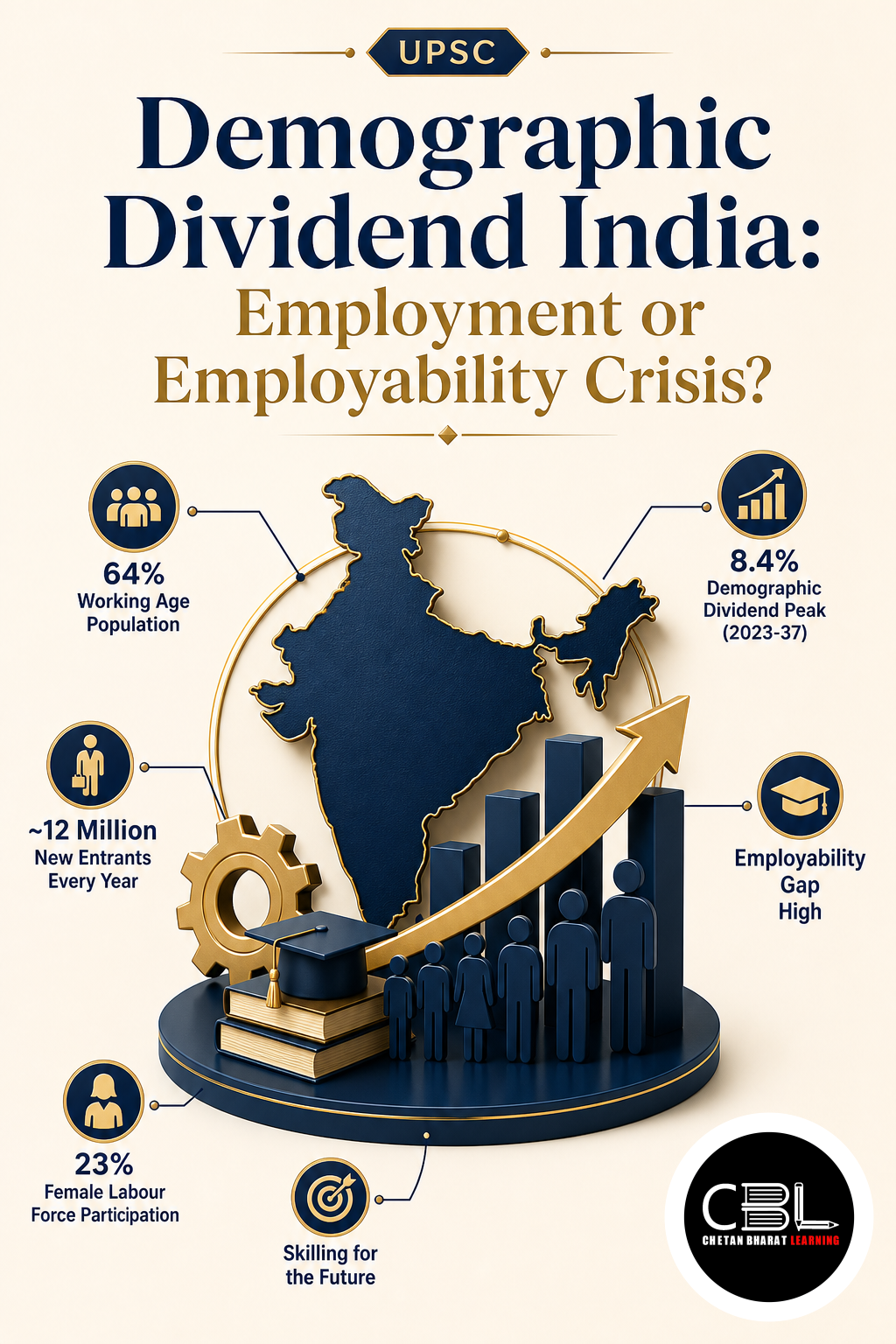
Demographic Dividend India refers to the economic growth potential arising from a large working-age population. With a median age of approximately 28 years and about 65% of the population below 35, India has a unique opportunity to boost productivity, savings, and consumption. However, this dividend is not automatic—it requires education, skills, and productive employment.
If employment does not expand, the demographic dividend can become a demographic burden. The latest PLFS data (October–December 2025) shows youth unemployment (15–29 years) at 14.3% on a current weekly status basis, but this alone does not capture the full picture.
Why is Demographic Dividend India in News?
Demographic Dividend India is in the news following Finance Minister Nirmala Sitharaman’s interview where she addressed youth concerns raised at the Jantar Mantar protests. She noted that the private sector will not invest unless there is demand for workers with specific skills, emphasising the need to identify and train people for available jobs.
The protests, which began over the NEET paper leak, expanded to include broader concerns about employment, the education-to-employment gap, and the quality of government schools. For more details, refer to this PIB release.
Key Features of Demographic Dividend India
- Young Population: India has one of the youngest populations globally, with a median age of 28 years.
- Large Workforce: The working-age population can drive higher productivity, savings, and economic growth.
- Education–Skills–Employment Link: The dividend depends on aligning education with labour market needs.
- NEP 2020 Focus: The new education policy emphasises multidisciplinary, vocational, and experiential learning.
- Inclusive Growth: The dividend must include women, rural youth, and marginalised communities.
Challenges in Demographic Dividend India
- Education–Employment Gap: Curriculum–industry mismatch, rote learning culture, and weak vocational orientation.
- Low Employability: Many graduates lack practical skills, critical thinking, and digital literacy.
- Technology Disruption: AI and automation are rapidly changing skill requirements, creating information asymmetry.
- Quality Disparities: Unequal quality of education between government and private schools, and rural–urban divides.
- Gender Barriers: Women face unpaid care work, safety issues, transport constraints, and social norms.
Way Forward for Demographic Dividend India
To harness Demographic Dividend India, a five-pillar strategy is needed: (1) strengthen foundational and secondary education, (2) align curricula with industry needs, (3) expand vocational and skill development, (4) promote digital literacy, and (5) create formal employment opportunities. Public–private partnerships can bridge the skill gap through apprenticeships and on-the-job training. Addressing gender barriers through childcare, safe transport, and flexible work options is crucial. Regular monitoring of job quality, underemployment, and wage stagnation is as important as tracking unemployment rates. For international best practices, refer to the ILO.
Prelims Practice Corner
Q1. What is the median age of India’s population?
- (a) 22 years
- (b) 28 years
- (c) 32 years
- (d) 35 years
Answer: (b) India’s median age is approximately 28 years.
Q2. What is the youth unemployment rate (15–29 years) as per PLFS (Oct–Dec 2025)?
- (a) 10.2%
- (b) 14.3%
- (c) 18.5%
- (d) 20.1%
Answer: (b) The unemployment rate is 14.3% for the 15–29 age group.
Q3. What percentage of India’s population is below 35 years?
- (a) 50%
- (b) 55%
- (c) 65%
- (d) 75%
Answer: (c) About 65% of India’s population is below 35 years.
Q4. Which education policy emphasises multidisciplinary and vocational learning?
- (a) National Education Policy 1986
- (b) National Education Policy 2020
- (c) Right to Education Act
- (d) Skill India Mission
Answer: (b) NEP 2020 emphasises multidisciplinary, vocational, and experiential learning.
Q5. What did FM Sitharaman identify as a key barrier to private job creation?
- (a) Lack of infrastructure
- (b) Insufficient demand for skilled workers
- (c) High taxes
- (d) Foreign competition
Answer: (b) Private investment depends on demand for workers with relevant skills.
Mains Practice Questions
Q1. Critically analyse the challenges in harnessing India’s demographic dividend, with a focus on the education-employment gap. (250 words, 15 marks)
Answer Structure:
- Intro: Define the demographic dividend and its significance.
- Body: Discuss the education-employment gap: curriculum mismatch, rote learning, weak vocational training. Analyse unemployment vs unemployability. Suggest reforms: NEP implementation, skill development, industry–academia linkage.
- Conclusion: Emphasise that the dividend requires a shift from degree-oriented to skill-oriented education.
Q2. What is the difference between unemployment and unemployability? Why does this distinction matter for India’s youth? (150 words, 10 marks)
Answer Structure:
- Intro: Define both terms.
- Body: Unemployment is the lack of jobs, while unemployability is the lack of skills. The distinction matters because creating more jobs is insufficient if graduates are not job-ready. Policy must address skill development, not just job creation.
- Conclusion: Conclude that both demand-side and supply-side interventions are needed.
FAQs on Demographic Dividend India
What is the demographic dividend?
It is the economic growth potential arising from a large working-age population, which can boost productivity, savings, and consumption if adequately educated and employed.
Why is India’s demographic dividend at risk?
The dividend is at risk due to the education-employment gap, low employability, technology disruption, and gender barriers that prevent the youth from participating productively in the economy.
What is the government’s flagship skill development programme?
The Skill India Mission and the National Education Policy (NEP) 2020 are key frameworks for enhancing employability through vocational training and multidisciplinary education.
Related Current Affairs
Preparing for UPSC, PCS or HCS?
Talk to a mentor at Chetan Bharat Learning, Chandigarh. Free guidance on choosing the right exam and building a study plan.
Chat on WhatsAppCall 97793 53345UPSC / IAS / PCS coaching in Chandigarh · Trusted by aspirants across Punjab & Haryana
Leave a Reply
You must be logged in to post a comment.