
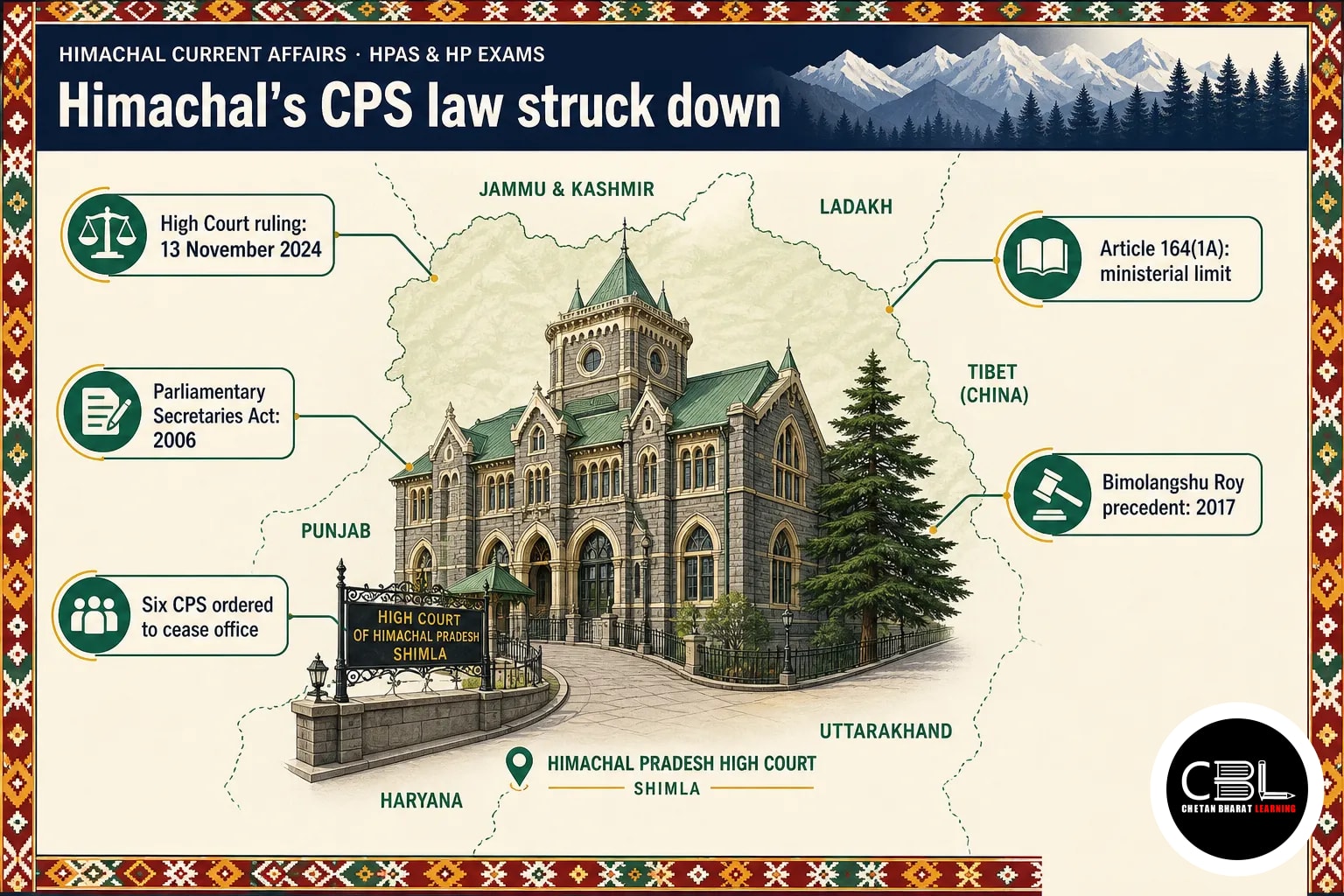
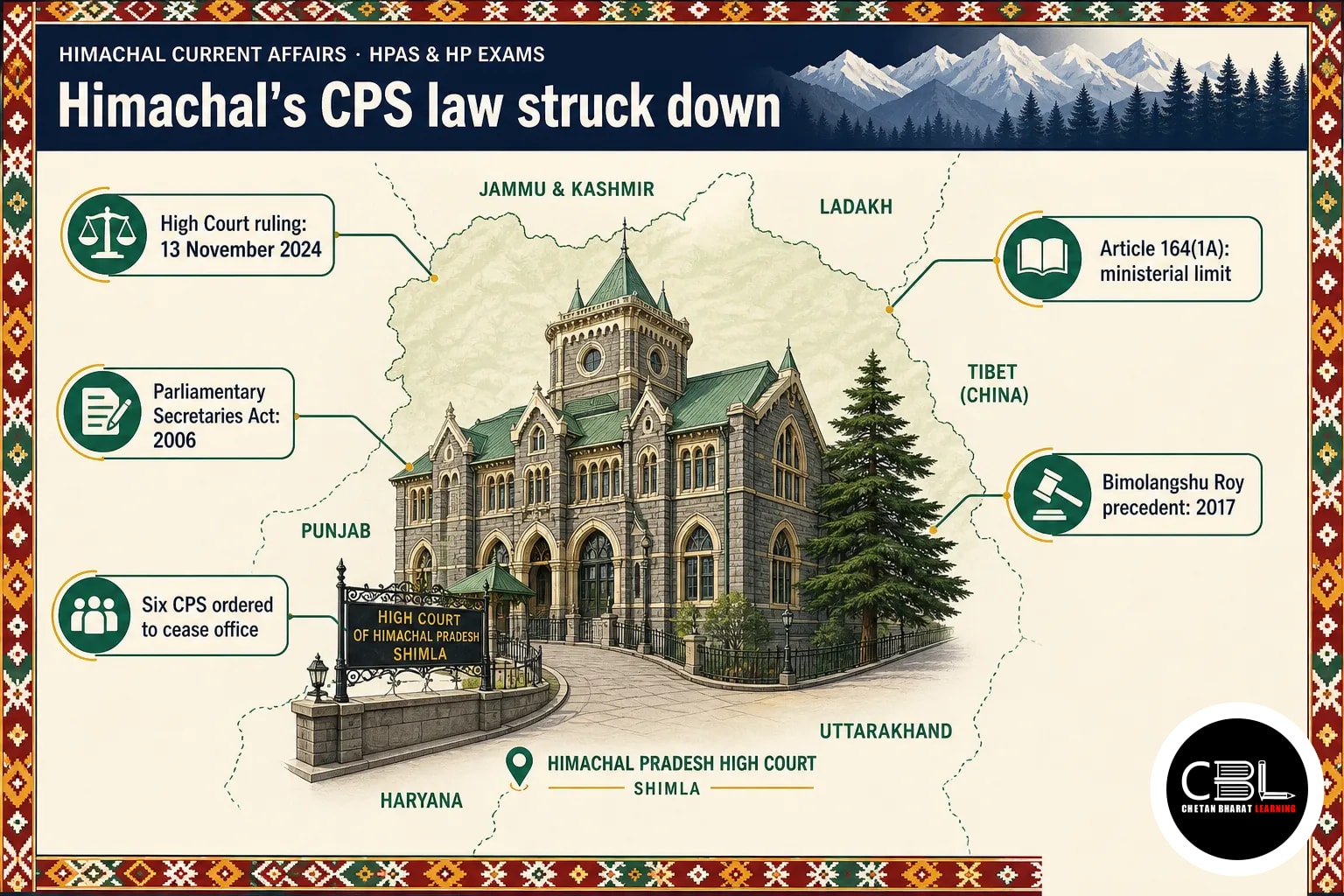
On 13 November 2024, the Himachal Pradesh High Court struck down the state’s 2006 parliamentary secretaries law. It ordered six Chief Parliamentary Secretaries (CPS) to cease holding office. The court found that the state lacked legislative competence to enact the law. It relied on the constitutional cap on ministers and a 2017 Supreme Court precedent. The state said it would appeal; the Supreme Court reportedly issued notice on its appeal.
Timeline: the law and its challenge
- 2003ConstitutionCap added
The 91st Amendment added Article 164(1A), limiting the size of state councils of ministers.
- 2006Himachal lawLaw enacted
The Himachal Pradesh Parliamentary Secretaries Act, 2006 became the law challenged in court.
- 2017Supreme CourtPrecedent
In Bimolangshu Roy, the Supreme Court struck down a similar Assam law.
- 13 Nov2024Law void
The High Court struck down the Act and ordered six CPS to cease holding office.
- The High Court struck down the Himachal parliamentary secretaries law on 13 November 2024.
- The court ordered six Chief Parliamentary Secretaries to cease holding office.
- The challenged Himachal Pradesh Parliamentary Secretaries Act was enacted in 2006.
- Article 164(1A) limits the size of a state council of ministers.
- The court relied on the Bimolangshu Roy judgment concerning an Assam law.
What did the High Court decide?
A bench of Justices Vivek Singh Thakur and Bipin Chander Negi declared the 2006 Act void ab initio: invalid from the beginning. It held that the state legislature lacked competence to enact it. Six Congress members of the Legislative Assembly appointed as CPS were ordered to cease holding those offices.
Article 164(1A), added by the 91st Constitutional Amendment, sets a ceiling of 15% of Assembly strength on a state’s council of ministers, subject to a minimum of 12 ministers. For Himachal’s 68-member Assembly, the limit is 12. Petitioners also raised office-of-profit and disqualification questions under Article 191.
Why it matters
The ruling ended the six office-holders’ CPS roles. It did not itself settle the separate disqualification questions raised by petitioners.
The constitutional limit on ministers is relevant to the size and cost of the political executive.
The decision highlights legislative competence and the need for state laws to conform to constitutional limits.
- Institution: The Himachal Pradesh High Court is located in Shimla.
- Legislature: Himachal Pradesh has a unicameral Legislative Assembly.
- Statehood: Himachal Pradesh became a full state on 25 January 1971.
Key data
| Point | Details |
|---|---|
| High Court decision | 13 November 2024 |
| Law struck down | Himachal Pradesh Parliamentary Secretaries Act, 2006 |
| Office-holders affected | Six Chief Parliamentary Secretaries |
| Constitutional cap | Article 164(1A): 15% of Assembly strength, subject to a minimum of 12 ministers |
| Himachal Assembly | 68 seats; council of ministers limit: 12 |
| Precedent | Bimolangshu Roy, Supreme Court, 2017; concerned an Assam law |
| Related provision | Article 191: disqualification of legislators, including office of profit |
Way forward
- Constitutional compliance: Examine proposed executive arrangements against Article 164(1A) and relevant judgments.
- Clear responsibilities: Allocate administrative work through lawful institutional channels.
- Transparent expenditure: Publish clear information on the costs and functions of political offices.
- Follow court directions: Implement applicable judicial orders while respecting the appeal process.
- Separate legal questions: Assess office-of-profit issues independently under the applicable law.
HPAS Mains practice questions
Explain the significance of the Himachal High Court ruling on parliamentary secretaries. (150 words)
Answer pointers:
- Introduce the 2024 decision and the 2006 Act.
- Explain legislative competence and the court’s finding.
- Connect Article 164(1A) and the 2017 precedent.
- Conclude with constitutional limits on executive arrangements.
Critically examine the use of parliamentary secretary appointments in the light of constitutional limits. (250 words)
Answer pointers:
- Introduce the ministerial cap and the Himachal ruling.
- Discuss the potential administrative value of distributing legislative and government work.
- Examine concerns about constitutional limits, competence and expenditure.
- Conclude with lawful allocation of work and transparent oversight.
As SDM of Shimla, how would you manage administrative communications after a court order affecting political office-holders? (150 words)
Answer pointers:
- Identify the applicable order and obtain authorised instructions.
- Inform relevant offices of changes in official communication channels.
- Maintain service delivery and document administrative actions.
- Avoid deciding disqualification or other matters outside your authority.
Discuss the relationship between Articles 164(1A) and 191 in assessing political offices in a state. (150 words)
Answer pointers:
- Introduce the two provisions and their distinct purposes.
- Explain the limit on the council of ministers under Article 164(1A).
- Discuss office of profit as a disqualification question under Article 191.
- Conclude that each question requires assessment under applicable law.
For prelims and HPRCA papers, memorise the 2006 Act, the 2024 ruling, six office-holders and Article 164(1A). For mains, distinguish the ministerial cap from the separate office-of-profit question.
MCQ Practice Corner
Q1. Consider the following statements:
1. Article 164(1A) was added by the 91st Constitutional Amendment.
2. Himachal’s council of ministers is limited to 12 members.
3. The Bimolangshu Roy precedent concerned an Assam law.
Which statements are correct?
(a) 1 and 2 only (b) 2 and 3 only (c) 1 and 3 only (d) 1, 2 and 3
Show answer
Answer: (d) because all three statements correctly describe the constitutional provision and precedent.
Q2. Which constitutional provision concerns disqualification of state legislators, including office of profit?
(a) Article 164(1A) (b) Article 191 (c) Article 275 (d) Article 324
Show answer
Answer: (b) because Article 191 addresses disqualifications for membership of a state legislature.
Q3. In which year did the Himachal High Court strike down the parliamentary secretaries law?
(a) 2003 (b) 2006 (c) 2017 (d) 2024
Show answer
Answer: (d) because the court gave its decision on 13 November 2024.
Q4. How many Himachal Chief Parliamentary Secretaries were ordered to cease holding office?
(a) Four (b) Six (c) Ten (d) Twelve
Show answer
Answer: (b) because the order affected six Chief Parliamentary Secretaries.
Frequently Asked Questions
What was the Himachal High Court’s CPS ruling?
The court struck down the Himachal Pradesh Parliamentary Secretaries Act, 2006. It ordered six Chief Parliamentary Secretaries to cease holding office.
What is the ministerial limit in Himachal Pradesh?
The limit is 12 ministers for the 68-member Assembly. Article 164(1A) sets a 15% ceiling subject to a minimum of 12 ministers.
Which Supreme Court precedent did the Himachal High Court rely on?
It relied on the 2017 Bimolangshu Roy judgment. That judgment struck down a similar Assam law.
Sources: The Print, Daily Pioneer, The News Himachal
Related Current Affairs
More Himachal topics for HPAS & HP exams
Preparing for UPSC, PCS or HCS?
Talk to a mentor at Chetan Bharat Learning, Chandigarh. Free guidance on choosing the right exam and building a study plan.
Chat on WhatsAppCall 97793 53345UPSC / IAS / PCS coaching in Chandigarh · Trusted by aspirants across Punjab & Haryana



Leave a Reply
You must be logged in to post a comment.