

UPSC Mapping
| Prelims | Polity and Social Justice |
|---|---|
| Mains | GS Paper 2 (Social Justice) |
Quick Facts
| Enactment Year | 1989 |
|---|---|
| Ministry | Ministry of Social Justice & Empowerment |
| Type | Special Legislation |
| Amendments | 2015 & 2018 |
Article
What is the Atrocities Act 1989?
The Atrocities Act 1989, officially the Scheduled Castes and the Scheduled Tribes (Prevention of Atrocities) Act, is a special law that provides safeguards against crimes and discrimination faced by SC/ST communities. It recognises that these groups experience violence, humiliation, and exploitation linked to their social identity, necessitating protections beyond ordinary criminal law.
The Act came into force in 1990 and has been strengthened through amendments in 2015 and 2018. It combines criminal justice, victim compensation, and preventive administration by establishing special courts, public prosecutors, and relief mechanisms. It also mandates preventive measures by governments and district authorities to curb atrocities proactively.
Why is the Atrocities Act 1989 in News?
The Act is in the news because an internal task force headed by the Secretary of the Ministry of Social Justice and Empowerment has recommended significant amendments to the Rules under the Act. A key proposal is to increase the relief and rehabilitation amounts for victims, which are currently fixed between Rs. 85,000 and Rs. 8.25 lakh, to account for inflation since they were last revised in 2016.
Separately, the National Commission for Scheduled Tribes (NCST) has proposed amendments to the Act itself, focusing on protecting the livelihoods of tribal communities whose land has been alienated. The NCST has also called for measures to prevent the registration of counter FIRs against those who report atrocity cases, which can discourage victims from coming forward.
Key Features of the Atrocities Act 1989
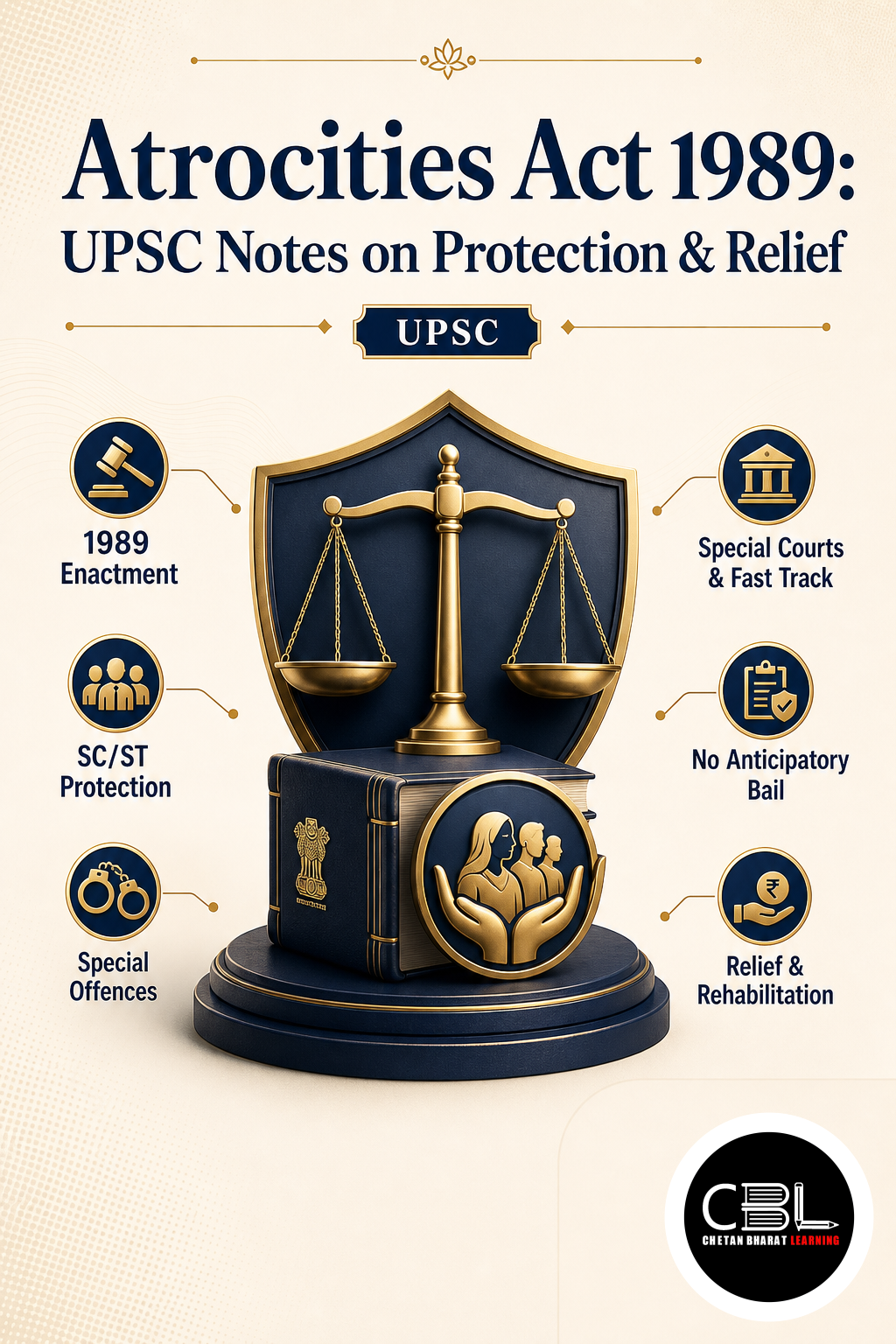
- Defines Specific Offences: Identifies a wide range of acts constituting atrocities, including physical violence, social discrimination, dispossession from land, and interference with rights and dignity.
- Special Courts: Establishes Exclusive Special Courts and Special Public Prosecutors to ensure speedy trial of offences under the Act.
- Relief and Rehabilitation: Provides a structured compensation scheme ranging from Rs. 85,000 to Rs. 8.25 lakh based on the severity of the offence.
- Protection of Victims: Includes provisions for the protection of victims and witnesses, and mandates preventive measures by the government and district authorities.
- Presumption and Accountability: The 2015 amendment introduced a presumption in certain circumstances and established greater accountability for public servants who wilfully neglect their duties.
Challenges Associated with the Atrocities Act 1989
- Inadequate Compensation: Relief amounts fixed in 2016 have not been revised for inflation, reducing real value of support.
- Slow Case Processing: Delays in investigation and trial due to lack of special courts deny timely justice.
- Insufficient Policing: Only seven States and UTs have established special police stations for the Act.
- Counter FIRs: Filing of counter FIRs against complainants discourages reporting and pressures victims.
- Low Awareness: Many victims, particularly in rural areas, remain unaware of their rights under the Act.
Way Forward for the Atrocities Act 1989
Recent proposals by the task force and the NCST provide direction for strengthening the Act. The government must expedite revision of relief amounts to reflect inflation and ensure timely compensation. Establishing special relief and rehabilitation cells in all States can improve assistance delivery and monitoring.
Protecting tribal land requires legal and administrative measures to secure livelihoods. Expedited establishment of special police stations is critical for effective investigation. A rights-based, implementation-oriented approach, greater awareness, and institutional capacity are essential to realise the Act’s objectives.
Prelims Practice Corner
-
Q1. The Scheduled Castes and the Scheduled Tribes (Prevention of Atrocities) Act was enacted in which year?
- (a) 1986
- (b) 1989
- (c) 1990
- (d) 1995
Answer: (b) The Act was enacted in 1989 and came into force in 1990.
-
Q2. What is the current prescribed range of relief for victims under the Atrocities Act Rules?
- (a) Rs. 25,000 to Rs. 2 lakh
- (b) Rs. 50,000 to Rs. 5 lakh
- (c) Rs. 85,000 to Rs. 8.25 lakh
- (d) Rs. 1 lakh to Rs. 10 lakh
Answer: (c) The relief ranges from Rs. 85,000 to Rs. 8.25 lakh, depending on the offence.
-
Q3. Which amendment to the Atrocities Act restored the position that no prior approval is required for arrest?
- (a) 2015
- (b) 2016
- (c) 2018
- (d) 2020
Answer: (c) The 2018 amendment restored this position following a Supreme Court judgment.
-
Q4. The recent task force recommendations pertain to amendments to the Rules under the Act. Who headed this task force?
- (a) Home Secretary
- (b) Secretary, Ministry of Social Justice & Empowerment
- (c) NCST Chairperson
- (d) Law Secretary
Answer: (b) The task force was headed by the Secretary, Ministry of Social Justice and Empowerment.
-
Q5. The Parliamentary Committee noted that only how many States/UTs have established special police stations for the Atrocities Act?
- (a) 5
- (b) 7
- (c) 10
- (d) 12
Answer: (b) Only seven States and Union Territories have established such special police stations.
Mains Practice Questions
-
Q1. Critically examine the effectiveness of the SC/ST (Prevention of Atrocities) Act, 1989, in addressing discrimination and violence against marginalized communities. (250 words, 15 marks)
Answer Structure:
- Intro: Briefly introduce the Act and its objectives as a special legislation for SC/ST protection.
- Body: Discuss strengths: special courts, defined offences, and relief provisions; challenges: inadequate compensation, slow trials, lack of special police stations, and counter FIRs.
- Conclusion: Suggest a way forward, including revising compensation, strengthening institutional mechanisms, and creating greater awareness.
-
Q2. Discuss the significance of the recent recommendations by the NCST and the central task force in strengthening the implementation of the SC/ST (Prevention of Atrocities) Act, 1989. (150 words, 10 marks)
Answer Structure:
- Intro: Frame the recommendations as a critical step to address implementation gaps in the Act.
- Body: Highlight the task force’s proposals on revising compensation and establishing relief cells; discuss the NCST’s focus on protecting tribal land and preventing counter FIRs.
- Conclusion: Conclude that these proposals are vital for a rights-based and holistic approach to social justice.
FAQs on the Atrocities Act 1989
- What is the main objective of the Atrocities Act 1989?
- The main objective is to prevent atrocities against SCs and STs, provide legal protection, and ensure relief and rehabilitation to victims of such crimes.
- What amendments have been made to the Atrocities Act 1989?
- Major amendments were made in 2015 and 2018. The 2015 amendment expanded offences and strengthened victim rights, while the 2018 amendment restored provisions regarding arrest and anticipatory bail following a Supreme Court judgment.
- What has the NCST proposed regarding tribal land?
- The NCST has proposed provisions to protect the livelihoods of ST communities whose land has been alienated and who are involved in prolonged legal disputes over their land.
Related Current Affairs
Preparing for UPSC, PCS or HCS?
Talk to a mentor at Chetan Bharat Learning, Chandigarh. Free guidance on choosing the right exam and building a study plan.
Chat on WhatsAppCall 97793 53345UPSC / IAS / PCS coaching in Chandigarh · Trusted by aspirants across Punjab & Haryana
Leave a Reply
You must be logged in to post a comment.