
UPSC Mapping
| Prelims | Mains |
|---|---|
| Environment & Biodiversity | GS Paper III – Conservation, Environment and Biodiversity |
Quick Facts
| Scientific Name | IUCN | CITES | WPA 1972 |
|---|---|---|---|
| Panthera leo persica | Vulnerable | Appendix I | Schedule I |
What is Asiatic Lion Conservation?
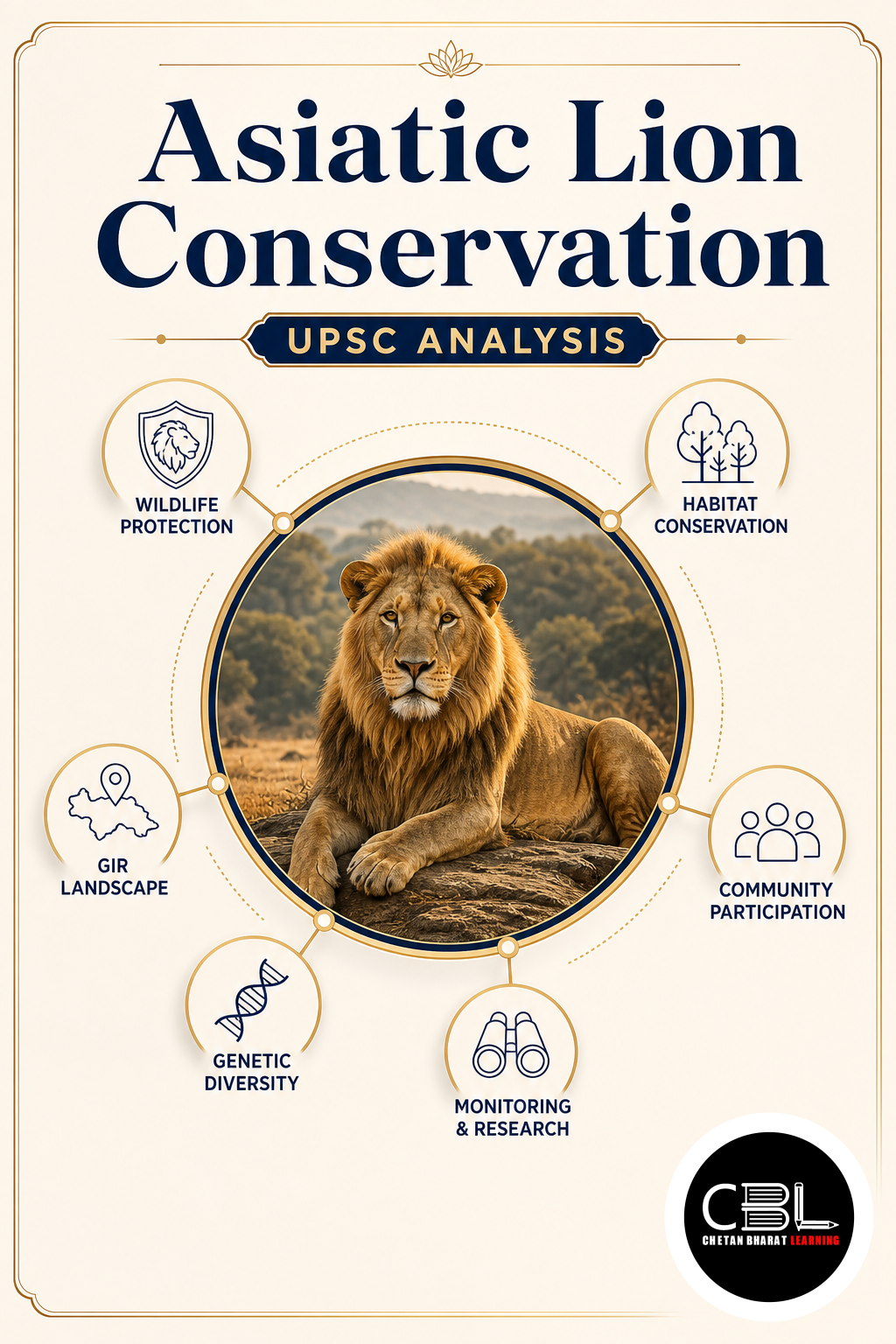
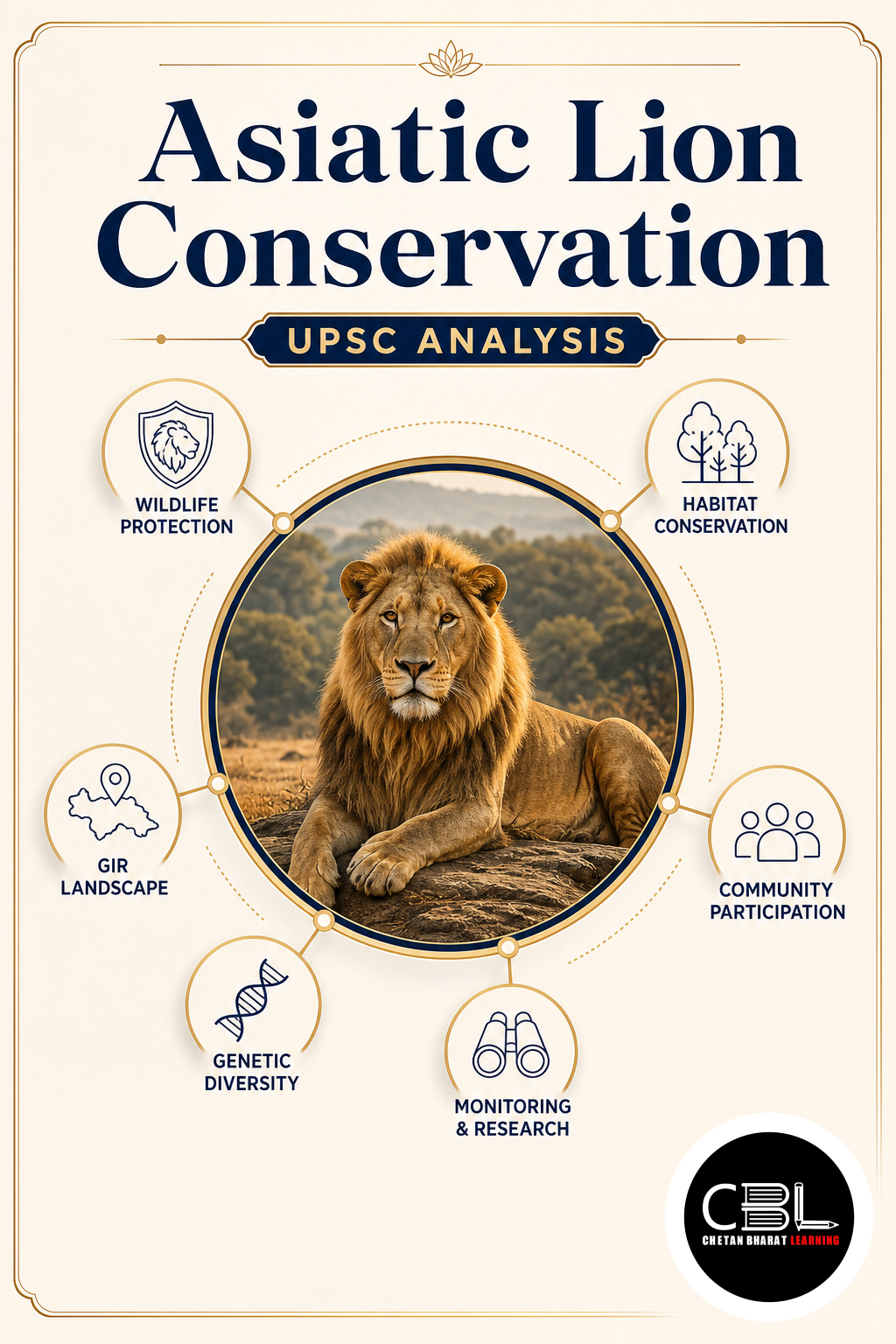
Asiatic Lion Conservation refers to the long-term protection and recovery of the Asiatic lion, now found only in the Gir landscape of Gujarat. India has increased the population from nearly 100–150 individuals six decades ago to over 1,000 through sustained conservation.
The strategy has evolved from protecting a single park to conserving an interconnected landscape of forests, grasslands, agricultural fields and wildlife corridors.
Why is Asiatic Lion Conservation in News?
A recent assessment noted that the growing lion population is a conservation success but warned that concentration in one region creates ecological risks.
The analysis recommends stronger landscape planning, disease surveillance and creation of a second free-ranging population. Official updates may be tracked through PIB.
Key Features
- Population recovery: Numbers have increased dramatically through sustained protection.
- Landscape approach: Lions now occupy Gir, Girnar, Mitiyala and adjoining landscapes.
- Community participation: Local acceptance has supported coexistence.
- Administrative support: Political commitment, funding and forest management have remained strong.
- Natural dispersal: Nearly half the population now occurs outside protected areas.
Challenges
- Single landscape concentration: One catastrophic event could affect the entire wild population.
- Disease outbreaks: The 2018 CDV outbreak highlighted vulnerability.
- Habitat fragmentation: Infrastructure and land-use changes may disrupt corridors.
- Human-wildlife interface: Expanding lion ranges require careful conflict management.
- Need for diversification: A second free-ranging population remains a priority.
Way Forward
Future efforts should protect ecological corridors, strengthen veterinary preparedness and integrate infrastructure planning with biodiversity conservation.
Developing a scientifically managed second free-ranging population would improve resilience against disease, disasters and genetic risks. Further policy information is available from the Ministry of Environment, Forest and Climate Change.
Prelims Practice Corner
Q1. The Asiatic lion is endemic to which landscape?
- (a) Sundarbans
- (b) Gir
- (c) Kaziranga
- (d) Simlipal
Answer: (b) Gir landscape.
Q2. IUCN status of the Asiatic lion?
- (a) Endangered
- (b) Critically Endangered
- (c) Vulnerable
- (d) Near Threatened
Answer: (c) Vulnerable.
Q3. The species is listed under which CITES Appendix?
- (a) I
- (b) II
- (c) III
- (d) None
Answer: (a) Appendix I.
Q4. Which disease affected lions in 2018?
- (a) Anthrax
- (b) CDV
- (c) FMD
- (d) Rabies
Answer: (b) CDV.
Q5. The biggest long-term conservation concern is:
- (a) Tourism
- (b) Poaching
- (c) Single landscape concentration
- (d) Rainfall
Answer: (c) Single landscape concentration.
Mains Practice Questions
Q1. Discuss the achievements and future priorities of Asiatic lion conservation in India. (10 marks)
Answer Structure
- Intro: Recovery story.
- Body: Population growth, landscape conservation, community role, challenges.
- Conclusion: Long-term ecological resilience.
Q2. Explain why India needs a second free-ranging population of Asiatic lions. (15 marks)
Answer Structure
- Intro: Current distribution.
- Body: Disease, disasters, genetics, resilience.
- Conclusion: Balanced conservation strategy.
FAQs on Asiatic Lion Conservation
Where are Asiatic lions found?
They occur naturally only in the Gir landscape of Gujarat.
Why is a second population important?
It reduces risks from disease outbreaks, disasters and genetic isolation.
Why is this topic important for UPSC?
It connects biodiversity conservation, protected areas, wildlife policy and sustainable development.
Related Current Affairs
Preparing for UPSC, PCS or HCS?
Talk to a mentor at Chetan Bharat Learning, Chandigarh. Free guidance on choosing the right exam and building a study plan.
Chat on WhatsAppCall 97793 53345UPSC / IAS / PCS coaching in Chandigarh · Trusted by aspirants across Punjab & Haryana
Leave a Reply
You must be logged in to post a comment.