
Important for:
UPSC, Haryana HCS, Punjab PCS
Prelims: Defence modernization, Integrated Theatre Commands, AI in warfare
Mains: GS Paper 3 — Internal Security, Defence Technology, Military Reforms
Why in News?
The Indian Armed Forces have started shaping a long-term strategic roadmap for:
India @2047
The plan aims to modernise India’s defence structure by learning from:
→ Recent conflicts
→ Emerging warfare technologies
→ Operation Sindoor experiences
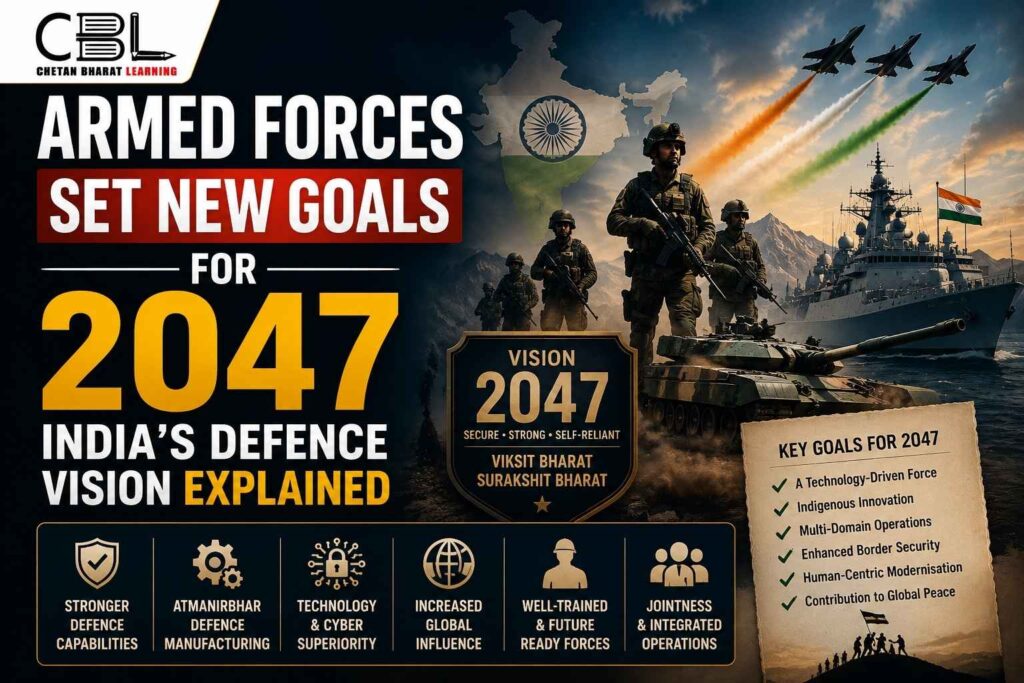
What Are the New Defence Goals?
India plans to transform its military into a:
✔ Technology-driven
✔ Integrated
✔ Self-reliant
✔ Multi-domain combat force
by:
2047
Major Focus Areas
1. Artificial Intelligence (AI)
Use of:
→ AI-enabled surveillance
→ Decision-making systems
→ Autonomous weapons
2. Drone Warfare
Expansion of:
✔ Combat drones
✔ Surveillance drones
✔ Swarm drone systems
3. Cyber Warfare
Strengthening:
→ Cyber defence infrastructure
→ Digital military networks
→ Information warfare systems
4. Space-Based Warfare
Focus on:
✔ Satellite security
✔ Space surveillance
✔ Strategic communication systems
5. Indigenous Defence Production
Push towards:
Atmanirbhar Bharat in Defence
through:
✔ Domestic manufacturing
✔ Defence startups
✔ Private sector participation
Integrated Theatre Commands
India is also focusing on:
Jointness among Army, Navy and Air Force
through:
→ Integrated Theatre Commands (ITCs)
Goal:
✔ Better coordination
✔ Faster military response
✔ Efficient resource utilisation
Lessons from Modern Conflicts
The roadmap draws insights from:
✔ Russia-Ukraine conflict
✔ Drone warfare trends
✔ Cyber attacks
✔ Precision missile warfare
✔ Operation Sindoor experiences
What is Operation Sindoor?
Operation Sindoor highlighted:
✔ Precision strikes
✔ Joint military operations
✔ Real-time intelligence coordination
✔ Modern battlefield preparedness
It became an important case study for future military planning.
Why Is This Important for India?
1. National Security
India faces:
→ Multiple strategic threats.
2. Border Challenges
Need for:
✔ Faster deployment
✔ Advanced surveillance
✔ Smart warfare systems
3. Global Military Competition
Modern warfare increasingly depends on:
→ Technology superiority.
4. Defence Exports
Indigenous production can boost:
✔ Defence exports
✔ Economic growth
✔ Strategic independence
Special Note for Aspirants
Students preparing through:
UPSC coaching Chandigarh
or
IAS coaching Chandigarh
should focus on:
✔ Theatre command reforms
✔ Defence modernization
✔ AI in warfare
✔ Cyber security
✔ Atmanirbhar Bharat in defence
These are highly important for:
→ GS3 + Essay + Interview.
Key Insight for UPSC
➤ India’s future military strategy focuses on:
✔ Technology
✔ Integration
✔ Self-reliance
✔ Multi-domain warfare readiness
PRELIMS PRACTICE QUESTIONS
Q1. Integrated Theatre Commands are related to:
A. Agriculture
B. Defence coordination
C. Banking system
D. Judiciary
⇢ Answer: B
Q2. Atmanirbhar Bharat in defence focuses on:
A. Import dependence
B. Indigenous manufacturing
C. Foreign control
D. Nuclear disarmament
⇢ Answer: B
Q3. Cyber warfare mainly targets:
A. Forest resources
B. Digital infrastructure
C. Agriculture production
D. Tourism
⇢ Answer: B
Q4. AI in defence can be used for:
A. Surveillance systems
B. Drone operations
C. Decision support
D. All of the above
⇢ Answer: D
Q5. Integrated military operations improve:
A. Resource coordination
B. Joint command efficiency
C. Faster response
D. All of the above
⇢ Answer: D
CBL Mains Practice Question
“Future warfare will increasingly depend on technology integration and multi-domain military capabilities.”
Discuss with reference to India’s defence roadmap for 2047.
FAQs
1. What is India’s defence roadmap for 2047?
A long-term military modernisation strategy.
2. What are Integrated Theatre Commands?
Unified military command structures for joint operations.
3. Why is AI important in defence?
It improves surveillance, decision-making and warfare capabilities.
4. What is Operation Sindoor?
An Indian military operation showcasing coordinated modern warfare capabilities.
5. Which GS paper covers this topic?
GS Paper 3.
Preparing for UPSC, PCS or HCS?
Talk to a mentor at Chetan Bharat Learning, Chandigarh. Free guidance on choosing the right exam and building a study plan.
Chat on WhatsAppCall 97793 53345UPSC / IAS / PCS coaching in Chandigarh · Trusted by aspirants across Punjab & Haryana
Leave a Reply
You must be logged in to post a comment.