
UPSC Syllabus Mapping
- GS Paper: GS-II
- Subject: Indian Polity & Constitution
- Topic: Parliament, Anti-Defection Law, Constitutional Amendments
- Prelims: Tenth Schedule, 52nd & 91st Constitutional Amendments
- Mains: Role of Anti-Defection Law in strengthening parliamentary democracy.
Why in News?
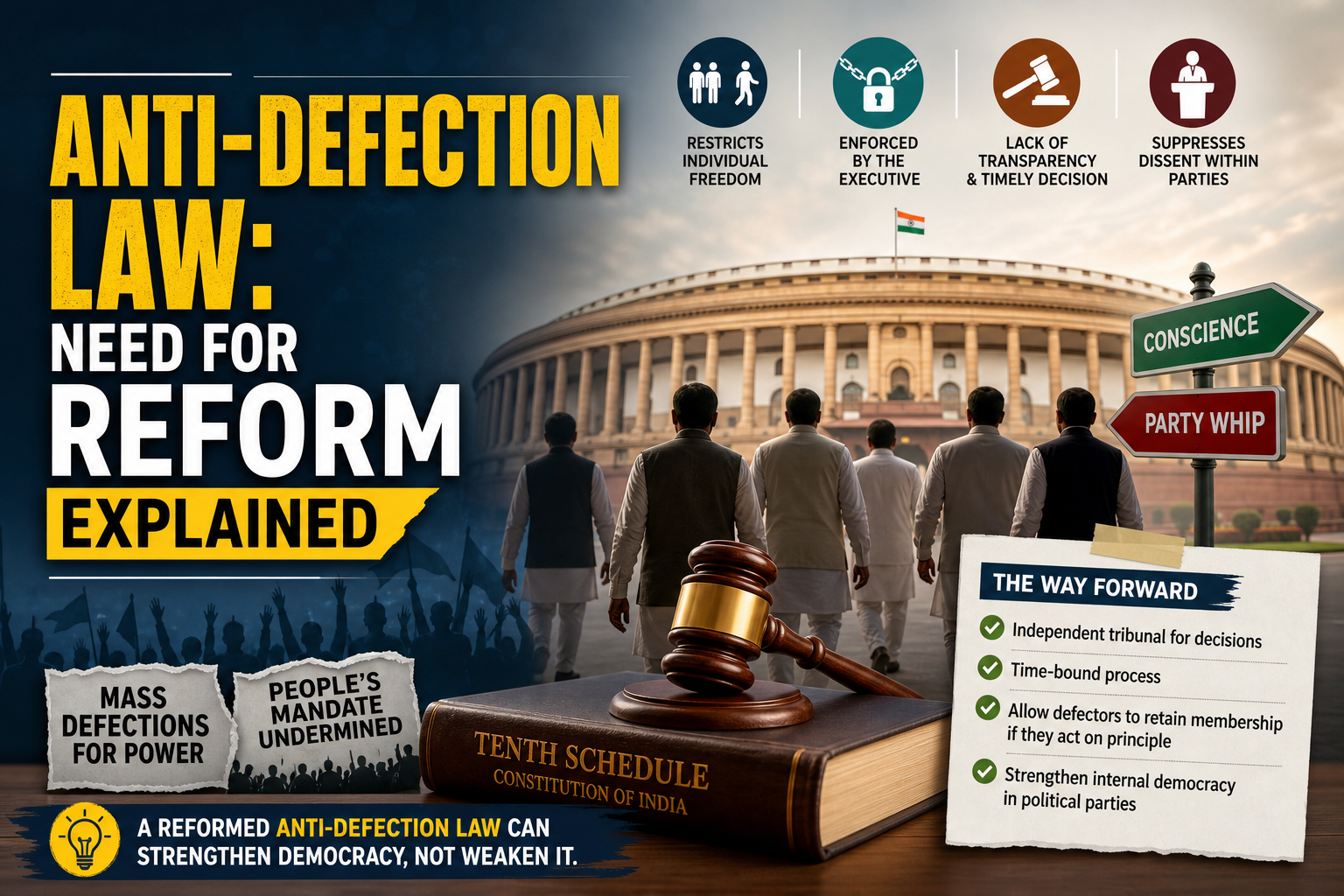
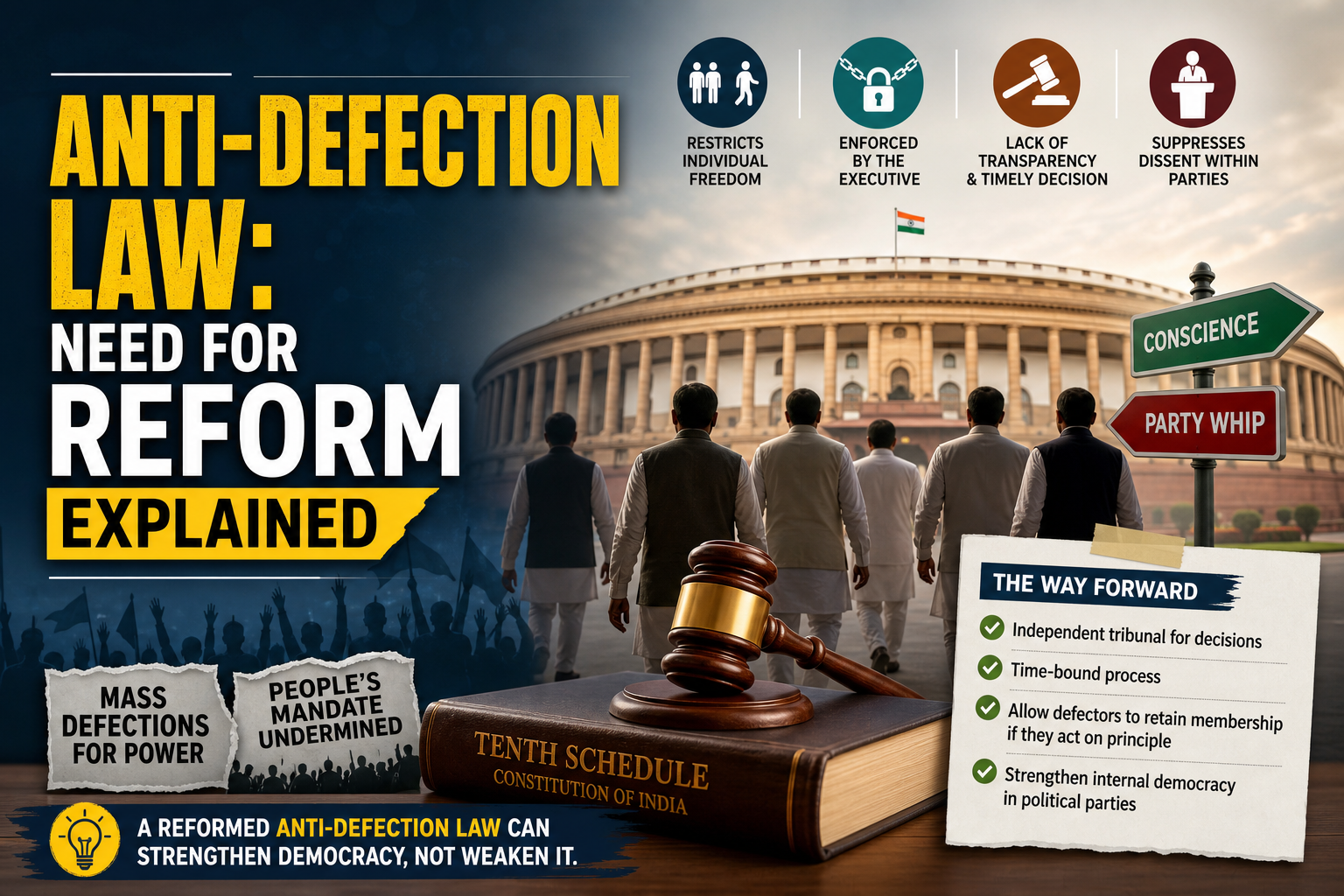
The existing Anti-Defection Law has not fully achieved its objective of preventing political defections. It recommends drastic reforms, including automatic loss of legislative membership upon defection and re-election before joining another political party.
Background
Before 1985, frequent defections led to unstable governments and political horse-trading. The phrase ‘Aaya Ram, Gaya Ram’ became synonymous with opportunistic party switching after repeated changes in party affiliation by legislators.
Constitutional Basis of Anti-Defection Law
- 52nd Constitutional Amendment Act, 1985 inserted the Tenth Schedule into the Constitution.
- The law aims to discourage political defections and ensure stable governments.
- 91st Constitutional Amendment Act, 2003 removed protection for one-third splits and allowed only mergers supported by at least two-thirds of legislators.
Objectives of the Anti-Defection Law
- Ensure political stability.
- Prevent horse-trading.
- Preserve the electoral mandate.
- Strengthen party discipline.
- Reduce corruption in legislative politics.
Grounds for Disqualification
- Voluntarily giving up membership of the political party.
- Voting or abstaining contrary to the party whip without prior permission.
- Independent members joining a political party after election.
- Nominated members joining a political party after six months from nomination.
Who Decides Disqualification?
Under the Tenth Schedule, the Speaker of the Lok Sabha or the Chairman of the Rajya Sabha decides disqualification petitions. Similar powers are exercised by the Speakers of State Legislative Assemblies. However, delays in decision-making have attracted criticism and raised concerns regarding impartiality.
Process Under the Tenth Schedule
- Complaint is filed.
- Speaker/Chairman examines the petition.
- Opportunity is provided to the concerned member.
- Decision on disqualification or rejection is issued.
Why Delay is a Concern
Delayed decisions often allow defecting legislators to influence government formation before any legal consequence follows, weakening the objective of the law.
Recent Reform Proposal
- Automatic vacation of the legislative seat immediately upon defection.
- Mandatory fresh election before rejoining any political party.
- Independent adjudicatory mechanism instead of the Speaker.
- Time-bound disposal of disqualification petitions.
Important Supreme Court Judgments
- Kihoto Hollohan v. Zachillhu (1992): Upheld the constitutional validity of the Anti-Defection Law while allowing judicial review of the Speaker’s decision.
- Keisham Meghachandra Singh v. Speaker, Manipur Legislative Assembly (2020): The Supreme Court recommended that Speakers decide disqualification petitions within a reasonable period, generally three months.
Criticism of the Existing Law
- Weakens legislative independence.
- Encourages excessive party control over legislators.
- Delay in Speaker’s decisions affects democratic accountability.
- Large-scale defections continue despite legal provisions.
Way Forward
Reforms should balance political stability with legislative independence by ensuring time-bound decisions, strengthening judicial oversight and preserving the voters’ mandate through transparent and accountable mechanisms.
Prelims Practice Corner (5 MCQs)
Q1. The Anti-Defection Law was inserted into the Constitution through:
A. 42nd Amendment
B. 44th Amendment
C. 52nd Amendment
D. 61st Amendment
Answer: C. The 52nd Constitutional Amendment Act, 1985 inserted the Tenth Schedule.
Q2. The Anti-Defection Law is contained in:
A. Ninth Schedule
B. Tenth Schedule
C. Eleventh Schedule
D. Twelfth Schedule
Answer: B.
Q3. Which Constitutional Amendment removed protection for one-third splits?
A. 73rd Amendment
B. 86th Amendment
C. 91st Amendment
D. 97th Amendment
Answer: C.
Q4. Who ordinarily decides disqualification petitions under the Tenth Schedule?
A. Election Commission
B. Supreme Court
C. President of India
D. Speaker/Chairman of the House
Answer: D.
Q5. Which judgment upheld the constitutional validity of the Anti-Defection Law?
A. Kesavananda Bharati
B. Kihoto Hollohan
C. SR Bommai
D. Indira Sawhney
Answer: B.
Mains Practice Questions & Answer Structure
Q1 (10 Marks): Examine the objectives and limitations of the Anti-Defection Law in ensuring political stability.
Answer Framework: Introduction → Constitutional basis → Objectives → Challenges → Way Forward → Conclusion.
Q2 (15 Marks): ‘The Anti-Defection Law has promoted political stability but weakened deliberative democracy.’ Critically examine.
Answer Framework: Introduction → Merits → Criticisms → Judicial observations → Suggested reforms → Balanced conclusion.
FAQs
1. What is the Anti-Defection Law?
It is a constitutional mechanism under the Tenth Schedule to prevent elected representatives from changing political parties after elections under specified circumstances.
2. Why was the Anti-Defection Law introduced?
It was enacted to curb political defections, ensure government stability and preserve the electoral mandate.
3. Why is the law criticised today?
Because delays in deciding disqualification petitions, excessive party control and continuing large-scale defections have reduced its effectiveness.
Related Current Affairs
Preparing for UPSC, PCS or HCS?
Talk to a mentor at Chetan Bharat Learning, Chandigarh. Free guidance on choosing the right exam and building a study plan.
Chat on WhatsAppCall 97793 53345UPSC / IAS / PCS coaching in Chandigarh · Trusted by aspirants across Punjab & Haryana
Leave a Reply
You must be logged in to post a comment.