
UPSC Mapping
| Prelims | Economy, Government Schemes and Environment |
|---|---|
| Mains | GS Paper III – Infrastructure, Energy and Sustainable Development |
Quick Facts
| Launched | September 2024 |
|---|---|
| Ministry | Heavy Industries |
| Scheme Type | Central Sector |
| Extended Until | 31 March 2028 |
What is PM E-DRIVE Scheme?
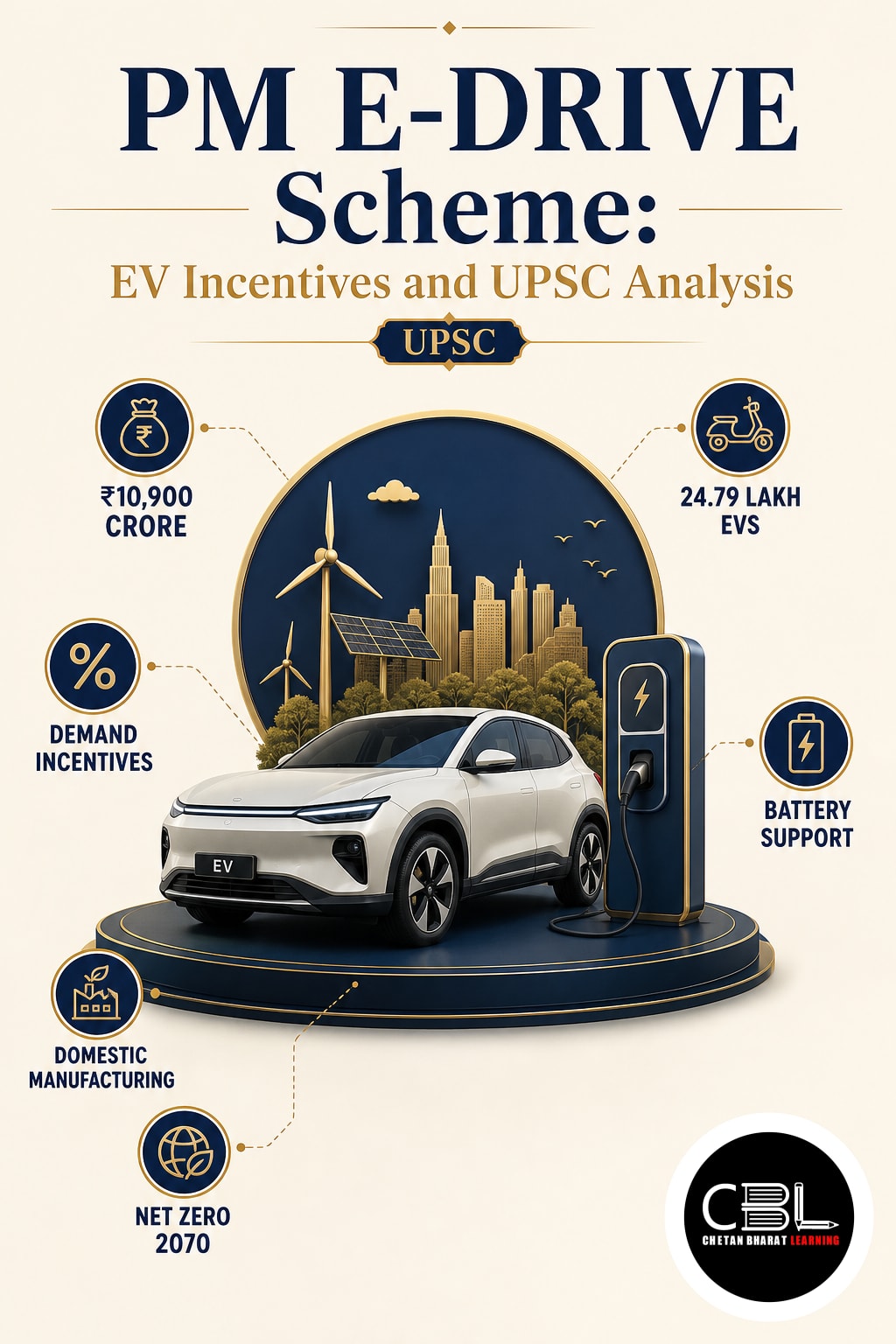
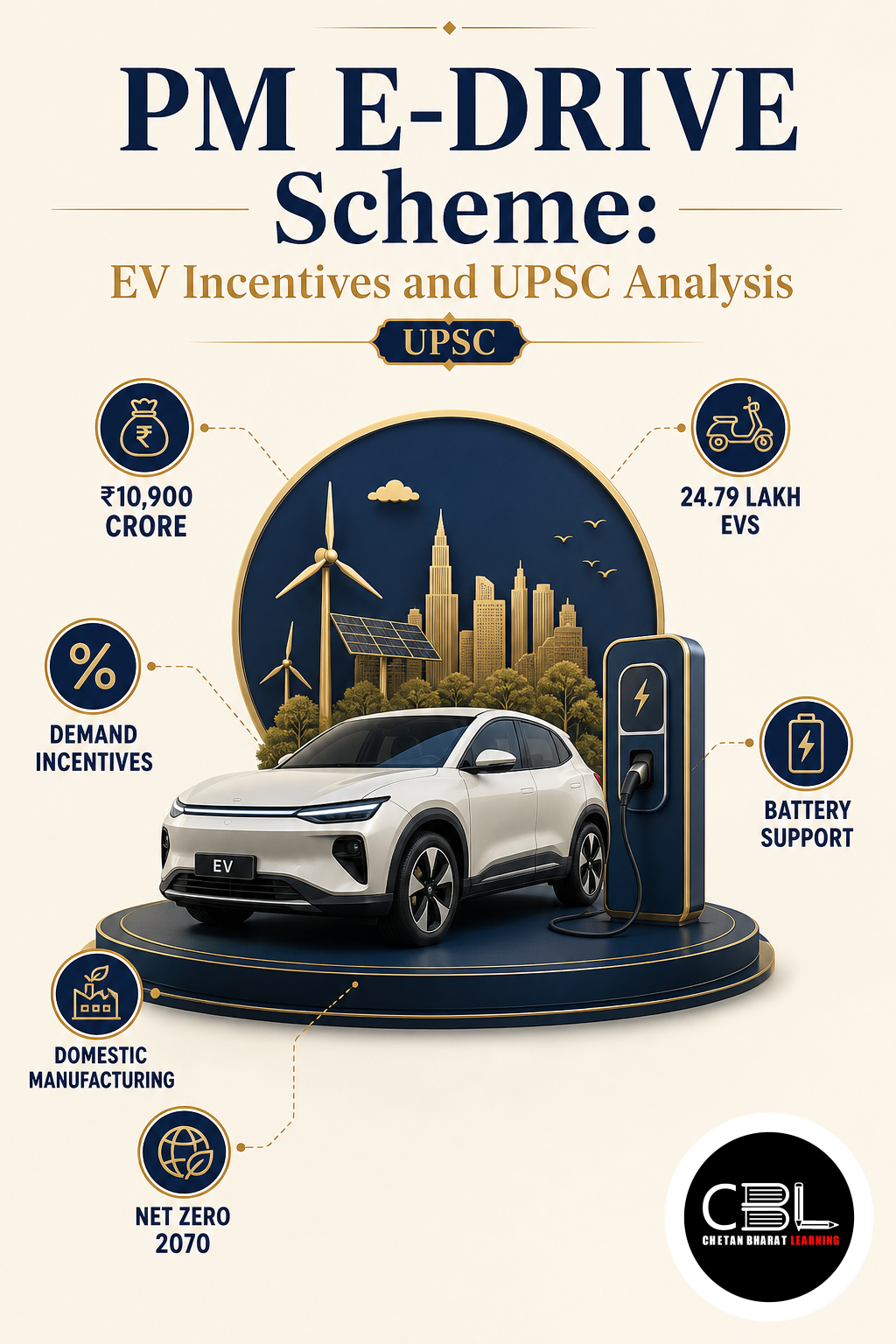
The PM Electric Drive Revolution in Innovative Vehicle Enhancement initiative is a Central Sector Scheme launched in September 2024. It aims to accelerate electric vehicle adoption through purchase incentives, public charging infrastructure and support for domestic manufacturing.
Implemented by the Ministry of Heavy Industries (MHI), the programme supports electric two-wheelers, three-wheelers, ambulances, trucks and buses. It also finances charging infrastructure and upgrades vehicle testing facilities to support emerging automotive technologies.
The scheme originally had an allocation of ₹10,900 crore. Following a subsequent enhancement, the October 2026 government backgrounder reported an outlay of ₹11,900 crore. Its implementation period has also been extended until 31 March 2028, although individual vehicle categories have separate incentive conditions and terminal dates.
The initiative seeks to improve electric mobility affordability while strengthening India’s manufacturing ecosystem. IFCI Limited serves as the Project Management Agency, supporting scheme administration and implementation.
Why in News?
The Ministry of Heavy Industries recently highlighted the progress of the PM E-DRIVE Scheme. According to the Press Information Bureau’s October 2026 backgrounder, 26.59 lakh electric vehicles had been sold under the programme by June 2026.
The government has allocated ₹4,391 crore for deploying 14,028 electric buses. Of these, 14,000 had been allocated by August 2026, including 13,800 buses across seven major cities: Delhi, Bengaluru, Hyderabad, Mumbai, Ahmedabad, Pune and Surat.
The programme has also progressed in charging infrastructure. As of 28 September 2026, the government had approved ₹851 crore for deploying 8,147 chargers through three oil marketing companies and ten states.
These developments demonstrate increasing policy support for electric mobility. They also highlight the importance of converting financial allocations and project approvals into operational transport infrastructure.
Key Features
- Electric two-wheeler incentives: Eligible registered e-2Ws receive ₹2,500 per kilowatt-hour of battery capacity, capped at ₹5,000 per vehicle or 15% of the ex-factory price, whichever is lower. Eligible models must satisfy the prescribed ₹1.5 lakh ex-factory price ceiling.
- Electric three-wheeler support: The scheme covers registered e-rickshaws and e-carts, with support extended until March 2028. The separate L5 three-wheeler incentive segment closed on 26 December 2025 after achieving its target.
- Electric bus deployment: The programme supports 14,028 e-buses to modernise public transport, reduce urban emissions and improve sustainable mobility in major cities.
- Other electric vehicles: Financial support extends to eligible electric ambulances and trucks, encouraging electrification beyond personal transport and strengthening cleaner commercial mobility.
- Charging infrastructure: A dedicated allocation of ₹2,000 crore supports public EV charging stations, addressing concerns about charging availability and encouraging wider adoption.
- Domestic manufacturing: Eligible vehicle manufacturers must meet prescribed localisation requirements under the Phased Manufacturing Programme and comply with applicable technical standards.
- Aadhaar-authenticated e-vouchers: Eligible buyers receive purchase incentives through authenticated electronic vouchers. Manufacturers provide the upfront price reduction and subsequently obtain reimbursement from MHI.
- Testing infrastructure: The government has allocated ₹780 crore for modernising vehicle testing agencies and strengthening India’s capacity to assess advanced electric vehicle technologies.
Challenges
- High purchase costs: Electric vehicles often have higher initial prices than comparable conventional vehicles. Limited subsidies may not fully address affordability concerns among lower-income consumers.
- Uneven charging availability: Charging infrastructure remains concentrated in better-served urban areas. Smaller cities, rural regions and highways require broader and more reliable networks.
- Battery supply chains: Dependence on imported battery materials and components creates vulnerabilities involving cost, availability and international supply disruptions.
- Implementation delays: Infrastructure projects require coordination among ministries, state governments, transport agencies and manufacturers. Approvals do not automatically guarantee timely deployment.
- Environmental concerns: Battery production, electricity generation and end-of-life disposal can create environmental pressures. Cleaner electricity and effective recycling systems are essential.
- Long-term market sustainability: EV adoption must gradually become commercially viable without permanent dependence on government subsidies. Predictable policies can support industry investment.
Way Forward
India should prioritise the timely deployment of reliable public charging stations, particularly along highways and in underserved regions. Standardised charging interfaces, transparent pricing and improved electricity distribution networks can strengthen consumer confidence.
Domestic battery manufacturing, research and recycling capacity should receive sustained attention. Greater investment in technology development and component localisation can reduce supply-chain dependence while creating skilled employment.
The government should strengthen monitoring of electric bus procurement, charging infrastructure approvals and manufacturer reimbursements. Performance-based evaluation can help ensure public funding produces measurable outcomes rather than remaining limited to announcements and allocations.
State governments, municipal bodies and electricity utilities must coordinate on charging infrastructure, public transport electrification and land availability. Detailed operational rules remain available through the official scheme guidelines.
A balanced approach combining incentives, infrastructure, local manufacturing and environmental safeguards can make electric mobility more accessible and economically sustainable. Aspirants can track related government initiatives through the daily current affairs archive.
Punjab & Haryana PCS Angle
For Punjab PCS and Haryana HCS, this scheme is relevant to sustainable urban transport, air pollution control and the role of state governments in implementing centrally sponsored mobility initiatives. Candidates should examine how electric buses, charging networks and coordination with power distribution utilities can improve transport sustainability, particularly in urban and peri-urban areas. The distinction between a Central Sector Scheme and a Centrally Sponsored Scheme is also important for Prelims.
Prelims Practice Corner
Q1. Which ministry implements the PM E-DRIVE initiative?
(a) Ministry of Power (b) Ministry of Heavy Industries (c) Ministry of New and Renewable Energy (d) Ministry of Road Transport and Highways
Answer: (b) The Ministry of Heavy Industries administers the scheme to promote electric mobility and manufacturing.
Q2. Consider the following statements: 1. PM E-DRIVE is a Central Sector Scheme. 2. It supports charging infrastructure and electric buses. 3. It provides purchase incentives for all private electric passenger cars. Which statements are correct?
(a) 1 and 3 only (b) 2 and 3 only (c) 1 and 2 only (d) 1, 2 and 3
Answer: (c) Statements 1 and 2 are correct. The scheme does not provide general purchase incentives for all private electric cars.
Q3. Which organisation serves as the Project Management Agency for the scheme?
(a) IFCI Limited (b) NITI Aayog (c) NABARD (d) SEBI
Answer: (a) IFCI Limited has been appointed as the Project Management Agency for scheme implementation.
Q4. The overall PM E-DRIVE programme has been extended until which date?
(a) 31 March 2026 (b) 31 December 2026 (c) 31 March 2027 (d) 31 March 2028
Answer: (d) The overall scheme has been extended until 31 March 2028, although individual vehicle categories have separate terminal dates.
Q5. Which of the following best describes the e-voucher mechanism?
(a) Subsidies are provided only through annual income-tax refunds. (b) Eligible buyers receive upfront price reductions, followed by reimbursement to manufacturers. (c) All EV buyers receive free charging for five years. (d) Incentives are paid exclusively to state governments.
Answer: (b) Aadhaar-authenticated e-vouchers support an upfront price reduction, with eligible incentives reimbursed to manufacturers.
Mains Practice Questions
Q1. Electric mobility can contribute significantly to India’s environmental sustainability and energy security. Discuss the role of government incentives and infrastructure development in accelerating EV adoption. (15 marks)
Answer Structure:
Intro: Explain the significance of electric mobility for reducing transport emissions and fossil-fuel dependence.
Body: Discuss EV purchase incentives, public charging infrastructure, electric buses, battery manufacturing, employment opportunities, implementation challenges and environmental safeguards.
Conclusion: Recommend coordinated investment in clean electricity, affordable EVs, domestic manufacturing and reliable charging facilities.
Q2. Examine how the PM Electric Drive Revolution in Innovative Vehicle Enhancement initiative can strengthen domestic manufacturing while promoting sustainable urban transport. (10 marks)
Answer Structure:
Intro: Introduce the scheme and its objectives of EV adoption, infrastructure expansion and manufacturing development.
Body: Explain localisation requirements, demand incentives, electric bus deployment, charging infrastructure, supply-chain concerns and implementation mechanisms.
Conclusion: Highlight the need for affordable mobility, indigenous technology and effective centre-state coordination.
Frequently Asked Questions
What is the main objective of the PM E-DRIVE Scheme?
The scheme aims to accelerate electric vehicle adoption through financial incentives, improved charging infrastructure and stronger domestic EV manufacturing. It supports cleaner transport and reduced dependence on fossil fuels.
Which electric vehicle categories are covered?
The scheme covers eligible electric two-wheelers, three-wheelers, ambulances, trucks and buses, alongside charging infrastructure and vehicle testing facilities. Incentive eligibility, amounts and deadlines differ across categories.
How does the scheme provide incentives to EV buyers?
Eligible buyers receive an upfront price reduction through an Aadhaar-authenticated electronic voucher. The Ministry of Heavy Industries subsequently reimburses the approved incentive amount to the vehicle manufacturer.
Related Current Affairs
Preparing for UPSC, PCS or HCS?
Talk to a mentor at Chetan Bharat Learning, Chandigarh. Free guidance on choosing the right exam and building a study plan.
Chat on WhatsAppCall 97793 53345UPSC / IAS / PCS coaching in Chandigarh · Trusted by aspirants across Punjab & Haryana
Leave a Reply
You must be logged in to post a comment.