

UPSC Mapping
| Prelims | Agricultural Credit, NABARD and e-NWRs |
|---|---|
| Mains | GS Paper III: Agriculture, Food Processing and Inclusive Growth |
| Coverage | Farm to Consumer |
| Key Institution | NABARD |
| Warehouse Instrument | Electronic Negotiable Warehouse Receipt |
| Infrastructure Facility | Agriculture Infrastructure Fund |
| Farmer Platform | FPOs and Cooperatives |
What is Value Chain Financing?
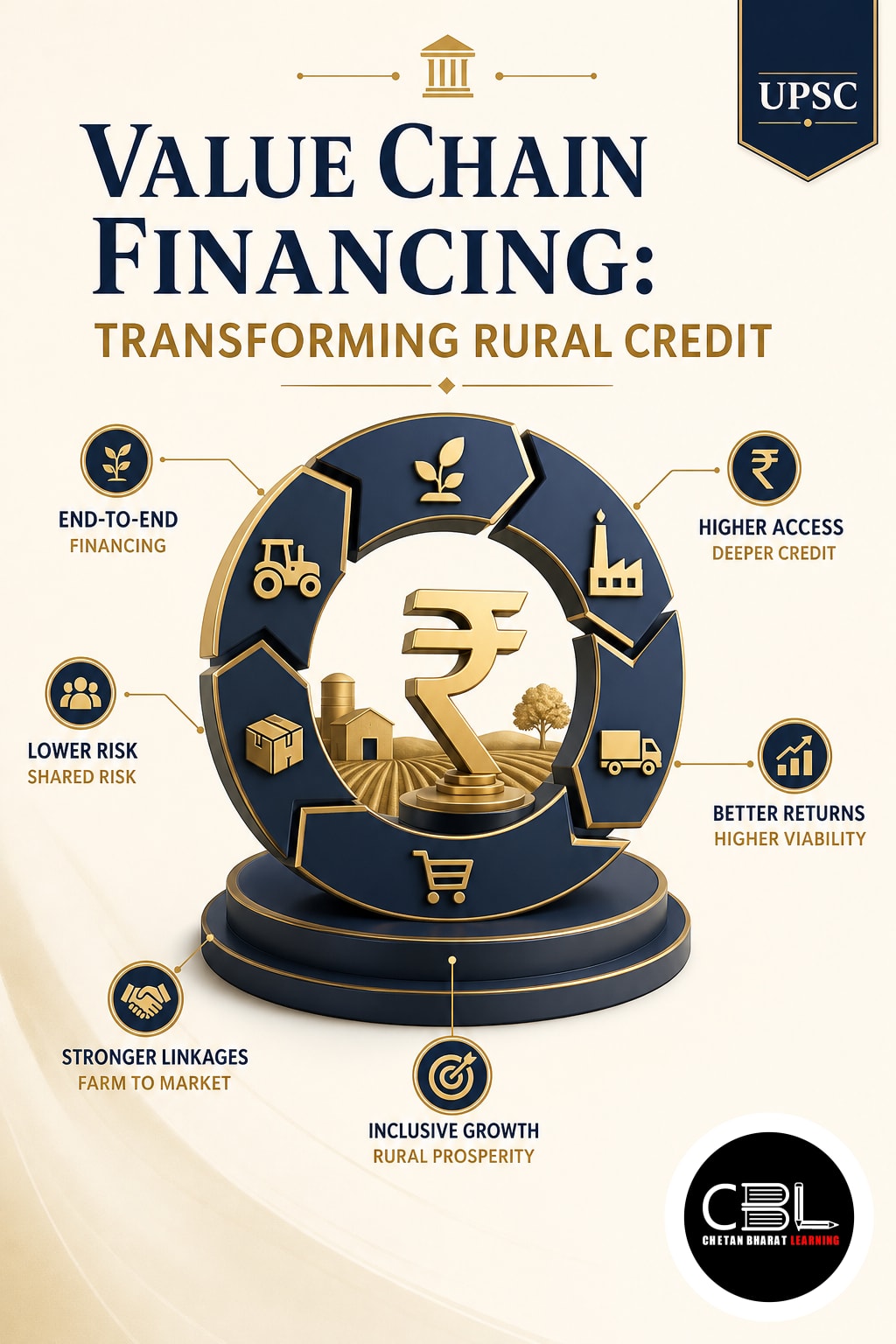
Value Chain Financing refers to financial products and fund flows supporting every commercially viable activity between agricultural inputs and the final consumer. It covers farmers, Farmer Producer Organisations, aggregators, warehouses, transporters, processors, wholesalers, exporters and retailers. Lenders evaluate commodity movement, commercial relationships and expected cash flows across the chain instead of relying only on land collateral, which many tenant farmers, producer collectives and rural enterprises cannot readily offer despite operating commercially viable activities.
Finance may originate within the chain through buyer advances, supplier credit or contract-based arrangements. External institutions can provide working capital, term loans, warehouse-receipt finance, receivables finance, leasing, guarantees and insurance. The approach uses verified transactions and linked repayment to reduce information gaps, align credit with production cycles and distribute risk among connected participants, provided lenders understand the full chain, monitor end-use and avoid transferring excessive obligations onto the weakest actor.
Why is Value Chain Financing in News?
A renewed policy debate argues that India’s agricultural-credit architecture remains concentrated around crop production while considerable value emerges after harvest. The rural prosperity analysis proposes a comprehensive framework for financing aggregation, storage, processing, branding and trade. It links this transition with farmer income, rural industry and Viksit Bharat 2047, arguing that food security must now be complemented by wider rural participation in post-harvest value creation.
India has built a broad production-credit system through commercial banks, cooperatives, Regional Rural Banks, NABARD and Kisan Credit Cards. Post-harvest enterprises still face seasonal procurement, large inventory requirements and uncertain prices before receiving sales revenue. A chain-based approach can match working capital and long-term investment with actual commodity cycles while allowing rural enterprises to retain more value locally, create non-farm jobs and reduce the migration pressure associated with limited village employment.
Key Features
- Commodity-specific design: Lenders map each commodity’s production calendar, procurement window, storage life, processing requirements, market structure and price risks before selecting appropriate loan tenures and repayment schedules.
- Cash-flow assessment: Financing decisions use purchase orders, supply contracts, invoices, warehouse records and expected sales rather than depending entirely on fixed assets.
- Internal finance: Input suppliers, traders, processors and anchor buyers can extend goods or advances on credit, recovering their funds when farmers deliver produce or downstream participants complete sales.
- External instruments: Banks and specialised lenders can combine working-capital loans, receivables discounting, factoring, equipment leasing, electronic warehouse-receipt finance, credit guarantees and insurance.
- Collective participation: FPOs, cooperatives and self-help groups aggregate produce, standardise quality, negotiate contracts and create transaction histories that help smallholders access finance.
Challenges
- Fragmented chains: Numerous small producers, informal traders and unregistered enterprises create incomplete records, weak contracts and high transaction costs.
- Concentrated shocks: Drought, flood, pest outbreaks, price crashes or export restrictions can affect several linked borrowers simultaneously.
- Infrastructure gaps: Insufficient accredited warehouses, cold chains, testing facilities, processing capacity and rural logistics.
- Power imbalance: Anchor buyers may impose restrictive contracts, delayed payments or quality deductions.
- Institutional silos: Agricultural credit, infrastructure schemes, warehouse regulation, digital platforms and market reforms often operate separately.
Way Forward
India should create commodity-specific financing frameworks that identify viable actors, funding gaps, cash-flow patterns and shared risks. Banks can combine digital transaction data with field appraisal instead of replacing human judgment with automated scores. Stronger FPO governance, model contracts and timely-payment rules can ensure that smallholders share the value created beyond the farm gate.
Policy should integrate the Agriculture Infrastructure Fund, electronic warehouse receipts, credit guarantees, insurance and receivables platforms into bankable financing packages. Regulators must improve warehouse supervision, interoperability and grievance redressal while protecting borrower data, and public agencies should publish commodity-level performance indicators to guide lenders.
Prelims Practice Corner
- Which institution primarily regulates registered warehouses issuing negotiable warehouse receipts in India?
(a) SEBI (b) WDRA (c) IRDAI (d) PFRDA
Answer: (b) The Warehousing Development and Regulatory Authority regulates registered warehouses and negotiable warehouse receipts. - The Agriculture Infrastructure Fund mainly supports:
(a) Urban housing (b) Post-harvest and community farm assets (c) Defence exports (d) University scholarships
Answer: (b) The fund finances eligible post-harvest management infrastructure and community farming assets. - An electronic negotiable warehouse receipt can primarily help a farmer to:
(a) Obtain credit against stored produce (b) Secure land ownership (c) Receive crop insurance automatically (d) Avoid quality assessment
Answer: (a) The receipt can support a loan against produce stored in a registered warehouse. - Which of the following represents internal agricultural value-chain finance?
(a) Buyer advance to a producer (b) Sovereign bond issue (c) Municipal property tax (d) Central bank currency swap
Answer: (a) A buyer advance moves finance within the commercial relationship of the value chain. - NABARD was established in:
(a) 1969 (b) 1975 (c) 1982 (d) 1998
Answer: (c) The National Bank for Agriculture and Rural Development was established in 1982.
Mains Practice Questions
- India’s next agricultural transformation requires financing value creation beyond the farm gate. Discuss. (250 words, 15 marks)
Answer Structure: Intro, Body, Conclusion
- Explain how FPOs and warehouse receipts can improve access to formal agricultural finance. (150 words, 10 marks)
Answer Structure: Intro, Body, Conclusion
FAQs on Value Chain Financing
- How does this approach differ from a conventional crop loan?
- A crop loan mainly finances cultivation expenses. The chain approach also finances aggregation, storage, processing, transport and sales through linked commercial transactions.
- Why are FPOs important for agricultural finance?
- FPOs aggregate produce and create scale for input purchase, storage and marketing. They also build transaction records that can improve lender confidence.
- What is warehouse-receipt finance?
- A lender advances money against produce stored in a recognised warehouse. The arrangement allows a farmer or trader to avoid an immediate sale while meeting short-term cash needs.
Related Current Affairs
Preparing for UPSC, PCS or HCS?
Talk to a mentor at Chetan Bharat Learning, Chandigarh. Free guidance on choosing the right exam and building a study plan.
Chat on WhatsAppCall 97793 53345UPSC / IAS / PCS coaching in Chandigarh · Trusted by aspirants across Punjab & Haryana
Leave a Reply
You must be logged in to post a comment.