
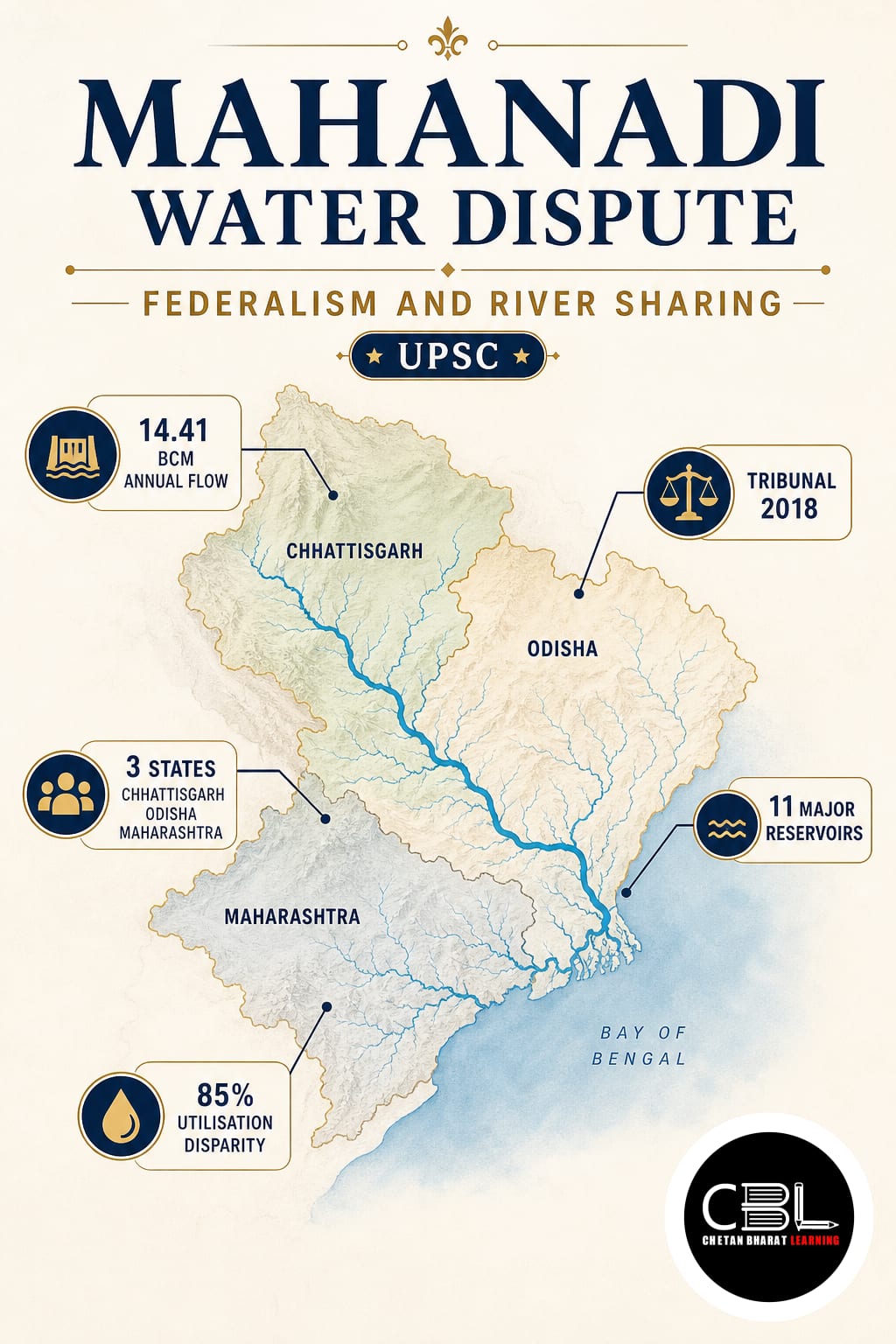

UPSC Mapping
Important for
- Prelims: Article 262 and Inter-State Rivers
- Mains: GS Paper II: Federalism and Water Governance
Quick Facts
| Core States | Odisha and Chhattisgarh |
|---|---|
| Tribunal Constituted | 12 March 2018 |
| Governing Law | Inter-State River Water Disputes Act, 1956 |
| Constitution | Article 262 |
| River Length | About 851 km |
Article
What is Mahanadi Water Dispute?
Mahanadi Water Dispute has returned to focus after renewed talks among Odisha, Chhattisgarh and the Union Government. Union Home Minister Amit Shah chaired a meeting with both Chief Ministers in New Delhi on 1 October 2026. The negotiations highlight cooperative federalism, river governance and constitutional adjudication themes covered in the daily current affairs archive.
The Mahanadi Water Dispute concerns the sharing, regulation and development of the inter-State river between upstream Chhattisgarh and downstream Odisha. Odisha argues that barrages and projects in the upper basin reduce lean-season inflows into the Hirakud reservoir. Chhattisgarh maintains that it needs river water for domestic supply, agriculture, industry and development within its basin area.
Odisha submitted a complaint to the Union Government in 2016 under the Inter-State River Water Disputes Act, 1956. After negotiations failed and the Supreme Court issued directions, the Centre constituted the specialised river-water tribunal on 12 March 2018. Jharkhand, Madhya Pradesh and Maharashtra also participate in tribunal proceedings because parts of the wider basin extend into them.
Why is Mahanadi Water Dispute in News?
The Union Home Minister chaired fresh discussions in New Delhi with Odisha Chief Minister Mohan Charan Majhi and Chhattisgarh Chief Minister Vishnu Deo Sai. The Union Jal Shakti Minister, Central Water Commission representatives and senior officials also joined the process. The meeting sought a mutually acceptable framework based on dialogue, technical assessment and protection of both States’ interests.
The official News on AIR report confirmed the high-level meeting on 1 October 2026. Recent consultations indicate that both States are exploring an amicable settlement alongside the existing legal process. Any final arrangement must still define dependable data, seasonal availability, project operations and enforceable sharing principles.
Key Features
The Mahanadi Water Dispute combines constitutional law, hydrology and competing development needs across an integrated river basin. Its major features explain why purely political or legal approaches remain insufficient.
- Upstream-downstream divide: Chhattisgarh controls important upper-basin locations, while Odisha depends heavily on downstream flows reaching Hirakud and its deltaic areas that support farming, power generation and local livelihoods.
- Seasonal concern: Odisha’s principal anxiety relates to reduced non-monsoon water availability rather than only the large flows received during monsoon months when flood management becomes a major concern.
- Tribunal mechanism: The Centre constituted a specialised adjudicatory body under the 1956 Act after earlier negotiation efforts did not resolve the dispute through ordinary inter-governmental consultation.
- Multiple basin States: Tribunal notices included Odisha, Chhattisgarh, Jharkhand, Madhya Pradesh and Maharashtra, reflecting the river basin’s wider geographical spread and the need for inclusive adjudication.
- Technical process: The Central Water Commission and joint technical mechanisms examine flows, projects, utilisation and other evidence required for an equitable arrangement grounded in an accepted factual record over time.
Article 262 allows Parliament to provide for adjudication of disputes concerning inter-State river waters. It also permits Parliament to exclude the jurisdiction of the Supreme Court and other courts through legislation. Parliament enacted the Inter-State River Water Disputes Act, 1956, to create the statutory tribunal route.
The Mahanadi rises in Chhattisgarh and flows eastwards through Odisha before entering the Bay of Bengal. Its major tributaries include the Seonath, Hasdeo, Mand, Ib, Ong, Tel and Jonk. Important structures include Ravishankar Sagar, Hirakud Dam and Naraj Barrage, while the river also passes through the Satkosia landscape.
The dispute concerns more than a fixed annual quantity of water. Reservoir operations, dry-season releases, new projects, irrigation demand and industrial withdrawals can alter the timing and reliability of downstream flows. An effective agreement must therefore combine allocation rules with coordinated basin management and regular information exchange.
Challenges
The Mahanadi Water Dispute faces data, trust and enforcement gaps that have prolonged disagreement between the two principal States. Climate variability and rising demand make historical flow patterns less reliable for future planning.
- Shared-data deficit: Disagreement over project capacity, withdrawals and seasonal flows can prevent both sides from accepting a common hydrological baseline.
- Competing priorities: Irrigation, drinking water, industry, ecosystems and flood management create different demands across upper and lower parts of the basin.
- Institutional delay: Lengthy tribunal proceedings can leave States without timely operational rules while projects and water requirements continue to change.
- Climate uncertainty: Erratic rainfall, droughts, floods and higher temperatures complicate estimates of dependable yield and future seasonal availability.
- Compliance concerns: A settlement needs clear monitoring, reservoir-operation protocols and dispute-resolution procedures to remain effective after political leadership changes.
Public debate often treats every upstream structure or downstream demand as a zero-sum claim. Basin-wide modelling can distinguish legitimate requirements from avoidable inefficiencies and identify opportunities for conservation. Readers can follow related constitutional issues through CBL’s Indian polity coverage.
Ecological needs also require representation in negotiations between governments. Adequate environmental flows support fisheries, wetlands, sediment movement and the health of the delta. Ignoring these functions could shift costs onto farmers, fishing communities and future generations even if an administrative settlement succeeds.
A basin agreement must remain workable during both scarcity and abundance. It should specify how authorities will update dependable-flow estimates, recognise water-saving measures and respond when rainfall departs sharply from long-term averages. Periodic scientific review can adjust operational rules without reopening every political question, while a neutral mechanism can verify compliance and address urgent grievances before they escalate into renewed inter-State confrontation.
Way Forward
Odisha and Chhattisgarh should pursue a time-bound Mahanadi Water Dispute settlement built on verified data and cooperative federalism. A shared information platform can publish rainfall, reservoir levels, withdrawals and releases at agreed intervals. The States should also prepare coordinated rules for drought years, flood periods and planned upstream projects.
A durable framework should integrate equitable utilisation, environmental flows, demand management and independent monitoring. Political dialogue can narrow differences, while the tribunal can provide legal certainty wherever negotiation remains incomplete. The Government’s settlement update outlines the role of technical consultation and cooperative federalism.
Prelims Practice Corner
Q1. Article 262 of the Constitution deals with:
- (a) Inter-State river water disputes
- (b) Financial emergencies
- (c) Election disputes
- (d) Scheduled Areas
Answer: (a) Article 262 concerns adjudication of disputes relating to inter-State river waters.
Q2. The specialised Mahanadi tribunal was constituted in:
- (a) 2006
- (b) 2012
- (c) 2018
- (d) 2022
Answer: (c) The Union Government constituted the Tribunal on 12 March 2018.
Q3. Which State lies upstream in the central Mahanadi dispute?
- (a) Odisha
- (b) Chhattisgarh
- (c) Jharkhand
- (d) Maharashtra
Answer: (b) Chhattisgarh is upstream, while Odisha is the principal downstream State.
Q4. Consider the following tributaries: 1. Seonath 2. Hasdeo 3. Tel. Which are tributaries of the Mahanadi?
- (a) 1 only
- (b) 1 and 2 only
- (c) 2 and 3 only
- (d) 1, 2 and 3
Answer: (d) Seonath, Hasdeo and Tel are tributaries of the Mahanadi.
Q5. Hirakud Dam is located in which State?
- (a) Chhattisgarh
- (b) Madhya Pradesh
- (c) Odisha
- (d) Jharkhand
Answer: (c) Hirakud Dam lies across the Mahanadi in Odisha.
Mains Practice Questions
Q1. Inter-State river disputes test both constitutional mechanisms and the practice of cooperative federalism. Discuss. (250 words, 15 marks)
Answer Structure
- Intro: Refer to Article 262 and the statutory tribunal mechanism for inter-State river disputes.
- Body: Cover competing State needs, tribunal delays, data disagreements, political dialogue, technical cooperation and environmental considerations.
- Conclusion: Advocate legally certain settlements supported by transparent basin-level institutions.
Q2. Suggest measures for equitable and sustainable management of India’s inter-State river basins. (150 words, 10 marks)
Answer Structure
- Intro: Frame rivers as ecological systems crossing administrative boundaries.
- Body: Discuss shared data, environmental flows, demand management, reservoir coordination, drought rules, monitoring and community participation.
- Conclusion: Emphasise cooperative institutions that combine hydrological evidence with federal fairness.
FAQs on Mahanadi Water Dispute
Which States are central to the dispute?
Odisha and Chhattisgarh are the principal parties. Chhattisgarh is upstream, while Odisha depends on downstream flows reaching Hirakud and the delta.
Why did the Centre constitute a tribunal?
Earlier negotiations did not settle Odisha’s complaint regarding Mahanadi waters and basin projects. The Centre constituted the tribunal in March 2018 following a Supreme Court direction.
What is the main concern raised by Odisha?
Odisha argues that upstream barrages and withdrawals affect non-monsoon flows into the Hirakud reservoir. It seeks reliable information and an equitable arrangement protecting downstream requirements.
Related Current Affairs
Preparing for UPSC, PCS or HCS?
Talk to a mentor at Chetan Bharat Learning, Chandigarh. Free guidance on choosing the right exam and building a study plan.
Chat on WhatsAppCall 97793 53345UPSC / IAS / PCS coaching in Chandigarh · Trusted by aspirants across Punjab & Haryana
Leave a Reply
You must be logged in to post a comment.