
UPSC Mapping
| Prelims | Science Olympiads and Astronomy |
|---|---|
| Mains | GS Paper III: Science and Technology |
Key Facts
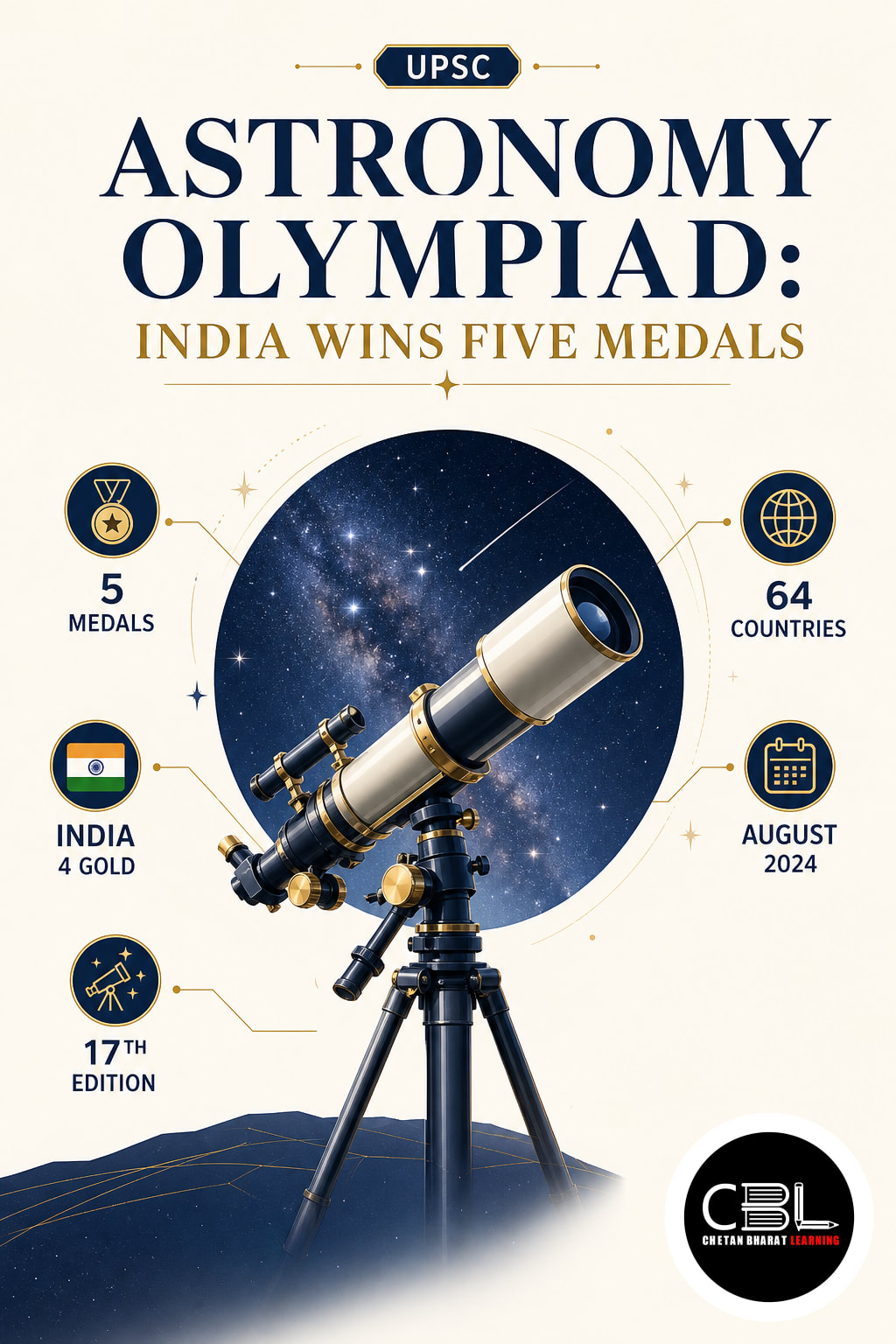
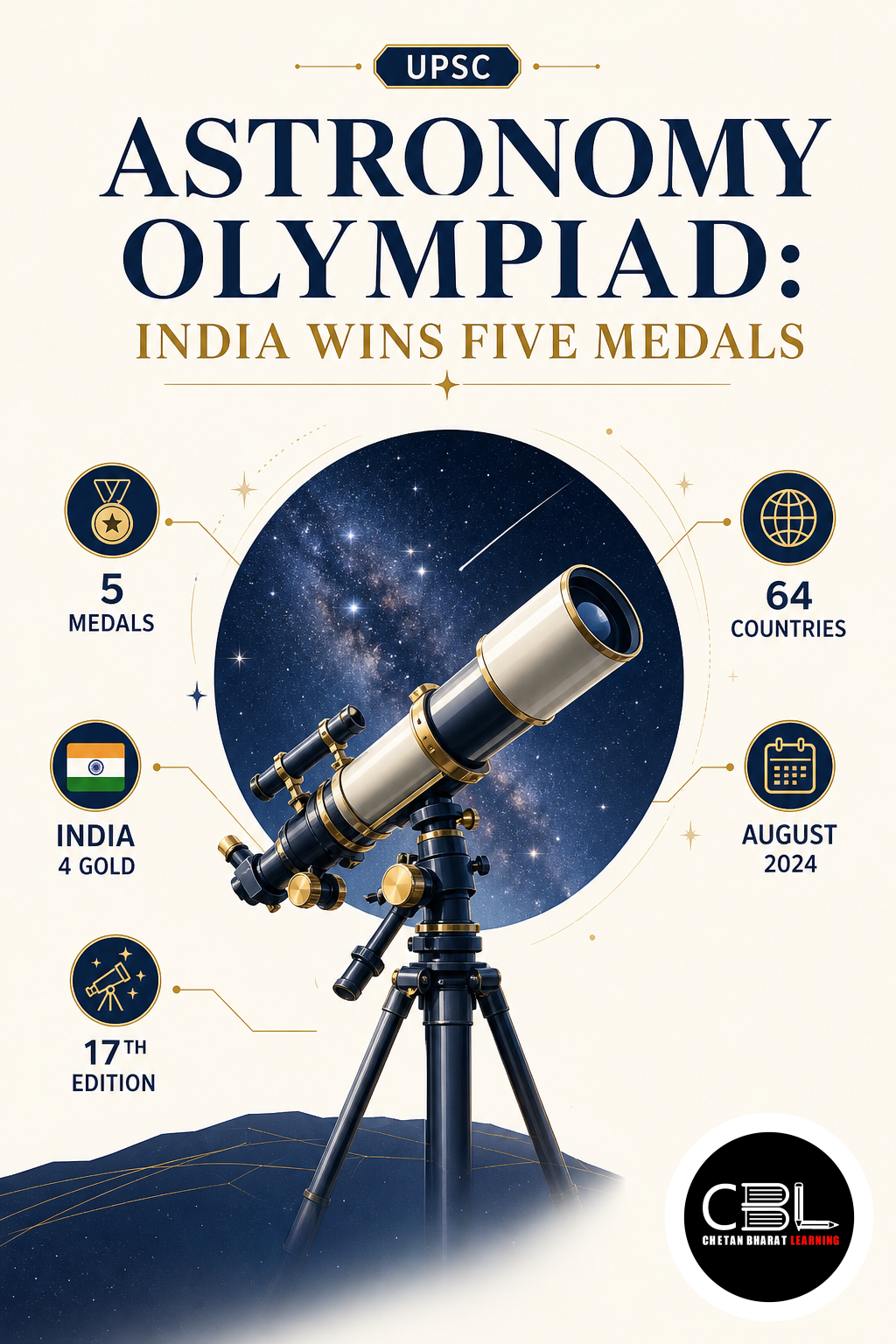
| Edition | 19th |
|---|---|
| Host City | Hanoi, Vietnam |
| Dates | 25 September–5 October 2026 |
| India’s Medals | 4 Gold, 1 Silver |
| Participation | 307 Students, 64 Countries |
What is Astronomy Olympiad?
The Astronomy Olympiad refers here to the International Olympiad on Astronomy and Astrophysics, an annual competition for secondary-school students. It tests conceptual knowledge, practical observation and the interpretation of astronomical data rather than rewarding memorisation alone. Organisers also use the event to encourage interest in astronomy, identify young talent and promote academic exchange across countries.
IOAA forms part of the wider family of International Science Olympiads and combines individual assessment with intercultural learning. Its competition model assigns 50 percent weight to theory, 25 percent to observation and 25 percent to data analysis. A separate mixed-nationality team activity encourages students to solve problems with peers from different educational and cultural backgrounds.
Why is Astronomy Olympiad in News?
India won four gold medals and one silver medal at the 19th IOAA, held in Hanoi from 25 September to 5 October 2026. Pranjal Dixit, Sumant Gupta, Akshat Srivastava and Arnav Sehrawat earned gold, while Harshil Amitkumar Patel earned silver. India shared third place with Vietnam’s guest team, behind Iran and South Korea, whose teams won five gold medals each.
The event brought together 307 students from 64 countries, making it the largest IOAA by both measures according to the Government of India. The official PIB announcement also reported that all five Indian participants won medals. This complete medal conversion highlights the depth of India’s selection process and the sustained work of students, teachers, mentors and scientific institutions.
Key Features
The Astronomy Olympiad combines scientific reasoning, practical skills and international exposure through a balanced assessment design. Its main features show how an academic contest can support both excellence and cooperation. Interdisciplinary learning remains central throughout the competition.
- Theory component: Students apply physics and mathematics to celestial mechanics, stellar properties, cosmology and other astronomical problems, with theory carrying half of the individual score and requiring clear assumptions, structured calculations and scientifically reasoned conclusions.
- Observational assessment: Participants identify celestial objects, interpret sky maps and handle observation-based tasks, which connect classroom concepts with the actual night sky and instruments while testing orientation, precision and practical judgement under time limits.
- Data analysis: Students process tables, graphs, images and measurements to draw defensible conclusions, developing skills that closely resemble evidence-based work in modern scientific research while teaching them to separate valid inferences from unsupported claims.
- National selection pathway: India uses a multi-stage programme beginning with the National Standard Examination in Astronomy and progressing through national-level screening, training and final team selection, ensuring that advancement depends on repeated performance across increasingly demanding stages.
- Institutional support: HBCSE-TIFR coordinates India’s programme as the nodal agency, while scientific departments and national institutions support training, mentoring and international participation through an organised partnership between education and the scientific community.
The assessment pattern rewards conceptual clarity because students must connect physical laws with unfamiliar astronomical situations. Observation and data tasks also demand careful estimation, interpretation and error awareness. These abilities support later work in physics, engineering, computing and quantitative research.
International participation gives students early experience of scientific collaboration across languages and education systems. Mixed-team activities place cooperation beside individual performance and encourage professional respect. Teachers and mentors also exchange methods that can improve national training programmes after each edition.
Challenges
The Astronomy Olympiad can inspire students, but the wider astronomy education ecosystem still faces access, capacity and continuity gaps. Addressing these constraints can spread the benefits beyond a small group of high performers. Equitable opportunity therefore matters alongside medal outcomes.
- Unequal access: Many rural and underserved schools lack telescopes, planetaria, laboratories and specialist teachers, which can limit early exposure to observational astronomy and advanced problem-solving before students even encounter the official national selection pathway.
- Teacher preparation: Astronomy crosses physics, mathematics, computing and earth science, so teachers need regular training and suitable classroom resources to guide interested students effectively and connect fundamental concepts with current discoveries, instruments and research methods.
- Observation barriers: Urban light pollution, cloudy weather and limited access to dark-sky sites can restrict practical learning, especially when schools depend only on direct night observations without remote telescope access, simulations or archived astronomical datasets.
- Representation gaps: Travel costs, language barriers and uneven awareness may reduce participation from some regions, requiring targeted outreach without weakening transparent, merit-based selection standards or creating unequal advantages through costly private coaching and travel.
- Long-term continuity: Medal success does not automatically create researchers, making sustained mentorship, undergraduate opportunities and research exposure essential for converting interest into scientific careers and preventing talented students from losing direction after school-level success.
India must connect competitive achievement with a broad public science culture through schools, universities, observatories and digital platforms. Wider participation would strengthen scientific literacy even among students who never enter the national team.
Preparation can become overly examination-oriented when students receive advanced problems without enough experimental context. Programmes should preserve curiosity-driven learning through sky observation, model building and open investigation.
Schools also need reliable information about eligibility, schedules and progression across selection stages. Clear outreach can help families distinguish official processes from commercial claims and plan participation early. Transparent communication protects fairness and strengthens trust in the national selection system.
Way Forward
India can use Astronomy Olympiad momentum to expand school astronomy clubs, mobile planetaria, teacher workshops and access to remote telescopes. HBCSE, universities and research institutes can share multilingual problem sets, recorded demonstrations and open datasets with schools across states. The HBCSE Olympiad portal can remain the authoritative gateway for selection rules, schedules and learning resources.
A stronger pathway should link Olympiad preparation with undergraduate research, summer projects, mentoring networks and career guidance. Institutions should also track participation across regions and social groups while protecting the integrity of selection. Such measures can turn international medals into durable scientific capacity and deepen India’s contribution to astronomy and astrophysics.
Prelims Practice Corner
-
Q1. Which institution serves as the nodal agency for India’s Science Olympiad programme? (a) ISRO (b) HBCSE-TIFR (c) UGC (d) AICTE
Answer: HBCSE-TIFR coordinates India’s national Science Olympiad programme.
-
Q2. What is the weight of theory in the IOAA individual competition? (a) 25 percent (b) 30 percent (c) 50 percent (d) 75 percent
Answer: Theory accounts for 50 percent of the individual score.
-
Q3. The 19th IOAA in 2026 took place in which city? (a) Hanoi (b) Seoul (c) Tehran (d) Bengaluru
Answer: Hanoi, Vietnam, hosted the 19th edition in 2026.
-
Q4. Consider the following components of IOAA: 1. Theory 2. Observation 3. Data analysis. Which are part of the individual competition? (a) 1 only (b) 1 and 2 only (c) 2 and 3 only (d) 1, 2 and 3
Answer: IOAA assesses theory, observation and data analysis.
-
Q5. How many medals did India’s five-member team win at IOAA 2026? (a) Three (b) Four (c) Five (d) Six
Answer: Every Indian team member won a medal, producing a total of five.
Mains Practice Questions
-
Q1. International science competitions can strengthen a country’s innovation ecosystem beyond medal achievements. Discuss with reference to India. (250 words, 15 marks)
Answer Structure:
- Intro: Define science Olympiads as competitive platforms for identifying and nurturing school-level talent.
- Body: Cover scientific reasoning, institutional training, international exposure, public interest, access gaps and links with higher education and research.
- Conclusion: Advocate an inclusive pipeline that converts early excellence into long-term national research capacity.
-
Q2. Examine the measures needed to widen access to astronomy education in India’s schools. (150 words, 10 marks)
Answer Structure:
- Intro: Link astronomy education with curiosity, scientific literacy and interdisciplinary learning.
- Body: Discuss teacher training, low-cost kits, remote telescopes, regional outreach, multilingual material and partnerships with observatories and universities.
- Conclusion: Emphasise equitable access while preserving transparent and merit-based pathways for advanced competition.
FAQs on Astronomy Olympiad
- What is IOAA?
- IOAA is the International Olympiad on Astronomy and Astrophysics, an annual competition for secondary-school students. It evaluates theory, observation and data-analysis skills while encouraging international academic exchange.
- How did India perform at IOAA 2026?
- India won four gold medals and one silver medal in Hanoi. Every member of the five-student Indian team secured a medal.
- How does India select students for IOAA?
- India follows a multi-stage national selection and training programme coordinated by HBCSE-TIFR. The process begins with the National Standard Examination in Astronomy and progressively identifies the final international team.
Related Current Affairs
Preparing for UPSC, PCS or HCS?
Talk to a mentor at Chetan Bharat Learning, Chandigarh. Free guidance on choosing the right exam and building a study plan.
Chat on WhatsAppCall 97793 53345UPSC / IAS / PCS coaching in Chandigarh · Trusted by aspirants across Punjab & Haryana
Leave a Reply
You must be logged in to post a comment.