
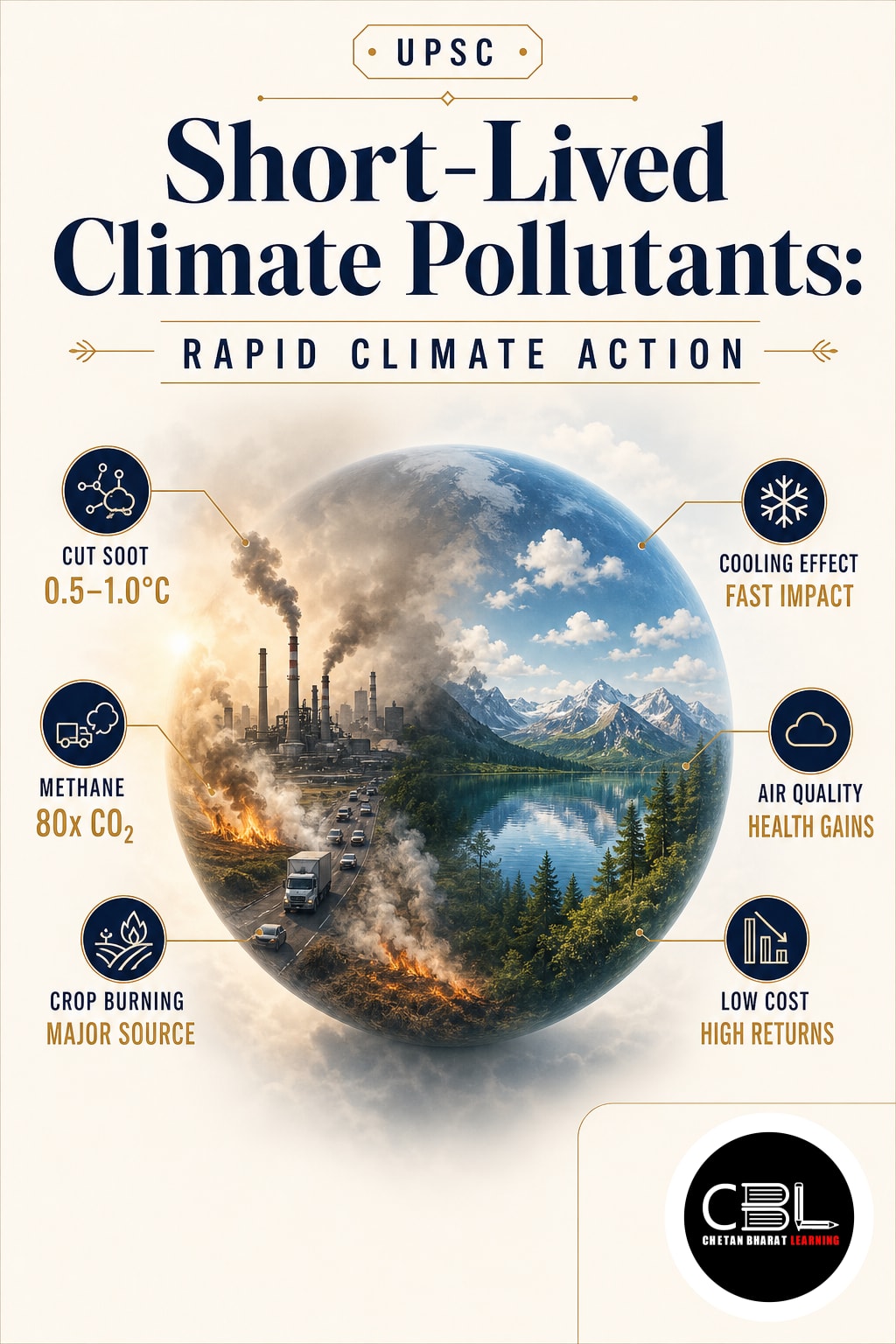

Short-Lived Climate Pollutants offer a powerful route to slow near-term warming while improving public health. Methane, black carbon, tropospheric ozone and hydrofluorocarbons remain in the atmosphere for less time than carbon dioxide but can exert strong climatic effects. Track related developments through our environment current affairs coverage.
What are Short-Lived Climate Pollutants?
Short-Lived Climate Pollutants are warming agents whose atmospheric lifetimes range from days to several years, much shorter than carbon dioxide’s enduring influence. Policy discussions usually place methane, black carbon, tropospheric ozone and many hydrofluorocarbons in this category. Their high radiative efficiency allows them to affect temperature strongly despite their shorter residence.
The broader scientific term, short-lived climate forcers, also includes compounds and aerosols that produce cooling effects. Some pollutants enter the air directly, while others form through atmospheric reactions involving precursor gases. Their uneven distribution means they can alter regional rainfall, monsoon behaviour, air quality and cryospheric melting as well as global temperature.
Why are Short-Lived Climate Pollutants in News?
Short-Lived Climate Pollutants have gained attention because climate policy increasingly recognises the need for rapid action alongside long-term carbon dioxide reduction. Cutting methane, soot and high-warming refrigerants can produce temperature and air-quality benefits within years or decades. This makes them important for slowing near-term warming while countries pursue net-zero transitions.
The IPCC stresses that reducing warming forcers cannot substitute for deep and sustained carbon dioxide cuts. Some short-lived aerosols cool the atmosphere, so poorly designed pollution controls may temporarily reveal previously masked warming. The official IPCC assessment therefore supports an integrated approach covering climate mitigation, clean air and development.
Key Features
These pollutants differ in their sources, atmospheric behaviour, warming mechanisms and available control measures.
- Methane: Livestock, rice cultivation, landfills, wastewater and fossil-fuel systems emit this potent greenhouse gas, which also helps form ground-level ozone.
- Black carbon: Incomplete combustion from diesel engines, biomass burning, household fuels, brick kilns and fires produces light-absorbing soot that warms air and darkens snow.
- Tropospheric ozone: Sunlight drives reactions among methane, nitrogen oxides, carbon monoxide and volatile organic compounds, creating a harmful secondary pollutant near Earth’s surface.
- Hydrofluorocarbons: Cooling and refrigeration systems use these synthetic gases, many of which possess high global warming potential despite containing no ozone-depleting chlorine.
- Rapid response: Sustained emission cuts can lower atmospheric concentrations relatively quickly, producing earlier climatic benefits than equivalent action on long-lived carbon dioxide alone.
Methane remains in the atmosphere for roughly a decade, while black carbon usually persists for days or weeks. Tropospheric ozone lasts from hours to weeks and forms rather than being emitted directly. HFC lifetimes vary widely by compound, so policy must prioritize gases with high warming potential and promote safe, efficient alternatives.
Prelims Practice Corner
Mains Practice Questions
FAQs on Short-Lived Climate Pollutants
Can controlling these pollutants replace carbon dioxide reduction?
No. Their control can slow near-term warming, but lasting climate stability requires deep and sustained carbon dioxide reductions.
Why is black carbon important for the Himalayas?
Black carbon darkens snow and ice after deposition, lowering albedo. Greater solar absorption can accelerate glacier and snow melt.
How does methane affect air quality?
Methane participates in atmospheric chemistry that produces tropospheric ozone. Reducing methane can therefore support both climate mitigation and cleaner air.
Related Current Affairs
Preparing for UPSC, PCS or HCS?
Talk to a mentor at Chetan Bharat Learning, Chandigarh. Free guidance on choosing the right exam and building a study plan.
Chat on WhatsAppCall 97793 53345UPSC / IAS / PCS coaching in Chandigarh · Trusted by aspirants across Punjab & Haryana
Leave a Reply
You must be logged in to post a comment.